
2002 AMC 12A Problema 25
Intenta el Problema 25 del 2002 AMC 12A a continuación y luego compara tu respuesta con la solución preparada profesionalmente de LIVE by Po-Shen Loh. También puedes intentar el examen cronometrado completo, ver todas las soluciones del 2002 AMC 12A, o revisar la clave de respuestas.
Todos los problemas se usan con el permiso legal oficial de la Mathematical Association of America (MAA).
25.
Todos los coeficientes no nulos de un polinomio con coeficientes reales se reemplazan por su media para formar un polinomio ¿Cuál de las siguientes podría ser una gráfica de y en el intervalo ?
The nonzero coefficients of a polynomial with real coefficients are all replaced by their mean to form a polynomial Which of the following could be a graph of and over the interval
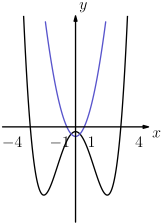
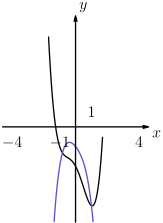
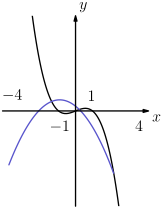
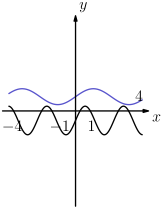
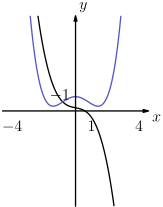
Respuesta: B
Pista pequeña:
La suma de los coeficientes de es igual a la suma de los coeficientes de .
The sum of the coefficients of equals the sum of the coefficients of
Pista grande:
Evaluar en da así que las dos gráficas deben cortarse en .
Evaluating at gives so the two graphs must intersect at
Solución:
Reemplazar los coeficientes no nulos por su media mantiene sin cambios el total de los coeficientes, así que y tienen la misma suma de coeficientes. Como y son iguales cada uno a esa suma,
Por lo tanto las gráficas de y deben cruzarse en La única opción que muestra una intersección en es la gráfica B. (Allí, y )
Por lo tanto, la respuesta correcta es B.
Replacing the nonzero coefficients by their mean keeps the total of the coefficients unchanged, so and have the same coefficient sum. Since and each equal that sum,
Therefore the graphs of and must cross at The only choice showing an intersection at is graph B. (There, and )
Thus, the correct answer is B.
El Problema 25 en otros años
- 1950 AMC 12
- 1951 AMC 12
- 1952 AMC 12
- 1953 AMC 12
- 1954 AMC 12
- 1955 AMC 12
- 1956 AMC 12
- 1957 AMC 12
- 1958 AMC 12
- 1959 AMC 12
- 1960 AMC 12
- 1961 AMC 12
- 1962 AMC 12
- 1963 AMC 12
- 1964 AMC 12
- 1965 AMC 12
- 1966 AMC 12
- 1967 AMC 12
- 1968 AMC 12
- 1969 AMC 12
- 1970 AMC 12
- 1971 AMC 12
- 1972 AMC 12
- 1973 AMC 12
- 1974 AMC 12
- 1975 AMC 12
- 1976 AMC 12
- 1977 AMC 12
- 1978 AMC 12
- 1979 AMC 12
- 1980 AMC 12
- 1981 AMC 12
- 1982 AMC 12
- 1983 AMC 12
- 1984 AMC 12
- 1985 AMC 12
- 1986 AMC 12
- 1987 AMC 12
- 1988 AMC 12
- 1989 AMC 12
- 1990 AMC 12
- 1991 AMC 12
- 1992 AMC 12
- 1993 AMC 12
- 1994 AMC 12
- 1995 AMC 12
- 1996 AMC 12
- 1997 AMC 12
- 1998 AMC 12
- 1999 AMC 12
- 2000 AMC 12
- 2001 AMC 12
- 2002 AMC 12B
- 2003 AMC 12A
- 2003 AMC 12B
- 2004 AMC 12A
- 2004 AMC 12B
- 2005 AMC 12A
- 2005 AMC 12B
- 2006 AMC 12A
- 2006 AMC 12B
- 2007 AMC 12A
- 2007 AMC 12B
- 2008 AMC 12A
- 2008 AMC 12B
- 2009 AMC 12A
- 2009 AMC 12B
- 2010 AMC 12A
- 2010 AMC 12B
- 2011 AMC 12A
- 2011 AMC 12B
- 2012 AMC 12A
- 2012 AMC 12B
- 2013 AMC 12A
- 2013 AMC 12B
- 2014 AMC 12A
- 2014 AMC 12B
- 2015 AMC 12A
- 2015 AMC 12B
- 2016 AMC 12A
- 2016 AMC 12B
- 2017 AMC 12A
- 2017 AMC 12B
- 2018 AMC 12A
- 2018 AMC 12B
- 2019 AMC 12A
- 2019 AMC 12B
- 2020 AMC 12A
- 2020 AMC 12B
- 2021 AMC 12A Spring
- 2021 AMC 12B Spring
- 2021 AMC 12A Fall
- 2021 AMC 12B Fall
- 2022 AMC 12A
- 2022 AMC 12B
- 2023 AMC 12A
- 2023 AMC 12B
- 2024 AMC 12A
- 2024 AMC 12B
- 2025 AMC 12A
- 2025 AMC 12B