
Soluciones del 2002 AMC 12A
Desplázate hacia abajo para ver las soluciones preparadas profesionalmente de LIVE by Po-Shen Loh, imprime las soluciones en PDF, consulta la clave de respuestas, o haz el examen cronometrado completo.
Todos los problemas se usan con el permiso legal oficial de la Mathematical Association of America (MAA).
1.
Calcule la suma de todas las raíces de
Compute the sum of all the roots of
Pista pequeña:
Ambos términos comparten el factor .
Both terms share the factor
Pista grande:
La ecuación se convierte en .
The equation becomes
Solución:
Al factorizar se obtiene
Las raíces son y cuya suma es
Por lo tanto, la respuesta correcta es A.
Factoring out gives
The roots are and whose sum is
Thus, the correct answer is A.
2.
La maestra le pidió a Cindy que restara de cierto número y luego dividiera el resultado entre En cambio, ella restó y luego dividió el resultado entre obteniendo como respuesta ¿Cuál habría sido su respuesta si hubiera resuelto el problema correctamente?
Cindy was asked by her teacher to subtract from a certain number and then divide the result by Instead, she subtracted and then divided the result by giving an answer of What would her answer have been had she worked the problem correctly?
Pista pequeña:
Su cálculo fue .
Her computation was
Pista grande:
Despeje luego evalúe .
Solve for then evaluate
Solución:
Sea el número. Cindy calculó así que y
El cálculo correcto da
Por lo tanto, la respuesta correcta es A.
Let be the number. Cindy computed so and
The correct computation gives
Thus, the correct answer is A.
3.
De acuerdo con la convención estándar para la exponenciación, Si se cambia el orden en que se realizan las exponenciaciones, ¿cuántos otros valores son posibles?
According to the standard convention for exponentiation, If the order in which the exponentiations are performed is changed, how many other values are possible?
Pista pequeña:
Hay cinco maneras de agrupar con paréntesis una torre de cuatro .
There are five ways to parenthesize a tower of four ’s
Pista grande:
Toda forma de agrupar con paréntesis da como resultado o .
Every parenthesization evaluates to either or
Solución:
Las cinco formas de agrupar con paréntesis dan
Así que los únicos valores son y Además del valor estándar hay exactamente más.
Por lo tanto, la respuesta correcta es B.
The five parenthesizations of give
So the only values are and Besides the standard value there is exactly other.
Thus, the correct answer is B.
4.
Halle la medida en grados de un ángulo cuyo complemento es el de su suplemento.
Find the degree measure of an angle whose complement is of its supplement.
Pista pequeña:
El complemento es y el suplemento es .
The complement is and the supplement is
Pista grande:
Resuelva .
Solve
Solución:
Sea el ángulo. Entonces de modo que
Esto da así que
Por lo tanto, la respuesta correcta es B.
Let the angle be Then so
This gives so
Thus, the correct answer is B.
5.
Cada uno de los círculos pequeños de la figura tiene radio uno. El círculo más interior es tangente a los seis círculos que lo rodean, y cada uno de esos círculos es tangente al círculo grande y a sus círculos pequeños vecinos. Halle el área de la región sombreada.
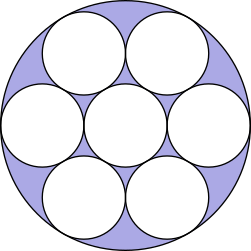
Each of the small circles in the figure has radius one. The innermost circle is tangent to the six circles that surround it, and each of those circles is tangent to the large circle and to its small-circle neighbors. Find the area of the shaded region.
Pista pequeña:
Cada círculo que rodea tiene su centro a unidades del centro, así que el círculo grande tiene radio .
Each surrounding circle has its center units from the center, so the large circle has radius
Pista grande:
Reste las áreas de los siete círculos unitarios del área del círculo grande.
Subtract the areas of the seven unit circles from the area of the large circle
Solución:
Cada uno de los seis círculos unitarios exteriores es tangente al círculo unitario central, así que su centro está a unidades del centro. Sumando un radio más, el círculo grande tiene radio y área
Los siete círculos unitarios tienen área total así que la región sombreada tiene área
Por lo tanto, la respuesta correcta es C.
Each of the six outer unit circles is tangent to the central unit circle, so its center is units from the center. Adding one more radius, the large circle has radius and area
The seven unit circles have total area so the shaded region has area
Thus, the correct answer is C.
6.
¿Para cuántos enteros positivos existe al menos un entero positivo tal que ?
For how many positive integers does there exist at least one positive integer such that
infinitos
infinitely many
Pista pequeña:
Considere qué sucede cuando .
Consider what happens when
Pista grande:
Para la desigualdad se reduce a .
For the inequality reduces to
Solución:
Tomando la desigualdad se convierte en que se cumple para todo entero positivo
Así que todo entero positivo funciona, y hay infinitos.
Por lo tanto, la respuesta correcta es E.
Taking the inequality becomes which holds for every positive integer
So every positive integer works, and there are infinitely many.
Thus, the correct answer is E.
7.
Si un arco de en el círculo tiene la misma longitud que un arco de en el círculo entonces la razón entre el área del círculo y el área del círculo es
If an arc of on circle has the same length as an arc of on circle then the ratio of the area of circle to the area of circle is
Pista pequeña:
Longitudes de arco iguales: .
Equal arc lengths:
Pista grande:
Halle la razón de áreas es su cuadrado.
Find the area ratio is its square
Solución:
Longitudes de arco iguales dan así que
La razón de áreas es
Por lo tanto, la respuesta correcta es A.
Equal arc lengths give so
The ratio of areas is
Thus, the correct answer is A.
8.
Betsy diseñó una bandera usando triángulos azules, pequeños cuadrados blancos y un cuadrado rojo central, como se muestra. Sea el área total de los triángulos azules, el área total de los cuadrados blancos y el área del cuadrado rojo. ¿Cuál de las siguientes opciones es correcta?
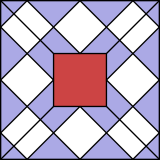
Betsy designed a flag using blue triangles, small white squares, and a red center square, as shown. Let be the total area of the blue triangles, the total area of the white squares, and the area of the red square. Which of the following is correct?
Pista pequeña:
Cubra toda la bandera con triángulos congruentes.
Cover the whole flag with congruent triangles
Pista grande:
Cuente cuántos de esos triángulos están en la región azul y en la región blanca.
Count how many of those triangles lie in the blue region and in the white region
Solución:
Trazando las diagonales mostradas, toda la bandera queda cubierta por triángulos congruentes. Contando, hay triángulos en la región azul, en la región blanca y en el cuadrado rojo.
Como las regiones azul y blanca contienen el mismo número de triángulos,
Por lo tanto, la respuesta correcta es A.
Drawing the diagonals shown, the entire flag is tiled by congruent triangles. Counting, there are triangles in the blue region, in the white region, and in the red square.
Since the blue and white regions contain the same number of triangles,
Thus, the correct answer is A.
9.
Jamal quiere almacenar archivos de computadora en disquetes, cada uno con una capacidad de megabytes (mb). Tres de sus archivos requieren mb de memoria cada uno, otros requieren mb cada uno, y los restantes requieren mb cada uno. Ningún archivo puede dividirse entre disquetes. ¿Cuál es el número mínimo de disquetes que contendrá todos los archivos?
Jamal wants to store computer files on floppy disks, each of which has a capacity of megabytes (mb). Three of his files require mb of memory each, more require mb each, and the remaining require mb each. No file can be split between floppy disks. What is the minimal number of floppy disks that will hold all the files?
Pista pequeña:
La memoria total necesaria es mb.
The total memory needed is mb
Pista grande:
Un disco que contiene un archivo de tiene espacio para solo un archivo de , desperdiciando mb; sume este desperdicio.
A disk holding a file has room for only one file, wasting mb; add up this waste
Solución:
Los archivos necesitan mb, así que al menos discos solo por volumen.
Un disco que contiene un archivo de -mb tiene espacio para solo un archivo más de -mb, dejando al menos mb sin usar. Entre los tres archivos de -mb esto desperdicia al menos mb, más de medio disco, lo que obliga a al menos discos.
Trece bastan: seis discos contienen cada uno dos archivos de -mb, tres discos contienen cada uno un archivo de -mb más un archivo de -mb, y cuatro discos contienen cada uno tres archivos de -mb.
Por lo tanto, la respuesta correcta es B.
The files need mb, so at least disks by volume alone.
A disk containing a -mb file has room for only one more -mb file, leaving at least mb unused. Across the three -mb files this wastes at least mb, over half a disk, forcing at least disks.
Thirteen suffice: six disks each hold two -mb files, three disks each hold one -mb file plus one -mb file, and four disks each hold three -mb files.
Thus, the correct answer is B.
10.
Sarah vierte cuatro onzas de café en una taza de ocho onzas y cuatro onzas de crema en una segunda taza del mismo tamaño. Luego transfiere la mitad del café de la primera taza a la segunda y, después de revolver bien, transfiere la mitad del líquido de la segunda taza de vuelta a la primera. ¿Qué fracción del líquido de la primera taza es ahora crema?
Sarah pours four ounces of coffee into an eight-ounce cup and four ounces of cream into a second cup of the same size. She then transfers half the coffee from the first cup to the second and, after stirring thoroughly, transfers half the liquid in the second cup back to the first. What fraction of the liquid in the first cup is now cream?
Pista pequeña:
Después de la primera transferencia, la taza contiene oz de café y oz de crema.
After the first transfer, cup holds oz coffee and oz cream
Pista grande:
Transferir de vuelta la mitad de la taza mueve su café y crema en igual proporción; halle la crema en la taza .
Transferring back half of cup moves its coffee and cream in equal proportion; find the cream in cup
Solución:
Después de transferir la mitad del café, la taza tiene oz de café y la taza tiene oz de café y oz de crema, un total de oz.
Transferir de vuelta la mitad de la taza mueve oz de café y oz de crema. La taza entonces contiene oz de café y oz de crema.
La fracción que es crema es
Por lo tanto, la respuesta correcta es D.
After transferring half the coffee, cup has oz coffee and cup has oz coffee and oz cream, a total of oz.
Transferring half of cup back moves oz coffee and oz cream. Cup then holds oz coffee and oz cream.
The fraction that is cream is
Thus, the correct answer is D.
11.
El Sr. Earl E. Bird sale de su casa hacia el trabajo exactamente a las A.M. cada mañana. Cuando promedia millas por hora, llega a su trabajo tres minutos tarde. Cuando promedia millas por hora, llega tres minutos temprano. ¿A qué velocidad promedio, en millas por hora, debe conducir el Sr. Bird para llegar a su trabajo justo a tiempo?
Mr. Earl E. Bird leaves his house for work at exactly A.M. every morning. When he averages miles per hour, he arrives at his workplace three minutes late. When he averages miles per hour, he arrives three minutes early. At what average speed, in miles per hour, should Mr. Bird drive to arrive at his workplace precisely on time?
Pista pequeña:
Sea el tiempo de viaje a tiempo en horas; tres minutos son horas.
Let be the on-time travel time in hours; three minutes is hours
Pista grande:
Plantee despeje luego halle la distancia.
Set solve for then find the distance
Solución:
Sea el tiempo en horas para llegar a tiempo. Como tres minutos son horas,
Esto da así que La distancia es millas, y la velocidad requerida es millas por hora.
Por lo tanto, la respuesta correcta es B.
Let be the time in hours to arrive on time. Since three minutes is hours,
This gives so The distance is miles, and the required speed is miles per hour.
Thus, the correct answer is B.
12.
Ambas raíces de la ecuación cuadrática son números primos. El número de valores posibles de es
Both roots of the quadratic equation are prime numbers. The number of possible values of is
más de cuatro
more than four
Pista pequeña:
Si las raíces son los primos y entonces .
If the roots are primes and then
Pista grande:
Una suma impar obliga a que uno de los primos sea .
An odd sum forces one of the primes to be
Solución:
Si las raíces son los primos y entonces por las fórmulas de Vieta y
Como es impar, uno de los primos debe ser par, es decir y el otro es Ambos son primos, así que es el único valor posible.
Por lo tanto, la respuesta correcta es B.
If the roots are primes and then by Vieta’s formulas and
Since is odd, one prime must be even, namely and the other is Both are prime, so is the only possible value.
Thus, the correct answer is B.
13.
Dos números positivos distintos y difieren cada uno de su recíproco en ¿Cuánto vale ?
Two different positive numbers and each differ from their reciprocals by What is
Pista pequeña:
Un número con satisface o .
A number with satisfies or
Pista grande:
Las dos soluciones positivas son recíprocas entre sí; súmelas usando la fórmula cuadrática.
The two positive solutions are reciprocals of each other; add them using the quadratic formula
Solución:
Un número positivo difiere de su recíproco en cuando o es decir o
Las raíces positivas son y que son recíprocas entre sí. Su suma es
Por lo tanto, la respuesta correcta es C.
A positive number differs from its reciprocal by when or i.e. or
The positive roots are and which are reciprocals of each other. Their sum is
Thus, the correct answer is C.
14.
Para todos los enteros positivos sea Sea ¿Cuál de las siguientes relaciones es verdadera?
For all positive integers let Let Which of the following relations is true?
Pista pequeña:
.
Pista grande:
Combine en y evalúe el producto interior.
Combine into and evaluate the product inside
Solución:
Usando y sumando logaritmos,
Como esto es
Por lo tanto, la respuesta correcta es D.
Using and adding logs,
Since this is
Thus, the correct answer is D.
15.
La media, la mediana, la moda única y el rango de una colección de ocho enteros son todos iguales a El mayor entero que puede ser un elemento de esta colección es
The mean, median, unique mode, and range of a collection of eight integers are all equal to The largest integer that can be an element of this collection is
Pista pequeña:
Los ocho enteros suman y la moda debe repetirse.
The eight integers sum to and the mode must repeat
Pista grande:
Pruebe el mayor valor el menor sería entonces y verifique la suma restante.
Test the largest value the smallest would then be and check the remaining sum
Solución:
La colección tiene media, mediana, moda única y rango iguales a así que se puede alcanzar.
Supongamos que el mayor valor fuera El rango obliga a que el menor sea Como es la moda, aparece en la lista ordenada; junto con la mediana esto obliga a que los dos valores centrales sean Entonces así que los otros cuatro valores suman con promedio Al menos uno sería menor que contradiciendo el mínimo. Por lo tanto, es imposible.
Así, la respuesta correcta es D.
The collection has mean, median, unique mode, and range all equal to so is attainable.
Suppose the largest were The range forces the smallest to be Because is the mode, it occurs in the sorted list; together with median this forces the two middle values to be Then so the remaining four values sum to averaging At least one would be below contradicting the minimum. So is impossible.
Thus, the correct answer is D.
16.
Tina selecciona al azar dos números distintos del conjunto y Sergio selecciona al azar un número del conjunto La probabilidad de que el número de Sergio sea mayor que la suma de los dos números elegidos por Tina es
Tina randomly selects two distinct numbers from the set and Sergio randomly selects a number from the set The probability that Sergio’s number is larger than the sum of the two numbers chosen by Tina is
Pista pequeña:
Tina tiene pares igualmente probables.
Tina has equally likely pairs
Pista grande:
Para un par con suma Sergio la supera con probabilidad .
For a pair with sum Sergio exceeds it with probability
Solución:
Los diez pares de Tina tienen sumas Para una suma el número de Sergio la supera con probabilidad
Los valores correspondientes de son que suman La probabilidad total es
Por lo tanto, la respuesta correcta es A.
Tina’s ten pairs have sums For a sum Sergio’s number exceeds it with probability
The corresponding values of are totaling The overall probability is
Thus, the correct answer is A.
17.
Varios conjuntos de números primos, como usan cada uno de los nueve dígitos no nulos exactamente una vez. ¿Cuál es la menor suma posible que podría tener tal conjunto de primos?
Several sets of prime numbers, such as use each of the nine nonzero digits exactly once. What is the smallest possible sum such a set of primes could have?
Pista pequeña:
Los dígitos no pueden terminar un primo de más de un dígito, así que cada uno debe ser un dígito de las decenas.
The digits cannot end a prime past one digit, so each must be a tens digit
Pista grande:
Esos tres aportan al menos y los seis dígitos restantes al menos su propia suma como dígitos de las unidades; luego verifique que exista un conjunto válido.
Those three contribute at least and the remaining six digits at least their own sum as units digits; then check a valid set exists
Solución:
Los dígitos pares no pueden ser el dígito de las unidades de un primo de varios dígitos, así que cada uno debe aparecer en las decenas o más, aportando al menos Los otros seis dígitos aportan al menos así que la suma es al menos
Esta cota se alcanza, por ejemplo con cuya suma es
Por lo tanto, la respuesta correcta es B.
The even digits cannot be the units digit of a multi-digit prime, so each must appear in a tens place or higher, contributing at least The other six digits contribute at least so the sum is at least
This bound is achieved, for example by whose sum is
Thus, the correct answer is B.
18.
Sean y los círculos definidos por y respectivamente. ¿Cuál es la longitud del segmento de recta más corto que es tangente a en y a en ?
Let and be circles defined by and respectively. What is the length of the shortest line segment that is tangent to at and to at
Pista pequeña:
El segmento más corto de este tipo es la tangente interior; cruza entre los centros.
The shortest such segment is the internal tangent; it crosses between the centers
Pista grande:
El punto de cruce divide en la razón de los radios use triángulos rectángulos semejantes.
The crossing point divides in the ratio of the radii use similar right triangles
Solución:
Los centros son y con radios y así que La tangente más corta es la interior, que corta en un punto que lo divide en la razón dando
Los triángulos rectángulos y son semejantes con razón Entonces y así que
Por lo tanto, la respuesta correcta es C.
The centers are and with radii and so The shortest tangent is the internal one, meeting at a point that splits it in the ratio giving
The right triangles and are similar with ratio Then and so
Thus, the correct answer is C.
19.
La gráfica de la función se muestra a continuación. ¿Cuántas soluciones tiene la ecuación ?
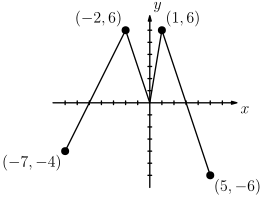
The graph of the function is shown below. How many solutions does the equation have?
Pista pequeña:
significa que debe ser una entrada donde es igual a .
means must be an input where equals
Pista grande:
En la gráfica en y cuente las soluciones de y .
From the graph at and count solutions of and
Solución:
La gráfica alcanza en y así que requiere o
La recta horizontal corta la gráfica dos veces, y la corta cuatro veces, dando soluciones.
Por lo tanto, la respuesta correcta es D.
The graph reaches at and so requires or
The horizontal line meets the graph twice, and meets it four times, giving solutions.
Thus, the correct answer is D.
20.
Suponga que y son dígitos, no ambos nueve y no ambos cero, y el decimal periódico se expresa como una fracción en su mínima expresión. ¿Cuántos denominadores diferentes son posibles?
Suppose that and are digits, not both nine and not both zero, and the repeating decimal is expressed as a fraction in lowest terms. How many different denominators are possible?
Pista pequeña:
donde es el valor de dos dígitos.
where is the two-digit value
Pista grande:
En su mínima expresión el denominador es un divisor de excluya ya que no son ambos .
In lowest terms the denominator is a divisor of exclude since are not both
Solución:
Como el denominador reducido divide a Sus divisores son
El denominador exigiría es decir, lo cual está excluido. Los demás se alcanzan: los numeradores y se reducen a los denominadores y respectivamente. Así, hay denominadores posibles.
Por lo tanto, la respuesta correcta es C.
Since the reduced denominator divides The divisors are
The denominator would require i.e. which is excluded. Each is achievable: numerators and reduce to denominators and respectively. Thus there are possible denominators.
Thus, the correct answer is C.
21.
Considere la sucesión de números Para el -ésimo término de la sucesión es el dígito de las unidades de la suma de los dos términos anteriores. Sea la suma de los primeros términos de esta sucesión. El menor valor de para el cual es
Consider the sequence of numbers For the th term of the sequence is the units digit of the sum of the two previous terms. Let denote the sum of the first terms of this sequence. The smallest value of for which is
Pista pequeña:
Escriba los términos hasta que el patrón se repita.
Write out terms until the pattern repeats
Pista grande:
Los primeros términos suman y luego se repiten; halle cuántos bloques completos permanecen por debajo de .
The first terms sum to and then repeat; find how many full blocks stay under
Solución:
Continuando la sucesión se obtiene que se repite con período Cada bloque de términos suma
El mayor con es dando Sumando los siguientes términos se aportan llevando el total más allá de Así que
Por lo tanto, la respuesta correcta es B.
Continuing the sequence gives which repeats with period Each block of terms sums to
The largest with is giving Adding the next terms contributes pushing the total past So
Thus, the correct answer is B.
22.
El triángulo es un triángulo rectángulo con como su ángulo recto, y Sea elegido al azar dentro de y extienda hasta cortar en ¿Cuál es la probabilidad de que ?
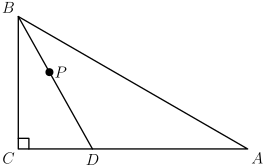
Triangle is a right triangle with as its right angle, and Let be randomly chosen inside and extend to meet at What is the probability that
Pista pequeña:
es -- con y .
is -- with and
Pista grande:
Elija en con de modo que entonces si y solo si está dentro de .
Choose on with so then iff lies inside
Solución:
Como y el triángulo -- tiene y
Ubique en con entonces A medida que se mueve a lo largo de supera exactamente cuando es decir cuando queda más allá de lo que ocurre si y solo si está dentro de
La probabilidad es
Por lo tanto, la respuesta correcta es C.
Since and the -- triangle has and
Place on with then As moves along exceeds exactly when i.e. when lies beyond which happens iff is inside
The probability is
Thus, the correct answer is C.
23.
En el triángulo el lado y la mediatriz de se cortan en el punto y biseca Si y ¿cuál es el área del triángulo ?
In triangle side and the perpendicular bisector of meet in point and bisects If and what is the area of triangle
Pista pequeña:
está en la mediatriz de así que .
is on the perpendicular bisector of so
Pista grande:
La bisectriz del ángulo da aplique la Ley de los Cosenos con leído de .
The angle bisector gives apply the Law of Cosines with read from
Solución:
Como está en la mediatriz de La bisectriz del ángulo da así que escribimos y
Sea En el triángulo isósceles el pie de la perpendicular es el punto medio de así que
Aplicando la Ley de los Cosenos en que se simplifica a así que y
Ahora tiene lados Por la fórmula de Herón con el área es
Por lo tanto, la respuesta correcta es D.
Since lies on the perpendicular bisector of The angle bisector gives so write and
Let In isosceles the foot of the perpendicular is the midpoint of so
Applying the Law of Cosines in which simplifies to so and
Now has sides By Heron’s formula with the area is
Thus, the correct answer is D.
24.
Halle el número de pares ordenados de números reales tales que
Find the number of ordered pairs of real numbers such that
Pista pequeña:
Escriba de modo que la ecuación es tome módulos.
Write so the equation is take magnitudes
Pista grande:
obliga a o cuando .
forces or when
Solución:
Sea La ecuación es Tomando módulos, así que dando o
Si entonces una solución. Si entonces así que es decir que tiene raíces distintas.
En total hay pares ordenados.
Por lo tanto, la respuesta correcta es E.
Let The equation is Taking magnitudes, so giving or
If then one solution. If then so i.e. which has distinct roots.
Altogether there are ordered pairs.
Thus, the correct answer is E.
25.
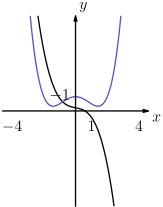
Todos los coeficientes no nulos de un polinomio con coeficientes reales se reemplazan por su media para formar un polinomio ¿Cuál de las siguientes podría ser una gráfica de y en el intervalo ?
The nonzero coefficients of a polynomial with real coefficients are all replaced by their mean to form a polynomial Which of the following could be a graph of and over the interval
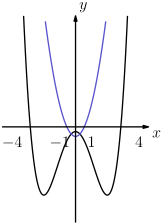
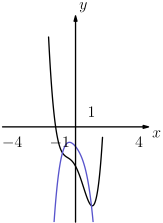
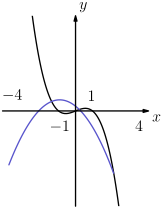
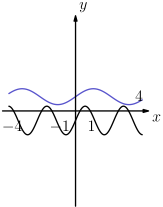
Pista pequeña:
La suma de los coeficientes de es igual a la suma de los coeficientes de .
The sum of the coefficients of equals the sum of the coefficients of
Pista grande:
Evaluar en da así que las dos gráficas deben cortarse en .
Evaluating at gives so the two graphs must intersect at
Solución:
Reemplazar los coeficientes no nulos por su media mantiene sin cambios el total de los coeficientes, así que y tienen la misma suma de coeficientes. Como y son iguales cada uno a esa suma,
Por lo tanto las gráficas de y deben cruzarse en La única opción que muestra una intersección en es la gráfica B. (Allí, y )
Por lo tanto, la respuesta correcta es B.
Replacing the nonzero coefficients by their mean keeps the total of the coefficients unchanged, so and have the same coefficient sum. Since and each equal that sum,
Therefore the graphs of and must cross at The only choice showing an intersection at is graph B. (There, and )
Thus, the correct answer is B.