2015 AMC 12A Problema 25

A continuación está la solución preparada profesionalmente para el Problema 25 del 2015 AMC 12A, de LIVE by Po-Shen Loh. También puedes intentar el examen cronometrado completo, ver todas las soluciones del 2015 AMC 12A, o revisar la clave de respuestas.

Todos los problemas se usan con el permiso legal oficial de la Mathematical Association of America (MAA).

Conceptos:circunferencias tangentessucesión geométricainducción

Nivel de dificultad: 2650

25.

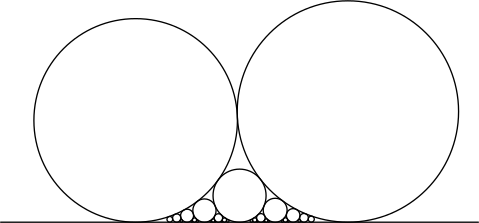
Una colección de círculos en el semiplano superior, todos tangentes al eje xx, se construye por capas de la siguiente manera. La capa L0L_0 consta de dos círculos de radios 70270^2 y 73273^2 que son tangentes externamente. Para k1,k \ge 1, los círculos en j=0k1Lj\bigcup_{j=0}^{k-1} L_j se ordenan según sus puntos de tangencia con el eje xx. Para cada par de círculos consecutivos en este orden, se construye un nuevo círculo tangente externamente a cada uno de los dos círculos del par. La capa LkL_k consta de los 2k12^{k-1} círculos construidos de esta manera. Sea S=j=06Lj,S = \bigcup_{j=0}^{6} L_j, y para cada círculo CC denota por r(C)r(C) su radio. ¿Cuánto vale CS1r(C)?\sum_{C \in S} \dfrac{1}{\sqrt{r(C)}}?

A collection of circles in the upper half-plane, all tangent to the xx-axis, is constructed in layers as follows. Layer L0L_0 consists of two circles of radii 70270^2 and 73273^2 that are externally tangent. For k1,k \ge 1, the circles in j=0k1Lj\bigcup_{j=0}^{k-1} L_j are ordered according to their points of tangency with the xx-axis. For every pair of consecutive circles in this order, a new circle is constructed externally tangent to each of the two circles in the pair. Layer LkL_k consists of the 2k12^{k-1} circles constructed in this way. Let S=j=06Lj,S = \bigcup_{j=0}^{6} L_j, and for every circle CC denote by r(C)r(C) its radius. What is CS1r(C)?\sum_{C \in S} \dfrac{1}{\sqrt{r(C)}}?

28635\dfrac{286}{35}

58370\dfrac{583}{70}

71573\dfrac{715}{73}

14314\dfrac{143}{14}

1573146\dfrac{1573}{146}

Solución:

Si un círculo de radio rr es tangente al eje xx y está encajado en el hueco entre dos círculos de radios r1r_1 y r2r_2 que también son tangentes al eje y entre sí, entonces 1r=1r1+1r2.\dfrac{1}{\sqrt{r}} = \dfrac{1}{\sqrt{r_1}} + \dfrac{1}{\sqrt{r_2}}.

Sea x=1702+1732x = \dfrac{1}{\sqrt{70^2}} + \dfrac{1}{\sqrt{73^2}} =170+173,= \dfrac{1}{70} + \dfrac{1}{73}, que es la suma sobre L0.L_0. El único círculo de L1L_1 también aporta x.x. Para k2,k \ge 2, cada nuevo círculo aporta la suma de sus dos vecinos, y cada círculo anterior se cuenta dos veces excepto los dos círculos de L0;L_0; esto da una suma de 3k1x3^{k-1}x sobre Lk.L_k.

Por lo tanto CS1r(C)=x+k=163k1x=x(1+3612)=x36+12=365x. \begin{gathered} \sum_{C \in S} \dfrac{1}{\sqrt{r(C)}} = x \\ {}+ \sum_{k=1}^{6} 3^{k-1}x \\ = x\left(1 + \dfrac{3^6 - 1}{2}\right) \\ = x\cdot\dfrac{3^6 + 1}{2} \\ = 365x. \end{gathered}

Como x=170+173x = \dfrac{1}{70} + \dfrac{1}{73} =1437073= \dfrac{143}{70\cdot 73} =1435110,= \dfrac{143}{5110}, la suma es 3651435110=14314.365\cdot\dfrac{143}{5110} = \dfrac{143}{14}.

Por lo tanto, la respuesta correcta es D.

If a circle of radius rr is tangent to the xx-axis and nestled in the crevice between two circles of radii r1r_1 and r2r_2 that are also tangent to the axis and to each other, then 1r=1r1+1r2.\dfrac{1}{\sqrt{r}} = \dfrac{1}{\sqrt{r_1}} + \dfrac{1}{\sqrt{r_2}}.

Let x=1702+1732x = \dfrac{1}{\sqrt{70^2}} + \dfrac{1}{\sqrt{73^2}} =170+173,= \dfrac{1}{70} + \dfrac{1}{73}, which is the sum over L0.L_0. The single circle of L1L_1 also contributes x.x. For k2,k \ge 2, each new circle contributes the sum of its two neighbors, and every earlier circle is counted twice except the two circles of L0;L_0; this yields a sum of 3k1x3^{k-1}x over Lk.L_k.

Therefore CS1r(C)=x+k=163k1x=x(1+3612)=x36+12=365x. \begin{gathered} \sum_{C \in S} \dfrac{1}{\sqrt{r(C)}} = x \\ {}+ \sum_{k=1}^{6} 3^{k-1}x \\ = x\left(1 + \dfrac{3^6 - 1}{2}\right) \\ = x\cdot\dfrac{3^6 + 1}{2} \\ = 365x. \end{gathered}

Since x=170+173x = \dfrac{1}{70} + \dfrac{1}{73} =1437073= \dfrac{143}{70\cdot 73} =1435110,= \dfrac{143}{5110}, the sum is 3651435110=14314.365\cdot\dfrac{143}{5110} = \dfrac{143}{14}.

Thus, the correct answer is D.

← Problema 24#24Examen completo

El Problema 25 en otros años