
Soluciones del 2015 AMC 12A
Desplázate hacia abajo para ver las soluciones preparadas profesionalmente de LIVE by Po-Shen Loh, imprime las soluciones en PDF, consulta la clave de respuestas, o haz el examen cronometrado completo.
Todos los problemas se usan con el permiso legal oficial de la Mathematical Association of America (MAA).
1.
¿Cuál es el valor de la expresión
What is the value of
Pista pequeña:
Primero evalúa dentro del paréntesis, usando .
Evaluate inside the parentheses first, using
Pista grande:
Un exponente significa tomar el recíproco antes de multiplicar por .
A exponent means take the reciprocal before multiplying by
Solución:
Dentro del paréntesis,
Luego
Por lo tanto, la respuesta correcta es C.
Inside the parentheses,
Then
Thus, the correct answer is C.
2.
Dos de los tres lados de un triángulo son y ¿Cuál de los siguientes números no puede ser el perímetro del triángulo?
Two of the three sides of a triangle are and Which of the following numbers is not a possible perimeter of the triangle?
Pista pequeña:
El tercer lado está estrictamente entre y
The third side lies strictly between and
Pista grande:
Suma a ese rango para acotar el perímetro
Add to that range to bound the perimeter
Solución:
Por la desigualdad triangular, el tercer lado satisface es decir
El perímetro es así que está estrictamente entre y Entre las opciones, solo queda fuera de este rango.
Por lo tanto, la respuesta correcta es E.
By the Triangle Inequality, the third side satisfies that is
The perimeter is so it lies strictly between and Among the choices, only falls outside this range.
Thus, the correct answer is E.
3.
El Sr. Patrick enseña matemáticas a estudiantes. Al calificar los exámenes, encontró que cuando calificó el examen de todos excepto el de Payton, el promedio de la clase era Después de calificar el examen de Payton, el promedio de la clase pasó a ¿Cuánto sacó Payton en el examen?
Mr. Patrick teaches math to students. He was grading tests and found that when he graded everyone’s test except Payton’s, the average grade for the class was After he graded Payton’s test, the class average became What was Payton’s score on the test?
Pista pequeña:
Los otros estudiantes juntos sumaron .
The other students together scored
Pista grande:
Las puntuaciones en total suman ; resta
All scores together total ; subtract
Solución:
La suma de las otras puntuaciones fue La suma de las puntuaciones fue
Por lo tanto, la puntuación de Payton fue
Por lo tanto, la respuesta correcta es E.
The sum of the other scores was The sum of all scores was
Therefore Payton’s score was
Thus, the correct answer is E.
4.
La suma de dos números positivos es veces su diferencia. ¿Cuál es la razón del número mayor al número menor?
The sum of two positive numbers is times their difference. What is the ratio of the larger number to the smaller number?
Pista pequeña:
Toma los números como y escribe
Let the numbers be and write
Pista grande:
Reordena para relacionar y , luego forma
Rearrange to relate and , then form
Solución:
Sean y los números con Entonces
Al desarrollar se obtiene así que y
Por lo tanto, la respuesta correcta es B.
Let and be the numbers with Then
Expanding gives so and
Thus, the correct answer is B.
5.
Amelia necesita estimar la cantidad donde y son enteros positivos grandes. Redondea cada uno de los enteros para que el cálculo sea más fácil de hacer mentalmente. ¿En cuál de estas situaciones su respuesta será necesariamente mayor que el valor exacto de ?
Amelia needs to estimate the quantity where and are large positive integers. She rounds each of the integers so that the calculation will be easier to do mentally. In which of these situations will her answer necessarily be greater than the exact value of
Redondea los tres números hacia arriba.
She rounds all three numbers up.
Redondea y hacia arriba, y redondea hacia
abajo.
She rounds and up, and she rounds down.
Redondea y hacia arriba, y redondea hacia
abajo.
She rounds and up, and she rounds down.
Redondea hacia arriba, y redondea y
hacia abajo.
She rounds up, and she rounds and
down.
Redondea hacia arriba, y redondea y hacia
abajo.
She rounds up, and she rounds and down.
Pista pequeña:
Aumentar o disminuir hace más grande
Increasing or decreasing makes larger
Pista grande:
Disminuir hace más grande; encuentra la opción donde cada cambio eleva el resultado
Decreasing makes larger; find the choice where every change raises the result
Solución:
Para hacer más grande, redondea el numerador hacia arriba y el denominador hacia abajo. Para hacer más grande, redondea hacia abajo.
Solo la opción hace las tres cosas: redondea hacia arriba mientras redondea y hacia abajo, así que cada cambio empuja la estimación por encima del valor exacto. En las otras opciones al menos un cambio va en la dirección equivocada, así que no se garantiza que la estimación sea mayor.
Por lo tanto, la respuesta correcta es D.
To make larger, round the numerator up and the denominator down. To make larger, round down.
Only choice does all three: it rounds up while rounding and down, so every change pushes the estimate above the exact value. In the other choices at least one change works the wrong way, so the estimate is not guaranteed to be larger.
Thus, the correct answer is D.
6.
Hace dos años Pete tenía el triple de la edad de su prima Claire. Dos años antes de eso, Pete tenía cuatro veces la edad de Claire. ¿Dentro de cuántos años la razón de sus edades será ?
Two years ago Pete was three times as old as his cousin Claire. Two years before that, Pete was four times as old as Claire. In how many years will the ratio of their ages be
Pista pequeña:
Sean sus edades actuales: y
Let be their current ages: and
Pista grande:
Despeja y luego encuentra con
Solve for and then find with
Solución:
Sean y las edades actuales de Pete y Claire. Entonces y
Al resolver se obtiene y así que Pete es años mayor que Claire.
La razón es cuando Claire tiene lo cual es dentro de años.
Por lo tanto, la respuesta correcta es B.
Let and be Pete’s and Claire’s current ages. Then and
Solving these gives and so Pete is years older than Claire.
The ratio is when Claire is which is years from now.
Thus, the correct answer is B.
7.
Dos cilindros circulares rectos tienen el mismo volumen. El radio del segundo cilindro es mayor que el radio del primero. ¿Cuál es la relación entre las alturas de los dos cilindros?
Two right circular cylinders have the same volume. The radius of the second cylinder is more than the radius of the first. What is the relationship between the heights of the two cylinders?
La segunda altura es menor que la primera.
The second height is less than the first.
La primera altura es mayor que la segunda.
The first height is more than the second.
La segunda altura es menor que la primera.
The second height is less than the first.
La primera altura es mayor que la
segunda.
The first height is more than the
second.
La segunda altura es de la primera.
The second height is of the first.
Pista pequeña:
Volúmenes iguales dan con .
Equal volumes give with
Pista grande:
Divide por para comparar y nota que .
Divide by to compare and note
Solución:
Sean y los radios y alturas del primer y segundo cilindro. Los volúmenes son iguales, así que y
Entonces Dividiendo por se obtiene así que la primera altura es mayor que la segunda.
Por lo tanto, la respuesta correcta es D.
Let and be the radii and heights of the first and second cylinders. The volumes are equal, so and
Then Dividing by yields so the first height is more than the second.
Thus, the correct answer is D.
8.
La razón del largo al ancho de un rectángulo es Si el rectángulo tiene una diagonal de longitud entonces el área puede expresarse como para cierta constante ¿Cuánto vale ?
The ratio of the length to the width of a rectangle is If the rectangle has diagonal of length then the area may be expressed as for some constant What is
Pista pequeña:
Toma los lados como y así que la diagonal es
Let the sides be and so the diagonal is
Pista grande:
Escribe el área en términos de
Write the area in terms of
Solución:
Sean los lados del rectángulo y Por el teorema de Pitágoras la diagonal es así que
El área es así que
Por lo tanto, la respuesta correcta es C.
Let the sides of the rectangle be and By the Pythagorean Theorem the diagonal is so
The area is so
Thus, the correct answer is C.
9.
Una caja contiene canicas rojas, canicas verdes y canicas amarillas. Carol toma canicas de la caja al azar; luego Claudia toma de las canicas restantes al azar; y después Cheryl toma las últimas canicas. ¿Cuál es la probabilidad de que Cheryl obtenga canicas del mismo color?
A box contains red marbles, green marbles, and yellow marbles. Carol takes marbles from the box at random; then Claudia takes of the remaining marbles at random; and then Cheryl takes the last marbles. What is the probability that Cheryl gets marbles of the same color?
Pista pequeña:
Como todas las extracciones son al azar, las canicas de Cheryl son simplemente un par aleatorio de las seis
Because all draws are random, Cheryl’s marbles are just a random pair of the six
Pista grande:
Fija su primera canica; su segunda tiene la misma probabilidad de ser cualquiera de las otras
Fix her first marble; her second is equally likely to be any of the other
Solución:
Como las canicas que quedan para Cheryl se determinan al azar, sus dos canicas tienen la misma probabilidad de ser cualquier par. Fijando su primera canica, la segunda tiene la misma probabilidad de ser cualquiera de las canicas restantes.
Exactamente una de esas coincide en color con la primera canica, así que la probabilidad es
Por lo tanto, la respuesta correcta es C.
Because the marbles left for Cheryl are determined at random, her two marbles are equally likely to be any pair. Fixing her first marble, the second is equally likely to be any of the remaining marbles.
Exactly one of those matches the first marble in color, so the probability is
Thus, the correct answer is C.
10.
Los enteros y con satisfacen ¿Cuánto vale ?
Integers and with satisfy What is
Pista pequeña:
Suma a ambos lados para que el lado izquierdo se factorice
Add to both sides so the left side factors
Pista grande:
usa con
use with
Solución:
Sumando a ambos lados y factorizando se obtiene
Como y son enteros positivos distintos con la única posibilidad es y Por lo tanto
Por lo tanto, la respuesta correcta es E.
Adding to both sides and factoring gives
Because and are distinct positive integers with the only possibility is and Therefore
Thus, the correct answer is E.
11.
En una hoja de papel, Isabella dibuja un círculo de radio un círculo de radio y todas las rectas posibles simultáneamente tangentes a ambos círculos. Isabella observa que ha dibujado exactamente rectas. ¿Cuántos valores diferentes de son posibles?
On a sheet of paper, Isabella draws a circle of radius a circle of radius and all possible lines simultaneously tangent to both circles. Isabella notices that she has drawn exactly lines. How many different values of are possible?
Pista pequeña:
El número de tangentes comunes depende de cómo estén posicionados los dos círculos
The number of common tangents depends on how the two circles are positioned
Pista grande:
Mueve los círculos desde uno dentro del otro hasta completamente separados y cuenta en cada etapa
Move the circles from one inside the other out to fully separated and count at each stage
Solución:
El número de rectas tangentes comunes depende de la posición relativa de los dos círculos:
Si el círculo menor está dentro del mayor, hay tangentes. Si son tangentes internamente, hay Si los círculos se cortan en dos puntos, hay Si son tangentes externamente, hay Si están separados, hay
Así puede ser cualquiera de lo que da valores posibles.
Por lo tanto, la respuesta correcta es D.
The number of common tangent lines depends on the relative position of the two circles:
If the smaller circle is inside the larger, there are tangents. If it is internally tangent, there is If the circles intersect at two points, there are If they are externally tangent, there are If they are separated, there are
Thus can be any of which gives possible values.
Thus, the correct answer is D.
12.
Las parábolas y cortan a los ejes coordenados en exactamente cuatro puntos, y estos cuatro puntos son los vértices de un cometa de área ¿Cuánto vale ?
The parabolas and intersect the coordinate axes in exactly four points, and these four points are the vertices of a kite of area What is
Pista pequeña:
Las dos intersecciones con el eje son y las intersecciones con el eje son simétricas respecto al eje
The two -intercepts are and the -intercepts are symmetric about the -axis
Pista grande:
Las diagonales del cometa son la distancia vertical y la extensión horizontal de las intersecciones con el eje
The kite’s diagonals are the vertical distance and the horizontal spread of the -intercepts
Solución:
Las intersecciones con el eje de las dos parábolas son y Para cortar el eje , la primera parábola abre hacia arriba y la segunda hacia abajo, así que sus intersecciones con el eje son para algún
El cometa tiene una diagonal de longitud a lo largo del eje y la otra de longitud Su área es así que
Así, las intersecciones con el eje son Para la primera parábola, da para la segunda, da Por lo tanto
Por lo tanto, la respuesta correcta es B.
The -intercepts of the two parabolas are and To intersect the -axis, the first parabola opens upward and the second opens downward, so their -intercepts are for some
The kite has one diagonal of length along the -axis and the other of length Its area is so
Thus the -intercepts are For the first parabola, gives for the second, gives Therefore
Thus, the correct answer is B.
13.
Una liga con equipos celebra un torneo de todos contra todos, en el que cada equipo juega contra cada uno de los demás exactamente una vez. Los partidos terminan con un equipo victorioso o bien terminan en empate. Un equipo obtiene puntos por cada partido que gana y punto por cada partido que empata. ¿Cuál de las siguientes afirmaciones sobre la lista de puntuaciones no es verdadera?
A league with teams holds a round-robin tournament, with each team playing every other team exactly once. Games either end with one team victorious or else end in a draw. A team scores points for every game it wins and point for every game it draws. Which of the following is not a true statement about the list of scores?
Debe haber un número par de puntuaciones impares.
There must be an even number of odd scores.
Debe haber un número par de puntuaciones pares.
There must be an even number of even scores.
No puede haber dos puntuaciones de
There cannot be two scores of
La suma de las puntuaciones debe ser al menos
The sum of the scores must be at least
La puntuación más alta debe ser al menos
The highest score must be at least
Pista pequeña:
Cada partido aporta exactamente puntos en total, así que la suma de todas las puntuaciones es fija
Every game contributes exactly points in total, so the sum of all scores is fixed
Pista grande:
Considera qué pasa si absolutamente todos los partidos terminan en empate
Consider what happens if every single game ends in a draw
Solución:
Cada uno de los equipos juega partidos, así que se juegan partidos, y cada partido añade puntos a la lista. El total de todas las puntuaciones es
Si todos los partidos son empate, cada equipo obtiene así que la puntuación más alta no necesita llegar a por lo tanto la afirmación puede fallar. Las otras afirmaciones siempre se cumplen: la suma el que la suma sea par obliga a que haya un número par de puntuaciones impares y por tanto un número par de puntuaciones pares, y dos equipos no pueden obtener ambos porque su partido mutuo le da al menos un punto a uno de ellos.
Por lo tanto, la respuesta correcta es E.
Each of the teams plays games, so games are played, and each game adds points to the list. The total of all scores is
If every game is a draw, each team scores so the highest score need not reach thus statement can fail. The other statements always hold: the sum the sum being even forces an even number of odd scores and hence an even number of even scores, and two teams cannot both score because their mutual game gives at least one of them a point.
Thus, the correct answer is E.
14.
¿Cuál es el valor de para el cual
What is the value of for which
Pista pequeña:
.
Pista grande:
La suma se convierte en
The sum becomes
Solución:
Por la fórmula de cambio de base, Por lo tanto
De esto se sigue que
Por lo tanto, la respuesta correcta es D.
By the change-of-base formula, Therefore
It follows that
Thus, the correct answer is D.
15.
¿Cuál es el número mínimo de dígitos a la derecha del punto decimal necesarios para expresar la fracción como decimal?
What is the minimum number of digits to the right of the decimal point needed to express the fraction as a decimal?
Pista pequeña:
El numerador no comparte ningún factor de o con el denominador.
The numerator shares no factor of or with the denominator
Pista grande:
Multiplica el numerador y el denominador para convertir el denominador en una potencia de
Multiply the top and bottom to turn the denominator into a power of
Solución:
El numerador y el denominador no comparten factores comunes. Para escribir la fracción como decimal, reescríbela con una potencia de en el denominador; la menor que funciona es
Como el numerador no es divisible por el decimal tiene exactamente cifras después del punto.
Por lo tanto, la respuesta correcta es C.
The numerator and denominator share no common factors. To write the fraction as a decimal, rewrite it with a power of in the denominator; the smallest that works is
Since the numerator is not divisible by the decimal has exactly places after the point.
Thus, the correct answer is C.
16.
El tetraedro tiene y ¿Cuál es el volumen del tetraedro?
Tetrahedron has and What is the volume of the tetrahedron?
Pista pequeña:
Los triángulos y son ambos triángulos rectángulos -- que comparten el lado
Triangles and are both -- right triangles sharing the edge
Pista grande:
Traza alturas desde y hacia su pie común muestra que es perpendicular a la base
Drop altitudes from and to their common foot shows is perpendicular to base
Solución:
Los triángulos y son triángulos rectángulos -- con área e hipotenusa común Sea el pie de la altura desde hacia entonces De igual modo, la altura desde llega a en el mismo punto con
El triángulo tiene lados y así que es un triángulo rectángulo isósceles con el ángulo recto en Por lo tanto y lo que hace que sea perpendicular al plano de
El volumen del tetraedro es
Por lo tanto, la respuesta correcta es C.
Triangles and are -- right triangles with area and common hypotenuse Let be the foot of the altitude from to then Likewise the altitude from meets at the same point with
Triangle has sides and so it is an isosceles right triangle with the right angle at Thus and making perpendicular to the plane of
The tetrahedron’s volume is
Thus, the correct answer is C.
17.
Ocho personas están sentadas alrededor de una mesa circular, cada una con una moneda justa. Las ocho personas lanzan sus monedas y quienes obtienen cara se ponen de pie, mientras que quienes obtienen cruz permanecen sentados. ¿Cuál es la probabilidad de que no haya dos personas adyacentes de pie?
Eight people are sitting around a circular table, each holding a fair coin. All eight people flip their coins and those who flip heads stand while those who flip tails remain seated. What is the probability that no two adjacent people will stand?
Pista pequeña:
Hay resultados igualmente probables; cuenta aquellos sin dos caras adyacentes
There are equally likely outcomes; count those with no two adjacent heads
Pista grande:
Agrupa por el número de personas de pie más de fuerza una adyacencia
Group by the number of people standing more than forces an adjacency
Solución:
Hay resultados igualmente probables. Cuenta las disposiciones de personas de pie (caras) sin dos adyacentes alrededor del círculo de asientos, agrupadas por cuántas personas se ponen de pie.
El número de maneras de elegir asientos no adyacentes de un círculo de es Para esto da para y más de personas de pie es imposible sin una adyacencia.
El total es así que la probabilidad es
Por lo tanto, la respuesta correcta es A.
There are equally likely outcomes. Count the arrangements of standers (heads) with no two adjacent around the circle of seats, grouped by how many people stand.
The number of ways to choose non-adjacent seats from a circle of is For this gives for and more than standers is impossible without an adjacency.
The total is so the probability is
Thus, the correct answer is A.
18.
Los ceros de la función son enteros. ¿Cuál es la suma de los posibles valores de ?
The zeros of the function are integers. What is the sum of the possible values of
Pista pequeña:
Si las raíces enteras son entonces y .
If the integer roots are then and
Pista grande:
Elimina para obtener es decir
Eliminate to get i.e.
Solución:
Sean los ceros enteros y Por las fórmulas de Vieta y así que Reordenando se obtiene
Los pares de factores enteros de son que dan pares cuyas sumas son y
Los distintos valores posibles de son cuya suma es
Por lo tanto, la respuesta correcta es C.
Let the integer zeros be and By Vieta’s formulas and so Rearranging gives
The integer factor pairs of are which yield pairs summing to and
The distinct possible values of are whose sum is
Thus, the correct answer is C.
19.
Para algunos enteros positivos existe un cuadrilátero con longitudes de lado enteras positivas, perímetro ángulos rectos en y y ¿Cuántos valores diferentes de son posibles?
For some positive integers there is a quadrilateral with positive integer side lengths, perimeter right angles at and and How many different values of are possible?
Pista pequeña:
Traza una perpendicular desde hacia con los ángulos rectos en eso crea un rectángulo
Drop a perpendicular from to with right angles at that creates a rectangle
Pista grande:
Si y entonces lo que obliga a que sea par
If and then which forces to be even
Solución:
En todo cuadrilátero de este tipo Sea el pie de la perpendicular desde hacia entonces y Sea y así que
Por el teorema de Pitágoras así que y es par. Escribiendo se obtiene y el perímetro es
Los valores crecientes dan los cuadriláteros requeridos con perímetro creciente. Para el perímetro es y para es Por lo tanto hay valores posibles de
Por lo tanto, la respuesta correcta es B.
In every such quadrilateral Let be the foot of the perpendicular from to then and Let and so
By the Pythagorean Theorem so and is even. Writing gives and the perimeter is
Increasing values give the required quadrilaterals with increasing perimeter. For the perimeter is and for it is Therefore there are possible values of
Thus, the correct answer is B.
20.
Los triángulos isósceles y no son congruentes pero tienen la misma área y el mismo perímetro. Los lados de miden y mientras que los de miden y ¿Cuál de los siguientes números es el más cercano a ?
Isosceles triangles and are not congruent but have the same area and the same perimeter. The sides of have lengths and while those of have lengths and Which of the following numbers is closest to
Pista pequeña:
tiene perímetro y área escribe esas mismas dos condiciones para
has perimeter and area write those same two conditions for
Pista grande:
Elimina usando llegas a una cúbica con la raíz extraña que se puede factorizar
Eliminate using you reach a cubic with the extraneous root to factor out
Solución:
La altura de sobre su base de longitud es así que tiene área y perímetro
Para necesitamos y área Sustituyendo y elevando al cuadrado se llega a
Como y no son congruentes, así que y Como esto está entre y así que el entero más cercano es
Por lo tanto, la respuesta correcta es A.
The altitude of to its base of length is so has area and perimeter
For we need and area Substituting and squaring leads to
Since and are not congruent, so and Because this is between and so the closest integer is
Thus, the correct answer is A.
21.
Un círculo de radio pasa por ambos focos, y por exactamente cuatro puntos, de la elipse de ecuación El conjunto de todos los valores posibles de es un intervalo ¿Cuánto vale ?
A circle of radius passes through both foci of, and exactly four points on, the ellipse with equation The set of all possible values of is an interval What is
Pista pequeña:
La elipse es con focos en
The ellipse is with foci at
Pista grande:
Un círculo que pasa por ambos focos está centrado en exige que su punto más bajo quede fuera de la elipse
A circle through both foci is centered at require its bottom point to lie outside the ellipse
Solución:
La elipse tiene semiejes y así que y los focos son
Un círculo que pasa por ambos focos tiene su centro en el eje , digamos con radio Su punto más alto siempre queda fuera de la elipse. Para tener cuatro puntos de intersección, su punto más bajo debe estar por debajo de lo que ocurre exactamente cuando
Cuando recorre el radio recorre así que
Por lo tanto, la respuesta correcta es D.
The ellipse has semi-axes and so and the foci are
A circle through both foci has its center on the -axis, say with radius Its top point always lies outside the ellipse. For four intersection points, its bottom point must be below which happens exactly when
As ranges over the radius ranges over so
Thus, the correct answer is D.
22.
Para cada entero positivo sea el número de sucesiones de longitud formadas únicamente por las letras y con no más de tres seguidas y no más de tres seguidas. ¿Cuál es el residuo cuando se divide entre ?
For each positive integer let be the number of sequences of length consisting solely of the letters and with no more than three s in a row and no more than three s in a row. What is the remainder when is divided by
Pista pequeña:
Una sucesión válida termina en una racha de o letras iguales, lo que da
A valid sequence ends in a run of or equal letters, giving
Pista grande:
Reduce la recurrencia módulo y módulo por separado para hallar su periodo
Reduce the recurrence modulo and modulo separately to find its period
Solución:
Observemos que Toda sucesión válida termina con una racha de una, dos o tres letras iguales; al quitar esa racha queda una sucesión válida de longitud o Por tanto,
Módulo los primeros términos son Los tres siguientes son que reproducen el estado inicial, así que la recurrencia se repite con período Como se sigue que
Módulo los términos se repiten como porque el estado de tres términos posterior a esos cuatro vuelve a ser Por tanto, el período es Como tenemos
Escribiendo la condición da así que
Por tanto, la respuesta correcta es D.
Note Every valid sequence ends in a run of one, two, or three equal letters; removing that run leaves a valid sequence of length or Thus
Modulo the first terms are The next three terms are which reproduce the initial state, so the recurrence repeats with period Since it follows that
Modulo the terms repeat as because the next three-term state after these four terms is again Thus the period is As we have
Writing the condition gives so
Thus, the correct answer is D.
23.
Sea un cuadrado de lado Se eligen dos puntos de forma independiente y al azar sobre los lados de La probabilidad de que la distancia en línea recta entre los puntos sea al menos es donde y son enteros positivos y ¿Cuánto vale ?
Let be a square of side length Two points are chosen independently at random on the sides of The probability that the straight-line distance between the points is at least is where and are positive integers and What is
Pista pequeña:
Condiciona según si los dos puntos están en el mismo lado, en lados opuestos o en lados adyacentes
Condition on whether the two points lie on the same side, opposite sides, or adjacent sides
Pista grande:
El caso de lados adyacentes produce el término mediante un cuarto de círculo de radio
The adjacent-sides case produces the term via a quarter-circle of radius
Solución:
El segundo punto está en el mismo lado que el primero con probabilidad en el lado opuesto con probabilidad y en un lado adyacente con probabilidad
Lados opuestos: la distancia siempre es al menos , probabilidad
Mismo lado: para los puntos y la condición tiene probabilidad
Lados adyacentes: para los puntos y la condición es la región fuera de un cuarto de círculo de radio con probabilidad
La probabilidad total es Así
Por lo tanto, la respuesta correcta es A.
The second point is on the same side as the first with probability on the opposite side with probability and on an adjacent side with probability
Opposite sides: the distance is at least always, probability
Same side: for points and the condition has probability
Adjacent sides: for points and the condition is the region outside a quarter-circle of radius with probability
The total probability is Thus
Thus, the correct answer is A.
24.
Los números racionales y se eligen al azar entre todos los números racionales del intervalo que pueden escribirse como fracciones donde y son enteros con ¿Cuál es la probabilidad de que sea un número real?
Rational numbers and are chosen at random among all rational numbers in the interval that can be written as fractions where and are integers with What is the probability that is a real number?
Pista pequeña:
y tienen cada uno valores permitidos; es real si y solo si o .
There are allowed values for each of and is real iff or
Pista grande:
Traduce eso a o
Translate those into or
Solución:
Hay valores posibles para cada uno de y En forma reducida, los denominadores aportan respectivamente valores en para un total de
Escribamos y la cuarta potencia es real si y solo si o
El caso significa y da pares; el caso significa y da otros pares, de los cuales ya se contaron.
Para la condición restante con ambos lados distintos de cero, los valores permitidos de son y Las cantidades correspondientes de valores permitidos de son Por ejemplo, cuando los valores son y los otros casos se obtienen con las mismas identidades de cuarto de vuelta. Así, esta condición aporta pares más.
En total hay pares válidos de así que la probabilidad es
Por lo tanto, la respuesta correcta es D.
There are possible values for each of and In reduced form, denominators contribute respectively values in for a total of
Writing and the fourth power is real if and only if or
The case means giving pairs; the case means giving another pairs, of which were already counted.
For the remaining condition with neither side zero, the allowed values of are and The corresponding numbers of allowed values of are respectively For example, when the values are and the other rows follow from the same quarter-turn identities. Hence this condition contributes more pairs.
In all there are valid pairs out of so the probability is
Thus, the correct answer is D.
25.
Una colección de círculos en el semiplano superior, todos tangentes al eje , se construye por capas de la siguiente manera. La capa consta de dos círculos de radios y que son tangentes externamente. Para los círculos en se ordenan según sus puntos de tangencia con el eje . Para cada par de círculos consecutivos en este orden, se construye un nuevo círculo tangente externamente a cada uno de los dos círculos del par. La capa consta de los círculos construidos de esta manera. Sea y para cada círculo denota por su radio. ¿Cuánto vale
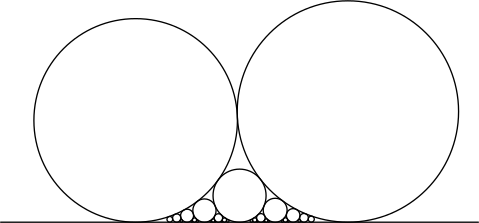
A collection of circles in the upper half-plane, all tangent to the -axis, is constructed in layers as follows. Layer consists of two circles of radii and that are externally tangent. For the circles in are ordered according to their points of tangency with the -axis. For every pair of consecutive circles in this order, a new circle is constructed externally tangent to each of the two circles in the pair. Layer consists of the circles constructed in this way. Let and for every circle denote by its radius. What is
Pista pequeña:
Para un círculo encajado entre dos círculos tangentes a la misma recta, .
For a circle nestled between two circles tangent to the same line,
Pista grande:
Sea las sumas de las capas son .
Let the layer sums are
Solución:
Si un círculo de radio es tangente al eje y está encajado en el hueco entre dos círculos de radios y que también son tangentes al eje y entre sí, entonces
Sea que es la suma sobre El único círculo de también aporta Para cada nuevo círculo aporta la suma de sus dos vecinos, y cada círculo anterior se cuenta dos veces excepto los dos círculos de esto da una suma de sobre
Por lo tanto
Como la suma es
Por lo tanto, la respuesta correcta es D.
If a circle of radius is tangent to the -axis and nestled in the crevice between two circles of radii and that are also tangent to the axis and to each other, then
Let which is the sum over The single circle of also contributes For each new circle contributes the sum of its two neighbors, and every earlier circle is counted twice except the two circles of this yields a sum of over
Therefore
Since the sum is
Thus, the correct answer is D.