
2004 AMC 12B Problema 14
Intenta el Problema 14 del 2004 AMC 12B a continuación y luego compara tu respuesta con la solución preparada profesionalmente de LIVE by Po-Shen Loh. También puedes intentar el examen cronometrado completo, ver todas las soluciones del 2004 AMC 12B, o revisar la clave de respuestas.
Todos los problemas se usan con el permiso legal oficial de la Mathematical Association of America (MAA).
14.
En y Los puntos y están en y respectivamente, con Los puntos y están en de modo que y son perpendiculares a ¿Cuál es el área del pentágono ?
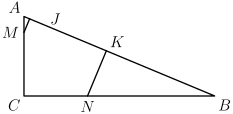
In and Points and lie on and respectively, with Points and are on so that and are perpendicular to What is the area of pentagon
Respuesta: D
Pista pequeña:
es rectángulo en porque .
is right-angled at since
Pista grande:
y son semejantes a con hipotenusas y .
and are similar to with hypotenuses and
Solución:
Como es rectángulo en con área Los pequeños triángulos rectángulos y son cada uno semejantes a con hipotenusas y Sus áreas son y
El pentágono es lo que queda:
Por lo tanto, la respuesta correcta es D.
Since is right-angled at with area The small right triangles and are each similar to with hypotenuses and Their areas are and
The pentagon is what remains:
Thus, the correct answer is D.
El Problema 14 en otros años
- 1950 AMC 12
- 1951 AMC 12
- 1952 AMC 12
- 1953 AMC 12
- 1954 AMC 12
- 1955 AMC 12
- 1956 AMC 12
- 1957 AMC 12
- 1958 AMC 12
- 1959 AMC 12
- 1960 AMC 12
- 1961 AMC 12
- 1962 AMC 12
- 1963 AMC 12
- 1964 AMC 12
- 1965 AMC 12
- 1966 AMC 12
- 1967 AMC 12
- 1968 AMC 12
- 1969 AMC 12
- 1970 AMC 12
- 1971 AMC 12
- 1972 AMC 12
- 1973 AMC 12
- 1974 AMC 12
- 1975 AMC 12
- 1976 AMC 12
- 1977 AMC 12
- 1978 AMC 12
- 1979 AMC 12
- 1980 AMC 12
- 1981 AMC 12
- 1982 AMC 12
- 1983 AMC 12
- 1984 AMC 12
- 1985 AMC 12
- 1986 AMC 12
- 1987 AMC 12
- 1988 AMC 12
- 1989 AMC 12
- 1990 AMC 12
- 1991 AMC 12
- 1992 AMC 12
- 1993 AMC 12
- 1994 AMC 12
- 1995 AMC 12
- 1996 AMC 12
- 1997 AMC 12
- 1998 AMC 12
- 1999 AMC 12
- 2000 AMC 12
- 2001 AMC 12
- 2002 AMC 12A
- 2002 AMC 12B
- 2003 AMC 12A
- 2003 AMC 12B
- 2004 AMC 12A
- 2005 AMC 12A
- 2005 AMC 12B
- 2006 AMC 12A
- 2006 AMC 12B
- 2007 AMC 12A
- 2007 AMC 12B
- 2008 AMC 12A
- 2008 AMC 12B
- 2009 AMC 12A
- 2009 AMC 12B
- 2010 AMC 12A
- 2010 AMC 12B
- 2011 AMC 12A
- 2011 AMC 12B
- 2012 AMC 12A
- 2012 AMC 12B
- 2013 AMC 12A
- 2013 AMC 12B
- 2014 AMC 12A
- 2014 AMC 12B
- 2015 AMC 12A
- 2015 AMC 12B
- 2016 AMC 12A
- 2016 AMC 12B
- 2017 AMC 12A
- 2017 AMC 12B
- 2018 AMC 12A
- 2018 AMC 12B
- 2019 AMC 12A
- 2019 AMC 12B
- 2020 AMC 12A
- 2020 AMC 12B
- 2021 AMC 12A Spring
- 2021 AMC 12B Spring
- 2021 AMC 12A Fall
- 2021 AMC 12B Fall
- 2022 AMC 12A
- 2022 AMC 12B
- 2023 AMC 12A
- 2023 AMC 12B
- 2024 AMC 12A
- 2024 AMC 12B
- 2025 AMC 12A
- 2025 AMC 12B