
2017 AMC 12A 第 16 题
先试着解答 2017 AMC 12A 第 16 题,然后核对你的答案与精心整理的解答,解答来自 LIVE by Po-Shen Loh。你也可以参加完整限时模拟考试、查看全部 2017 AMC 12A 解答,或核对答案。
所有题目均经美国数学协会(MAA)官方合法授权使用。
16.
在下图中,以 和 为圆心、半径分别为 和 的半圆,画在一个以 为直径的半圆内部,并与它共用底边。两个较小的半圆彼此外切,并且都与最大半圆内切。以 为圆心的圆与两个较小半圆外切,并与最大半圆内切。以 为圆心的圆的半径是多少?
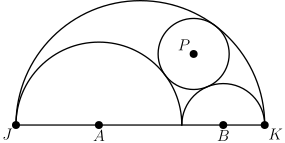
In the figure below, semicircles with centers at and and with radii and respectively, are drawn in the interior of, and sharing bases with, a semicircle with diameter The two smaller semicircles are externally tangent to each other and internally tangent to the largest semicircle. A circle centered at is drawn externally tangent to the two smaller semicircles and internally tangent to the largest semicircle. What is the radius of the circle centered at
小提示:
设 为大半圆圆心;则 ,,。
Let be the center of the large semicircle; then
大提示:
从 向 作垂线,并令三个关于高度平方的表达式相等
Drop a perpendicular from to and set the three expressions for its squared height equal
解答:
大半圆半径为 ,圆心 是 的中点。把 放在原点,则沿底边有 、、、。设 处圆的半径为 。
由相切可知 ,,且 。从 向底边作垂线,垂足的水平位置为 ,高度为 ,由勾股定理得
令第一个表达式与中间那个相等,得到 ;令最后一个表达式与中间那个相等,得到 。两式相加得 ,所以 。
所以正确答案是 B。
The large semicircle has radius and center the midpoint of Placing at the origin, along the base. Let be the radius of the circle at
By tangency, and Dropping a perpendicular from to the base at horizontal position with height the Pythagorean theorem gives
Equating the first expression with the middle one gives while equating the last expression with the middle one gives Adding yields so
Thus, the correct answer is B.
其他年份的第 16 题
- 1950 AMC 12
- 1951 AMC 12
- 1952 AMC 12
- 1953 AMC 12
- 1954 AMC 12
- 1955 AMC 12
- 1956 AMC 12
- 1957 AMC 12
- 1958 AMC 12
- 1959 AMC 12
- 1960 AMC 12
- 1961 AMC 12
- 1962 AMC 12
- 1963 AMC 12
- 1964 AMC 12
- 1965 AMC 12
- 1966 AMC 12
- 1967 AMC 12
- 1968 AMC 12
- 1969 AMC 12
- 1970 AMC 12
- 1971 AMC 12
- 1972 AMC 12
- 1973 AMC 12
- 1974 AMC 12
- 1975 AMC 12
- 1976 AMC 12
- 1977 AMC 12
- 1978 AMC 12
- 1979 AMC 12
- 1980 AMC 12
- 1981 AMC 12
- 1982 AMC 12
- 1983 AMC 12
- 1984 AMC 12
- 1985 AMC 12
- 1986 AMC 12
- 1987 AMC 12
- 1988 AMC 12
- 1989 AMC 12
- 1990 AMC 12
- 1991 AMC 12
- 1992 AMC 12
- 1993 AMC 12
- 1994 AMC 12
- 1995 AMC 12
- 1996 AMC 12
- 1997 AMC 12
- 1998 AMC 12
- 1999 AMC 12
- 2000 AMC 12
- 2001 AMC 12
- 2002 AMC 12A
- 2002 AMC 12B
- 2003 AMC 12A
- 2003 AMC 12B
- 2004 AMC 12A
- 2004 AMC 12B
- 2005 AMC 12A
- 2005 AMC 12B
- 2006 AMC 12A
- 2006 AMC 12B
- 2007 AMC 12A
- 2007 AMC 12B
- 2008 AMC 12A
- 2008 AMC 12B
- 2009 AMC 12A
- 2009 AMC 12B
- 2010 AMC 12A
- 2010 AMC 12B
- 2011 AMC 12A
- 2011 AMC 12B
- 2012 AMC 12A
- 2012 AMC 12B
- 2013 AMC 12A
- 2013 AMC 12B
- 2014 AMC 12A
- 2014 AMC 12B
- 2015 AMC 12A
- 2015 AMC 12B
- 2016 AMC 12A
- 2016 AMC 12B
- 2017 AMC 12B
- 2018 AMC 12A
- 2018 AMC 12B
- 2019 AMC 12A
- 2019 AMC 12B
- 2020 AMC 12A
- 2020 AMC 12B
- 2021 AMC 12A Spring
- 2021 AMC 12B Spring
- 2021 AMC 12A Fall
- 2021 AMC 12B Fall
- 2022 AMC 12A
- 2022 AMC 12B
- 2023 AMC 12A
- 2023 AMC 12B
- 2024 AMC 12A
- 2024 AMC 12B
- 2025 AMC 12A
- 2025 AMC 12B