
2008 AMC 12A Problema 22
Intenta el Problema 22 del 2008 AMC 12A a continuación y luego compara tu respuesta con la solución preparada profesionalmente de LIVE by Po-Shen Loh. También puedes intentar el examen cronometrado completo, ver todas las soluciones del 2008 AMC 12A, o revisar la clave de respuestas.
Todos los problemas se usan con el permiso legal oficial de la Mathematical Association of America (MAA).
22.
Una mesa redonda tiene radio Se colocan seis manteles individuales rectangulares sobre la mesa. Cada mantel tiene ancho y largo como se muestra. Se colocan de modo que cada mantel tenga dos esquinas en el borde de la mesa, siendo estas dos esquinas los extremos del mismo lado de largo Además, los manteles se colocan de modo que las esquinas interiores toquen cada una una esquina interior de un mantel adyacente. ¿Cuánto vale ?
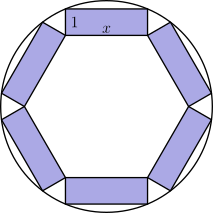
A round table has radius Six rectangular place mats are placed on the table. Each place mat has width and length as shown. They are positioned so that each mat has two corners on the edge of the table, these two corners being endpoints of the same side of length Further, the mats are positioned so that the inner corners each touch an inner corner of an adjacent mat. What is
Respuesta: C
Pista pequeña:
Para un mantel, sean sus esquinas exteriores y el punto diametralmente opuesto a entonces es rectángulo con .
For one mat, let be its outer corners and the point diametrically opposite then is right-angled with
Pista grande:
Las esquinas interiores forman triángulos isósceles con ángulo en el vértice aportando un segmento de longitud .
The inner corners form isosceles triangles with vertex angle contributing a segment of length
Solución:
Tomemos un mantel con esquinas exteriores y y sea el punto del borde de la mesa diametralmente opuesto a Entonces es un diámetro, así que tiene un ángulo recto en con
A lo largo de las esquinas interiores de manteles vecinos se encuentran en un triángulo isósceles con dos lados de longitud y ángulo en el vértice cuya base es Por lo tanto
El Teorema de Pitágoras da que se simplifica a
Tomando la raíz positiva,
Por lo tanto, C es la respuesta correcta.
Take one mat with outer corners and and let be the point of the table’s edge diametrically opposite Then is a diameter, so has a right angle at with
Along the inner corners of neighboring mats meet in an isosceles triangle with two sides of length and vertex angle whose base is Hence
The Pythagorean Theorem gives which simplifies to
Taking the positive root,
Thus, C is the correct answer.
El Problema 22 en otros años
1950 AMC 12 · 1951 AMC 12 · 1952 AMC 12 · 1953 AMC 12 · 1954 AMC 12 · 1955 AMC 12 · 1956 AMC 12 · 1957 AMC 12 · 1958 AMC 12 · 1959 AMC 12 · 1960 AMC 12 · 1961 AMC 12 · 1962 AMC 12 · 1963 AMC 12 · 1964 AMC 12 · 1965 AMC 12 · 1966 AMC 12 · 1967 AMC 12 · 1968 AMC 12 · 1969 AMC 12 · 1970 AMC 12 · 1971 AMC 12 · 1972 AMC 12 · 1973 AMC 12 · 1974 AMC 12 · 1975 AMC 12 · 1976 AMC 12 · 1977 AMC 12 · 1978 AMC 12 · 1979 AMC 12 · 1980 AMC 12 · 1981 AMC 12 · 1982 AMC 12 · 1983 AMC 12 · 1984 AMC 12 · 1985 AMC 12 · 1986 AMC 12 · 1987 AMC 12 · 1988 AMC 12 · 1989 AMC 12 · 1990 AMC 12 · 1991 AMC 12 · 1992 AMC 12 · 1993 AMC 12 · 1994 AMC 12 · 1995 AMC 12 · 1996 AMC 12 · 1997 AMC 12 · 1998 AMC 12 · 1999 AMC 12 · 2000 AMC 12 · 2001 AMC 12 · 2002 AMC 12A · 2002 AMC 12B · 2003 AMC 12A · 2003 AMC 12B · 2004 AMC 12A · 2004 AMC 12B · 2005 AMC 12A · 2005 AMC 12B · 2006 AMC 12A · 2006 AMC 12B · 2007 AMC 12A · 2007 AMC 12B · 2008 AMC 12B · 2009 AMC 12A · 2009 AMC 12B · 2010 AMC 12A · 2010 AMC 12B · 2011 AMC 12A · 2011 AMC 12B · 2012 AMC 12A · 2012 AMC 12B · 2013 AMC 12A · 2013 AMC 12B · 2014 AMC 12A · 2014 AMC 12B · 2015 AMC 12A · 2015 AMC 12B · 2016 AMC 12A · 2016 AMC 12B · 2017 AMC 12A · 2017 AMC 12B · 2018 AMC 12A · 2018 AMC 12B · 2019 AMC 12A · 2019 AMC 12B · 2020 AMC 12A · 2020 AMC 12B · 2021 AMC 12A Spring · 2021 AMC 12B Spring · 2021 AMC 12A Fall · 2021 AMC 12B Fall · 2022 AMC 12A · 2022 AMC 12B · 2023 AMC 12A · 2023 AMC 12B · 2024 AMC 12A · 2024 AMC 12B · 2025 AMC 12A · 2025 AMC 12B