
Problemas del 2008 AMC 12A
¡Desplázate hacia abajo y presiona Iniciar para intentar el examen! O ve al PDF imprimible, la clave de respuestas, o las soluciones profesionales preparadas por LIVE by Po-Shen Loh.
Todos los problemas se usan con el permiso legal oficial de la Mathematical Association of America (MAA).
O salta directamente a un solo problema con su solución: 1 · 2 · 3 · 4 · 5 · 6 · 7 · 8 · 9 · 10 · 11 · 12 · 13 · 14 · 15 · 16 · 17 · 18 · 19 · 20 · 21 · 22 · 23 · 24 · 25
¿Quieres aprender de forma profesional con clases interactivas en video?
Con tiempo
1:15:00
1.
El dueño de una panadería enciende su máquina de rosquillas a las de la mañana. A las de la mañana la máquina ha completado un tercio del trabajo del día. ¿A qué hora terminará la máquina de rosquillas el trabajo?
A bakery owner turns on his doughnut machine at am. At am the machine has completed one third of the day’s job. At what time will the doughnut machine complete the job?
de la tarde
pm
de la tarde
pm
de la tarde
pm
de la tarde
pm
de la tarde
pm
Respuesta: D
Pista pequeña:
Halla cuánto tiempo tomó terminar el primer tercio del trabajo.
Find how long it took to finish the first third of the job
Pista grande:
El trabajo completo toma tres veces lo que ese primer tercio.
The whole job takes three times as long as that first third
Solución:
Desde las de la mañana hasta las de la mañana hay horas minutos, es decir, minutos, para completar un tercio del trabajo.
Entonces el trabajo completo toma minutos, es decir, horas. Sumar horas a las de la mañana da las de la tarde.
Por lo tanto, D es la respuesta correcta.
From am to am is hours minutes, or minutes, to complete one third of the job.
The whole job then takes minutes, or hours. Adding hours to am gives pm.
Thus, D is the correct answer.
2.
¿Cuál es el recíproco de
What is the reciprocal of
Respuesta: A
Pista pequeña:
Suma las dos fracciones usando un común denominador.
Add the two fractions using a common denominator
Pista grande:
El recíproco intercambia el numerador y el denominador.
The reciprocal swaps the numerator and denominator
Solución:
Usando un común denominador,
El recíproco de es
Por lo tanto, A es la respuesta correcta.
Using a common denominator,
The reciprocal of is
Thus, A is the correct answer.
3.
Supongamos que de plátanos valen tanto como naranjas. ¿Cuántas naranjas valen tanto como de plátanos?
Suppose that of bananas are worth as much as oranges. How many oranges are worth as much as of bananas?
Respuesta: C
Pista pequeña:
Primero halla cuántas naranjas vale un solo plátano.
First find how many oranges a single banana is worth
Pista grande:
de plátanos son plátanos, y estos equivalen a naranjas.
of bananas is bananas, and these equal oranges
Solución:
Como de plátanos son plátanos, que valen naranjas, un plátano vale naranjas.
Entonces de plátanos son plátanos, que valen naranjas.
Por lo tanto, C es la respuesta correcta.
Since of bananas is bananas, worth oranges, one banana is worth oranges.
Then of bananas is bananas, worth oranges.
Thus, C is the correct answer.
4.
¿Cuál de las siguientes opciones es igual al producto
Which of the following is equal to the product
Respuesta: B
Pista pequeña:
Cada denominador se cancela con el numerador de la fracción anterior.
Each denominator cancels with the numerator of the previous fraction
Pista grande:
Solo sobreviven el último numerador y el primer denominador.
Only the last numerator and the first denominator survive
Solución:
Todo denominador salvo el primero se cancela con el numerador de la fracción precedente, así que el producto se reduce a
Por lo tanto, B es la respuesta correcta.
Every denominator except the first cancels with the numerator of the preceding fraction, so the product collapses to
Thus, B is the correct answer.
5.
Supongamos que es un entero. ¿Cuál de las siguientes afirmaciones debe ser verdadera acerca de ?
Suppose that is an integer. Which of the following statements must be true about
Es negativo.
It is negative.
Es par, pero no necesariamente un múltiplo de
It is even, but not necessarily a multiple of
Es un múltiplo de pero no necesariamente par.
It is a multiple of but not necessarily even.
Es un múltiplo de pero no necesariamente un múltiplo de
It is a multiple of but not necessarily a multiple of
Es un múltiplo de
It is a multiple of
Respuesta: B
Pista pequeña:
Combina las dos fracciones sobre un común denominador.
Combine the two fractions over a common denominator
Pista grande:
Simplifica hasta y luego decide qué condición de divisibilidad hace que esto sea un entero.
Simplify to then decide what divisibility condition makes this an integer
Solución:
Combinando las fracciones,
Esto es un entero exactamente cuando es par. El ejemplo es par pero no un múltiplo de lo que descarta toda otra afirmación.
Por lo tanto, B es la respuesta correcta.
Combining the fractions,
This is an integer exactly when is even. The example is even but not a multiple of which rules out every other statement.
Thus, B is the correct answer.
6.
Heather compara el precio de una computadora nueva en dos tiendas diferentes. La tienda A ofrece de descuento sobre el precio de lista seguido de un reembolso de , y la tienda B ofrece de descuento sobre el mismo precio de lista sin reembolso. Heather ahorra comprando la computadora en la tienda A en lugar de la tienda B. ¿Cuál es el precio de lista de la computadora, en dólares?
Heather compares the price of a new computer at two different stores. Store A offers off the sticker price followed by a rebate, and store B offers off the same sticker price with no rebate. Heather saves by buying the computer at store A instead of store B. What is the sticker price of the computer, in dollars?
Respuesta: A
Pista pequeña:
Escribe el precio de cada tienda en términos del precio de lista .
Write each store’s price in terms of the sticker price
Pista grande:
El precio de la tienda A es dólares menor que el precio de la tienda B.
Store A’s price is dollars less than store B’s price
Solución:
Sea el precio de lista en dólares. La tienda A cobra dólares, y la tienda B cobra dólares.
Como la tienda A es dólares más barata, así que y
Por lo tanto, A es la respuesta correcta.
Let be the sticker price in dollars. Store A charges dollars, and store B charges dollars.
Since store A is dollars cheaper, so and
Thus, A is the correct answer.
7.
Mientras Steve y LeRoy pescan a milla de la orilla, su bote comienza a hacer agua, y el agua entra a una tasa constante de galones por minuto. El bote se hundirá si entran más de galones de agua. Steve comienza a remar hacia la orilla a una tasa constante de millas por hora mientras LeRoy achica agua del bote. ¿Cuál es la tasa más lenta, en galones por minuto, a la que LeRoy puede achicar si quieren llegar a la orilla sin hundirse?
While Steve and LeRoy are fishing mile from shore, their boat springs a leak, and water comes in at a constant rate of gallons per minute. The boat will sink if it takes in more than gallons of water. Steve starts rowing toward the shore at a constant rate of miles per hour while LeRoy bails water out of the boat. What is the slowest rate, in gallons per minute, at which LeRoy can bail if they are to reach the shore without sinking?
Respuesta: D
Pista pequeña:
Halla cuántos minutos toma el viaje a la orilla.
Find how many minutes the trip to shore takes
Pista grande:
El agua entra durante minutos, y a lo sumo pueden quedar galones en el bote.
Water enters for minutes, and at most gallons may remain in the boat
Solución:
Remar milla a millas por hora toma de hora, es decir, minutos. En ese tiempo entran galones de agua al bote.
Como a lo sumo pueden quedar galones, LeRoy debe achicar galones en minutos, una tasa de galones por minuto.
Por lo tanto, D es la respuesta correcta.
Rowing mile at miles per hour takes hour, or minutes. In that time gallons of water enter the boat.
Since at most gallons may remain, LeRoy must bail gallons in minutes, a rate of gallons per minute.
Thus, D is the correct answer.
8.
¿Cuál es el volumen de un cubo cuya área superficial es el doble de la de un cubo de volumen ?
What is the volume of a cube whose surface area is twice that of a cube with volume
Respuesta: C
Pista pequeña:
Un cubo de volumen tiene área superficial .
A cube with volume has surface area
Pista grande:
Si el cubo más grande tiene lado entonces .
If the larger cube has side then
Solución:
El cubo de volumen tiene lado y área superficial El cubo más grande tiene área superficial así que si su lado es entonces lo que da
Su volumen es
Por lo tanto, C es la respuesta correcta.
The cube with volume has side and surface area The larger cube has surface area so if its side is then giving
Its volume is
Thus, C is the correct answer.
9.
Las pantallas de televisión más antiguas tienen una relación de aspecto de Es decir, la razón entre el ancho y la altura es La relación de aspecto de muchas películas no es por lo que a veces se muestran en una pantalla de televisión mediante el “formato de buzón”, oscureciendo franjas de igual altura en la parte superior e inferior de la pantalla, como se muestra. Supongamos que una película tiene una relación de aspecto de y se muestra en una pantalla de televisión antigua con una diagonal de pulgadas. ¿Cuál es la altura, en pulgadas, de cada franja oscurecida?
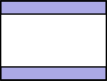
Older television screens have an aspect ratio of That is, the ratio of the width to the height is The aspect ratio of many movies is not so they are sometimes shown on a television screen by “letterboxing” — darkening strips of equal height at the top and bottom of the screen, as shown. Suppose a movie has an aspect ratio of and is shown on an older television screen with a -inch diagonal. What is the height, in inches, of each darkened strip?
Respuesta: D
Pista pequeña:
El ancho, la altura y la diagonal de la pantalla están en razón .
The screen’s width, height, and diagonal are in ratio
Pista grande:
La región iluminada de la película conserva el ancho completo pero tiene una altura igual a la mitad de ese ancho.
The lit movie region keeps the full width but has height equal to half that width
Solución:
Como los lados y la diagonal están en razón la altura es pulgadas y el ancho es pulgadas.
La película tiene relación de aspecto así que su altura es pulgadas.
Por lo tanto, cada franja oscurecida tiene altura pulgadas.
Por lo tanto, D es la respuesta correcta.
Since the sides and diagonal are in ratio the height is inches and the width is inches.
The movie has aspect ratio so its height is inches.
Each darkened strip therefore has height inches.
Thus, D is the correct answer.
10.
Doug puede pintar una habitación en horas. Dave puede pintar la misma habitación en horas. Doug y Dave pintan la habitación juntos y toman un descanso de una hora para almorzar. Sea el tiempo total, en horas, que necesitan para completar el trabajo trabajando juntos, incluyendo el almuerzo. ¿Cuál de las siguientes ecuaciones satisface ?
Doug can paint a room in hours. Dave can paint the same room in hours. Doug and Dave paint the room together and take a one-hour break for lunch. Let be the total time, in hours, required for them to complete the job working together, including lunch. Which of the following equations is satisfied by
Respuesta: D
Pista pequeña:
Juntos pintan de la habitación cada hora.
Together they paint of the room each hour
Pista grande:
De las horas, una hora es el almuerzo, así que en realidad trabajan horas.
Of the hours, one hour is lunch, so they actually work hours
Solución:
En una hora Doug pinta de la habitación y Dave pinta así que juntos pintan de la habitación por hora.
Del tiempo total una hora se dedica al almuerzo, así que trabajan durante horas. La fracción pintada debe ser igual a lo que da
Por lo tanto, D es la respuesta correcta.
In one hour Doug paints of the room and Dave paints so together they paint of the room per hour.
Of the total time one hour is spent at lunch, so they work for hours. The fraction painted must equal giving
Thus, D is the correct answer.
11.
Tres cubos se forman cada uno a partir del patrón mostrado. Luego se apilan sobre una mesa uno encima de otro de modo que los números visibles tengan la mayor suma posible. ¿Cuál es esa suma?
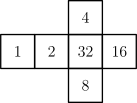
Three cubes are each formed from the pattern shown. They are then stacked on a table one on top of another so that the visible numbers have the greatest possible sum. What is that sum?
Respuesta: C
Pista pequeña:
En cada cubo las caras opuestas son y y y y .
On each cube the opposite faces are & & and &
Pista grande:
Cada uno de los dos cubos inferiores oculta un par de caras opuestas; el cubo superior oculta solo su cara inferior.
The two lower cubes each hide a pair of opposite faces; the top cube hides only its bottom face
Solución:
Las seis caras de cada cubo suman Del patrón, los pares de caras opuestas son y y y y
Cada uno de los dos cubos inferiores oculta un par de caras opuestas (arriba y abajo); ocultar el par es lo mejor. El cubo superior oculta solo su cara inferior, así que se oculta el
La mayor suma es
Por lo tanto, C es la respuesta correcta.
The six faces of each cube sum to From the pattern, the pairs of opposite faces are & & and &
Each of the two lower cubes hides a pair of opposite faces (top and bottom); hiding the pair is best. The top cube hides only its bottom face, so hide the
The greatest sum is
Thus, C is the correct answer.
12.
Una función tiene dominio y rango (La notación denota ) ¿Cuáles son el dominio y el rango, respectivamente, de la función definida por
A function has domain and range (The notation denotes ) What are the domain and range, respectively, of the function defined by
Respuesta: B
Pista pequeña:
está definida cuando .
is defined when
Pista grande:
Restar de invierte el intervalo pero lo mantiene .
Subtracting from reverses the interval but keeps it
Solución:
El valor está definido cuando es decir, así que el dominio de es
Cuando recorre el valor recorre también, así que el rango de es
Por lo tanto, B es la respuesta correcta.
The value is defined when that is, so the domain of is
As ranges over the value ranges over as well, so the range of is
Thus, B is the correct answer.
13.
Los puntos y están en un círculo centrado en y Un segundo círculo es tangente internamente al primero y tangente a y ¿Cuál es la razón entre el área del círculo menor y la del círculo mayor?
Points and lie on a circle centered at and A second circle is internally tangent to the first and tangent to both and What is the ratio of the area of the smaller circle to that of the larger circle?
Respuesta: B
Pista pequeña:
El centro del círculo pequeño está en la bisectriz de .
The center of the small circle lies on the bisector of
Pista grande:
Trazar un radio perpendicular a forma un triángulo -- en el que .
Dropping a radius to makes a -- triangle in which
Solución:
Sean y los radios de los círculos menor y mayor, y sea el centro del círculo menor. Por simetría está en la bisectriz de así que forma un ángulo de con
Trazar el radio perpendicular a da un triángulo -- con Como los círculos son tangentes internamente,
Entonces así que y La razón de áreas es
Por lo tanto, B es la respuesta correcta.
Let and be the radii of the smaller and larger circles, and let be the center of the smaller circle. By symmetry lies on the bisector of so makes a angle with
Dropping the radius perpendicular to gives a -- triangle with Since the circles are internally tangent,
Then so and The ratio of areas is
Thus, B is the correct answer.
14.
¿Cuál es el área de la región definida por la desigualdad
What is the area of the region defined by the inequality
Respuesta: A
Pista pequeña:
La región es un rombo centrado donde y .
The region is a rhombus centered where and
Pista grande:
Su diagonal horizontal abarca y su diagonal vertical abarca .
Its horizontal diagonal spans and its vertical diagonal spans
Solución:
La región es un rombo centrado en Poner da así que una diagonal horizontal de longitud
Poner da así que una diagonal vertical de longitud
El área del rombo es la mitad del producto de sus diagonales,
Por lo tanto, A es la respuesta correcta.
The region is a rhombus centered at Setting gives so a horizontal diagonal of length
Setting gives so a vertical diagonal of length
The area of the rhombus is half the product of its diagonals,
Thus, A is the correct answer.
15.
Sea ¿Cuál es el dígito de las unidades de ?
Let What is the units digit of
Respuesta: D
Pista pequeña:
El dígito de las unidades de recorre con período .
The units digit of cycles with period
Pista grande:
Halla primero el dígito de las unidades de , luego observa que es un múltiplo de .
Find the units digit of first, then note that is a multiple of
Solución:
El dígito de las unidades de es Como es un múltiplo de el dígito de las unidades de es Así tiene dígito de las unidades y también lo tiene
Tanto como son múltiplos de así que es un múltiplo de Por lo tanto el dígito de las unidades de es
El dígito de las unidades de es entonces
Por lo tanto, D es la respuesta correcta.
The units digit of is Since is a multiple of the units digit of is Thus has units digit and so does
Both and are multiples of so is a multiple of Therefore the units digit of is
The units digit of is then
Thus, D is the correct answer.
16.
Los números y son los primeros tres términos de una sucesión aritmética, y el o término de la sucesión es ¿Cuánto vale ?
The numbers and are the first three terms of an arithmetic sequence, and the th term of the sequence is What is
Respuesta: D
Pista pequeña:
Escribe cada término como e iguala las diferencias consecutivas.
Write each term as and set the consecutive differences equal
Pista grande:
Diferencias iguales fuerzan reduciendo cada término a un múltiplo de .
Equal differences force reducing every term to a multiple of
Solución:
Los tres términos son y Igualando las dos diferencias consecutivas, así que
El primer término es entonces y la diferencia común es
El o término es así que
Por lo tanto, D es la respuesta correcta.
The three terms are and Setting the two consecutive differences equal, so
The first term is then and the common difference is
The th term is so
Thus, D is the correct answer.
17.
Sea una sucesión de enteros determinada por la regla si es par y si es impar. ¿Para cuántos enteros positivos es cierto que es menor que cada uno de y ?
Let be a sequence of integers determined by the rule if is even and if is odd. For how many positive integers is it true that is less than each of and
Respuesta: D
Pista pequeña:
Si es par entonces así que debe ser impar.
If is even then so must be odd
Pista grande:
Divide el caso impar según si o .
Split the odd case according to whether or
Solución:
Si es par, entonces así que la condición falla.
Si entonces es un múltiplo de así que y y de nuevo la condición falla.
Si entonces es par pero no un múltiplo de así que y es impar, lo que da La condición se cumple.
Exactamente valores de satisfacen
Por lo tanto, D es la respuesta correcta.
If is even, then so the condition fails.
If then is a multiple of so and and again the condition fails.
If then is even but not a multiple of so and is odd, giving The condition holds.
Exactly values of satisfy
Thus, D is the correct answer.
18.
El triángulo con lados de longitud y tiene un vértice en el eje positivo, uno en el eje positivo, y uno en el eje positivo. Sea el origen. ¿Cuál es el volumen del tetraedro ?
Triangle with sides of length and has one vertex on the positive -axis, one on the positive -axis, and one on the positive -axis. Let be the origin. What is the volume of tetrahedron
Respuesta: C
Pista pequeña:
Sean los vértices y escribe las tres ecuaciones de longitudes de lado.
Let the vertices be and write the three side-length equations
Pista grande:
Sumar las tres ecuaciones da y el volumen es .
Adding the three equations gives and the volume is
Solución:
Sean Asignando los lados,
Sumando se obtiene así que y
El volumen es
Por lo tanto, C es la respuesta correcta.
Let Assigning the sides,
Adding gives so and
The volume is
Thus, C is the correct answer.
19.
En el desarrollo de ¿cuál es el coeficiente de ?
In the expansion of what is the coefficient of
Respuesta: C
Pista pequeña:
Un término tiene la forma con y .
A term has the form with and
Pista grande:
Para cada uno de los pares hay un único valor válido excepto cuando .
For each of the pairs there is a unique valid except when
Solución:
Cada término es con y Para obtener necesitamos
Hay opciones para Para cada opción salvo el valor requerido está en dando un término válido.
El coeficiente de es por lo tanto
Por lo tanto, C es la respuesta correcta.
Each term is with and To get we need
There are choices for For every choice except the required lies in giving a valid term.
The coefficient of is therefore
Thus, C is the correct answer.
20.
El triángulo tiene y El punto está en y biseca el ángulo recto. Los círculos inscritos de y tienen radios y respectivamente. ¿Cuánto vale ?
Triangle has and Point is on and bisects the right angle. The inscribed circles of and have radii and respectively. What is
Respuesta: E
Pista pequeña:
Por el Teorema de la Bisectriz del Ángulo, .
By the Angle Bisector Theorem,
Pista grande:
Para cada triángulo pequeño los dos triángulos comparten la base .
For each small triangle the two triangles share the base
Solución:
Por el Teorema de la Bisectriz del Ángulo, así que y Las áreas de y comparten la base así que están en razón a saber y
Dividir a lo largo de que corta cada cateto a da así que
Los dos semiperímetros son Usando
Racionalizando, así que
Por lo tanto, E es la respuesta correcta.
By the Angle Bisector Theorem, so and The areas of and share base so they are in ratio namely and
Splitting along which meets each leg at gives so
The two semiperimeters are Using
Rationalizing, so
Thus, E is the correct answer.
21.
Una permutación de es cola pesada si ¿Cuál es el número de permutaciones de cola pesada?
A permutation of is heavy-tailed if What is the number of heavy-tailed permutations?
Respuesta: D
Pista pequeña:
Por simetría, y ocurren con igual frecuencia.
By symmetry, and occur equally often
Pista grande:
Cuenta las permutaciones equilibradas aquí .
Count the balanced permutations here
Solución:
Llamemos equilibrada a una permutación si Invertir las entradas intercambia los dos casos estrictos, así que las permutaciones de cola pesada y las de cabeza pesada son igual de numerosas.
El total es impar, así que en una permutación equilibrada debe ser impar, uno de Para cada elección, los cuatro números restantes se dividen de manera única en dos pares de igual suma.
Cualquiera de los cuatro puede ser (fijando ), y cualquiera de los números restantes puede ser (fijando ), lo que da permutaciones equilibradas.
Las otras permutaciones se dividen por igual, así que hay permutaciones de cola pesada.
Por lo tanto, D es la respuesta correcta.
Call a permutation balanced if Reversing the entries swaps the two strict cases, so heavy-tailed and heavy-headed permutations are equally numerous.
The total is odd, so in a balanced permutation must be odd, one of For each choice, the remaining four numbers split uniquely into two equal-sum pairs.
Any of the four can be (fixing ), and either remaining number can be (fixing ), giving balanced permutations.
The other permutations split evenly, so there are heavy-tailed permutations.
Thus, D is the correct answer.
22.
Una mesa redonda tiene radio Se colocan seis manteles individuales rectangulares sobre la mesa. Cada mantel tiene ancho y largo como se muestra. Se colocan de modo que cada mantel tenga dos esquinas en el borde de la mesa, siendo estas dos esquinas los extremos del mismo lado de largo Además, los manteles se colocan de modo que las esquinas interiores toquen cada una una esquina interior de un mantel adyacente. ¿Cuánto vale ?
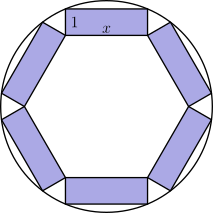
A round table has radius Six rectangular place mats are placed on the table. Each place mat has width and length as shown. They are positioned so that each mat has two corners on the edge of the table, these two corners being endpoints of the same side of length Further, the mats are positioned so that the inner corners each touch an inner corner of an adjacent mat. What is
Respuesta: C
Pista pequeña:
Para un mantel, sean sus esquinas exteriores y el punto diametralmente opuesto a entonces es rectángulo con .
For one mat, let be its outer corners and the point diametrically opposite then is right-angled with
Pista grande:
Las esquinas interiores forman triángulos isósceles con ángulo en el vértice aportando un segmento de longitud .
The inner corners form isosceles triangles with vertex angle contributing a segment of length
Solución:
Tomemos un mantel con esquinas exteriores y y sea el punto del borde de la mesa diametralmente opuesto a Entonces es un diámetro, así que tiene un ángulo recto en con
A lo largo de las esquinas interiores de manteles vecinos se encuentran en un triángulo isósceles con dos lados de longitud y ángulo en el vértice cuya base es Por lo tanto
El Teorema de Pitágoras da que se simplifica a
Tomando la raíz positiva,
Por lo tanto, C es la respuesta correcta.
Take one mat with outer corners and and let be the point of the table’s edge diametrically opposite Then is a diameter, so has a right angle at with
Along the inner corners of neighboring mats meet in an isosceles triangle with two sides of length and vertex angle whose base is Hence
The Pythagorean Theorem gives which simplifies to
Taking the positive root,
Thus, C is the correct answer.
23.
Las soluciones de la ecuación son los vértices de un polígono convexo en el plano complejo. ¿Cuál es el área del polígono?
The solutions of the equation are the vertices of a convex polygon in the complex plane. What is the area of the polygon?
Respuesta: D
Pista pequeña:
Suma a ambos lados para reconocer una cuarta potencia perfecta.
Add to both sides to recognize a perfect fourth power
Pista grande:
Los cuatro valores de están igualmente espaciados en un círculo de radio formando un cuadrado.
The four values of lie equally spaced on a circle of radius forming a square
Solución:
Sumando a ambos lados, el lado izquierdo se convierte en así que
Las cuatro soluciones para están igualmente espaciadas en un círculo de radio y forman un cuadrado. Restar solo lo traslada.
Un cuadrado inscrito en un círculo de radio tiene diagonal así que su lado es
El área es
Por lo tanto, D es la respuesta correcta.
Adding to both sides, the left side becomes so
The four solutions for are equally spaced on a circle of radius and they form a square. Subtracting merely translates it.
A square inscribed in a circle of radius has diagonal so its side is
The area is
Thus, D is the correct answer.
24.
El triángulo tiene y El punto es el punto medio de ¿Cuál es el mayor valor posible de ?
Triangle has and Point is the midpoint of What is the largest possible value of
Respuesta: D
Pista pequeña:
Coloca y con .
Place and with
Pista grande:
Usar las pendientes da maximiza sobre .
Using slopes gives maximize over
Solución:
Coloca de modo que y y sea con Entonces es el punto medio de
Los vectores y tienen producto vectorial de magnitud y producto escalar que siempre es positivo. Por lo tanto
La derivada tiene el signo de así que el único máximo se alcanza en Sustituyendo,
Por lo tanto, D es la respuesta correcta.
Place so that and and let with Then is the midpoint of
The vectors and have cross-product magnitude and dot product which is always positive. Hence
The derivative has the sign of so the unique maximum occurs at Substituting,
Thus, D is the correct answer.
25.
Una sucesión de puntos en el plano coordenado satisface Supongamos que ¿Cuánto vale ?
A sequence of points in the coordinate plane satisfies Suppose that What is
Respuesta: D
Pista pequeña:
Escribe la recurrencia se convierte en .
Write the recurrence becomes
Pista grande:
Como aplica el teorema de De Moivre a .
Since apply De Moivre’s theorem to
Solución:
Sea Entonces así que y
Como el teorema de De Moivre da Como es coterminal con esto es igual a
Así de modo que
Entonces y así que
Por lo tanto, D es la respuesta correcta.
Let Then so and
Since De Moivre’s theorem gives As is coterminal with this equals
Thus so
Then and so
Thus, D is the correct answer.