
2018 AIME II Problema 4
Intenta el Problema 4 del 2018 AIME II a continuación y luego compara tu respuesta con la solución preparada profesionalmente de LIVE by Po-Shen Loh. También puedes intentar el examen cronometrado completo, ver todas las soluciones del 2018 AIME II, o revisar la clave de respuestas.
Todos los problemas se usan con el permiso legal oficial de la Mathematical Association of America (MAA).
4.
En el octágono equiangular se tiene y El octágono autointersecante encierra seis regiones triangulares que no se solapan. Sea el área encerrada por es decir, el área total de las seis regiones triangulares. Entonces donde y son enteros positivos primos entre sí. Halla
In equiangular octagon and The self-intersecting octagon encloses six non-overlapping triangular regions. Let be the area enclosed by that is, the total area of the six triangular regions. Then where and are relatively prime positive integers. Find
Respuesta: 23
Pista pequeña:
Coloca el octágono en una cuadrícula: los lados de son diagonales de cuadrados unitarios, así que los ocho vértices son puntos de la red
Place the octagon on a grid: the sides are diagonals of unit squares, so all eight vertices are lattice points
Pista grande:
El camino tiene una simetría de rotación de ; halla dónde los segmentos y cortan al segmento y entre sí
The path has a rotational symmetry; find where segments and cross segment and each other
Solución:
Como los ángulos interiores son todos de y los lados de son diagonales de cuadrados unitarios, el octágono encaja en una red: El camino queda invariante bajo la rotación de alrededor de Sean y los puntos donde y cortan a y sea El segmento tiene pendiente así que y por simetría y
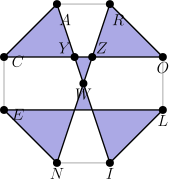
Las seis regiones encerradas son los cuatro triángulos congruentes de las esquinas, como , y los dos pequeños triángulos congruentes, como El triángulo tiene base y altura así que su área es El triángulo tiene base y altura así que su área es Por lo tanto y
Since the interior angles are all and the sides are diagonals of unit squares, the octagon fits on a lattice: The path is carried to itself by the rotation about Let and be the points where and cross and let Segment has slope so and by symmetry and
The six enclosed regions are the four congruent corner triangles like and the two small congruent triangles like Triangle has base and height so its area is Triangle has base and height so its area is Therefore and
El Problema 4 en otros años
1983 AIME · 1984 AIME · 1985 AIME · 1986 AIME · 1987 AIME · 1988 AIME · 1989 AIME · 1990 AIME · 1991 AIME · 1992 AIME · 1993 AIME · 1994 AIME · 1995 AIME · 1996 AIME · 1997 AIME · 1998 AIME · 1999 AIME · 2000 AIME I · 2000 AIME II · 2001 AIME I · 2001 AIME II · 2002 AIME I · 2002 AIME II · 2003 AIME I · 2003 AIME II · 2004 AIME I · 2004 AIME II · 2005 AIME I · 2005 AIME II · 2006 AIME I · 2006 AIME II · 2007 AIME I · 2007 AIME II · 2008 AIME I · 2008 AIME II · 2009 AIME I · 2009 AIME II · 2010 AIME I · 2010 AIME II · 2011 AIME I · 2011 AIME II · 2012 AIME I · 2012 AIME II · 2013 AIME I · 2013 AIME II · 2014 AIME I · 2014 AIME II · 2015 AIME I · 2015 AIME II · 2016 AIME I · 2016 AIME II · 2017 AIME I · 2017 AIME II · 2018 AIME I · 2019 AIME I · 2019 AIME II · 2020 AIME I · 2020 AIME II · 2021 AIME I · 2021 AIME II · 2022 AIME I · 2022 AIME II · 2023 AIME I · 2023 AIME II · 2024 AIME I · 2024 AIME II · 2025 AIME I · 2025 AIME II · 2026 AIME I · 2026 AIME II