2000 AIME I Problema 4

A continuación está la solución preparada profesionalmente para el Problema 4 del 2000 AIME I, de LIVE by Po-Shen Loh. También puedes intentar el examen cronometrado completo, ver todas las soluciones del 2000 AIME I, o revisar la clave de respuestas.

Todos los problemas se usan con el permiso legal oficial de la Mathematical Association of America (MAA).

Conceptos:rectángulocuadrado (geometría)sistema de ecuaciones

Nivel de dificultad: 2400

4.

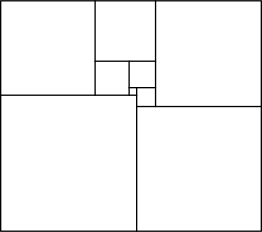
El diagrama muestra un rectángulo que ha sido dividido en nueve cuadrados que no se superponen. Dado que el ancho y el alto del rectángulo son enteros positivos primos entre sí, halla el perímetro del rectángulo.

The diagram shows a rectangle that has been dissected into nine non-overlapping squares. Given that the width and the height of the rectangle are relatively prime positive integers, find the perimeter of the rectangle.

Solución:

Sea xx el lado del cuadrado más pequeño (en el centro) y yy el lado del cuadrado pequeño justo debajo y a su derecha. Siguiendo las longitudes de los bordes por la figura, los cuadrados restantes tienen lados x+y,x + y, luego (x+y)+x=2x+y,(x + y) + x = 2x + y, luego (x+y)+(2x+y)=3x+2y,(x + y) + (2x + y) = 3x + 2y, luego (2x+y)+(3x+2y)=5x+3y(2x + y) + (3x + 2y) = 5x + 3y (el cuadrado superior izquierdo). El cuadrado alto de la derecha abarca los tres anteriores a lo largo de su borde izquierdo menos los solapes, lo que da lado 4x+4y;4x + 4y; el cuadrado inferior derecho tiene lado (4x+4y)+y=4x+5y;(4x + 4y) + y = 4x + 5y; y el cuadrado inferior izquierdo tiene lado xx +(2x+y)+ (2x + y) +(5x+3y)+ (5x + 3y) =8x+4y.= 8x + 4y.

Midiendo el alto del rectángulo por sus lados izquierdo y derecho, (8x+4y)+(5x+3y)=(4x+5y)+(4x+4y), \begin{aligned} &(8x + 4y) + (5x + 3y) \\ &= (4x + 5y) \\ &\quad {}+ (4x + 4y), \end{aligned} lo que se simplifica a 5x=2y.5x = 2y. Tomando los menores enteros positivos, x=2x = 2 y y=5,y = 5, los nueve cuadrados tienen lados 2,5,7,9,16,25,28,33,36,2, 5, 7, 9, 16, 25, 28, 33, 36, y el rectángulo es (36+33)×(36+25)=69×61.(36 + 33) \times (36 + 25) = 69 \times 61. Estas dimensiones son primas entre sí (cualquier escalado común lo rompería), y las áreas concuerdan: 6961=420969 \cdot 61 = 4209 es igual a la suma de las áreas de los nueve cuadrados.

El perímetro es 2(69+61)=260.2(69 + 61) = 260.

Let the tiniest square (in the middle) have side xx and the small square just below and to its right have side y.y. Chasing edge lengths through the figure, the remaining squares have sides x+y,x + y, then (x+y)+x=2x+y,(x + y) + x = 2x + y, then (x+y)+(2x+y)=3x+2y,(x + y) + (2x + y) = 3x + 2y, then (2x+y)+(3x+2y)=5x+3y(2x + y) + (3x + 2y) = 5x + 3y (the top-left square). The tall square on the right spans the previous three along its left edge minus overlaps, giving side 4x+4y;4x + 4y; the bottom-right square has side (4x+4y)+y=4x+5y;(4x + 4y) + y = 4x + 5y; and the bottom-left square has side xx +(2x+y)+ (2x + y) +(5x+3y)+ (5x + 3y) =8x+4y.= 8x + 4y.

Measuring the rectangle's height along its left and right sides, (8x+4y)+(5x+3y)=(4x+5y)+(4x+4y), \begin{aligned} &(8x + 4y) + (5x + 3y) \\ &= (4x + 5y) \\ &\quad {}+ (4x + 4y), \end{aligned} which simplifies to 5x=2y.5x = 2y. Taking the smallest positive integers, x=2x = 2 and y=5,y = 5, the nine squares have sides 2,5,7,9,16,25,28,33,36,2, 5, 7, 9, 16, 25, 28, 33, 36, and the rectangle is (36+33)×(36+25)=69×61.(36 + 33) \times (36 + 25) = 69 \times 61. These dimensions are relatively prime (any common scaling would break that), and the areas check: 6961=420969 \cdot 61 = 4209 equals the sum of the nine squares' areas.

The perimeter is 2(69+61)=260.2(69 + 61) = 260.

← Problema 3#3Examen completoProblema 5#5 →

El Problema 4 en otros años