2018 AIME II Problema 4

A continuación está la solución preparada profesionalmente para el Problema 4 del 2018 AIME II, de LIVE by Po-Shen Loh. También puedes intentar el examen cronometrado completo, ver todas las soluciones del 2018 AIME II, o revisar la clave de respuestas.

Todos los problemas se usan con el permiso legal oficial de la Mathematical Association of America (MAA).

Conceptos:polígono equiángulogeometría analíticadescomposición de áreassimetría

Nivel de dificultad: 2640

4.

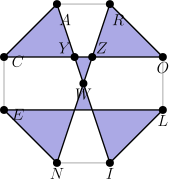
En el octágono equiangular CAROLINE,CAROLINE, se tiene CA=RO=LI=NE=2CA = RO = LI = NE = \sqrt{2} y AR=OL=IN=EC=1.AR = OL = IN = EC = 1. El octágono autointersecante CORNELIACORNELIA encierra seis regiones triangulares que no se solapan. Sea KK el área encerrada por CORNELIA,CORNELIA, es decir, el área total de las seis regiones triangulares. Entonces K=ab,K = \frac{a}{b}, donde aa y bb son enteros positivos primos entre sí. Halla a+b.a + b.

In equiangular octagon CAROLINE,CAROLINE, CA=RO=LI=NE=2CA = RO = LI = NE = \sqrt{2} and AR=OL=IN=EC=1.AR = OL = IN = EC = 1. The self-intersecting octagon CORNELIACORNELIA encloses six non-overlapping triangular regions. Let KK be the area enclosed by CORNELIA,CORNELIA, that is, the total area of the six triangular regions. Then K=ab,K = \frac{a}{b}, where aa and bb are relatively prime positive integers. Find a+b.a + b.

Solución:

Como los ángulos interiores son todos de 135135^\circ y los lados de 2\sqrt{2} son diagonales de cuadrados unitarios, el octágono encaja en una red: C=(0,0),C = (0, 0), A=(1,1),A = (1, 1), R=(2,1),R = (2, 1), O=(3,0),O = (3, 0), L=(3,1),L = (3, -1), I=(2,2),I = (2, -2), N=(1,2),N = (1, -2), E=(0,1).E = (0, -1). El camino CORNELIACORNELIA queda invariante bajo la rotación de 180180^\circ alrededor de (32,12).(\tfrac{3}{2}, -\tfrac{1}{2}). Sean YY y ZZ los puntos donde AIAI y RNRN cortan a CO,CO, y sea W=AIRN.W = AI \cap RN. El segmento AIAI tiene pendiente 3,-3, así que Y=(43,0),Y = (\tfrac{4}{3}, 0), y por simetría Z=(53,0)Z = (\tfrac{5}{3}, 0) y W=(32,12).W = (\tfrac{3}{2}, -\tfrac{1}{2}).

Las seis regiones encerradas son los cuatro triángulos congruentes de las esquinas, como CAYCAY, y los dos pequeños triángulos congruentes, como YZW.YZW. El triángulo CAYCAY tiene base CY=43CY = \tfrac{4}{3} y altura 1,1, así que su área es 23.\tfrac{2}{3}. El triángulo YZWYZW tiene base YZ=13YZ = \tfrac{1}{3} y altura 12,\tfrac{1}{2}, así que su área es 112.\tfrac{1}{12}. Por lo tanto K=423+2112=83+16=176, \begin{aligned} K &= 4 \cdot \frac{2}{3} + 2 \cdot \frac{1}{12} \\ &= \frac{8}{3} + \frac{1}{6} = \frac{17}{6}, \end{aligned} y a+b=17+6=23.a + b = 17 + 6 = 23.

Since the interior angles are all 135135^\circ and the 2\sqrt{2} sides are diagonals of unit squares, the octagon fits on a lattice: C=(0,0),C = (0, 0), A=(1,1),A = (1, 1), R=(2,1),R = (2, 1), O=(3,0),O = (3, 0), L=(3,1),L = (3, -1), I=(2,2),I = (2, -2), N=(1,2),N = (1, -2), E=(0,1).E = (0, -1). The path CORNELIACORNELIA is carried to itself by the 180180^\circ rotation about (32,12).(\tfrac{3}{2}, -\tfrac{1}{2}). Let YY and ZZ be the points where AIAI and RNRN cross CO,CO, and let W=AIRN.W = AI \cap RN. Segment AIAI has slope 3,-3, so Y=(43,0),Y = (\tfrac{4}{3}, 0), and by symmetry Z=(53,0)Z = (\tfrac{5}{3}, 0) and W=(32,12).W = (\tfrac{3}{2}, -\tfrac{1}{2}).

The six enclosed regions are the four congruent corner triangles like CAYCAY and the two small congruent triangles like YZW.YZW. Triangle CAYCAY has base CY=43CY = \tfrac{4}{3} and height 1,1, so its area is 23.\tfrac{2}{3}. Triangle YZWYZW has base YZ=13YZ = \tfrac{1}{3} and height 12,\tfrac{1}{2}, so its area is 112.\tfrac{1}{12}. Therefore K=423+2112=83+16=176, \begin{aligned} K &= 4 \cdot \frac{2}{3} + 2 \cdot \frac{1}{12} \\ &= \frac{8}{3} + \frac{1}{6} = \frac{17}{6}, \end{aligned} and a+b=17+6=23.a + b = 17 + 6 = 23.

← Problema 3#3Examen completoProblema 5#5 →

El Problema 4 en otros años