
Problemas del 2000 AIME I
¡Desplázate hacia abajo y presiona Iniciar para intentar el examen! O ve al PDF imprimible, la clave de respuestas, o las soluciones profesionales preparadas por LIVE by Po-Shen Loh.
Todos los problemas se usan con el permiso legal oficial de la Mathematical Association of America (MAA).
O salta directamente a un solo problema con su solución: 1 · 2 · 3 · 4 · 5 · 6 · 7 · 8 · 9 · 10 · 11 · 12 · 13 · 14 · 15
¿Quieres aprender de forma profesional con clases interactivas en video?
Con tiempo
3:00:00
1.
Halla el menor entero positivo tal que, sin importar cómo se exprese como producto de dos enteros positivos cualesquiera, al menos uno de esos dos enteros contenga el dígito
Find the least positive integer such that no matter how is expressed as the product of any two positive integers, at least one of these two integers contains the digit
Respuesta: 8
Pista pequeña:
Todo factor de tiene la forma y cualquier factor divisible a la vez por y por termina en el dígito
Every factor of has the form and any factor divisible by both and ends in the digit
Pista grande:
Así que la única separación candidata es halla el primer para el cual o contenga un dígito
So the only candidate splitting is find the first for which or contains a digit
Solución:
Toda factorización es Si un factor es divisible a la vez por y por es un múltiplo de y termina en el dígito Así que la única factorización posible sin ceros es y necesitamos el menor para el cual o contenga un dígito
Las potencias son , sin ceros. Las potencias son , sin ceros, pero contiene un
Por lo tanto, toda factorización de contiene un dígito mientras que no, así que la respuesta es
Every factorization is If a factor is divisible by both and it is a multiple of and ends in the digit So the only possible zero-free factorization is and we need the least for which or contains a digit
The powers are — no zeros. The powers are — no zeros — but contains a
Hence every factorization of contains a digit while does not, so the answer is
2.
Sean y enteros que satisfacen Sea sea la reflexión de respecto a la recta sea la reflexión de respecto al eje , sea la reflexión de respecto al eje , y sea la reflexión de respecto al eje . El área del pentágono es Halla
Let and be integers satisfying Let let be the reflection of across the line let be the reflection of across the -axis, let be the reflection of across the -axis, and let be the reflection of across the -axis. The area of pentagon is Find
Respuesta: 21
Pista pequeña:
Calcula los vértices:
Compute the vertices:
Pista grande:
El pentágono es un rectángulo más un triángulo; su área se factoriza como y
The pentagon is a rectangle plus a triangle; its area factors as and
Solución:
Al efectuar las reflexiones, y Los puntos forman un rectángulo de ancho y alto con área y sobresale hacia su derecha. El triángulo tiene base vertical de longitud y altura horizontal así que su área es
Por lo tanto, el área del pentágono es Como tenemos lo que descarta la factorización Así que y lo que da que en efecto satisface
Por lo tanto,
Carrying out the reflections, and The points form a rectangle of width and height with area and sticks out to its right. Triangle has vertical base of length and horizontal height so its area is
The pentagon’s area is therefore Since we have which rules out the factorization So and giving which indeed satisfies
Thus
3.
En el desarrollo de donde y son enteros positivos primos entre sí, los coeficientes de y son iguales. Halla
In the expansion of where and are relatively prime positive integers, the coefficients of and are equal. Find
Respuesta: 667
Pista pequeña:
Iguala los coeficientes y
Set the coefficients and equal
Pista grande:
Cancela los factores comunes para obtener y luego usa que y son primos entre sí
Cancel common factors to get then use that and are relatively prime
Solución:
Por el teorema del binomio, los coeficientes de y son y Igualándolos y cancelando se obtiene de modo que
Como debe ser y así que
By the binomial theorem, the coefficients of and are and Setting them equal and cancelling gives so
Since we must have and so
4.
El diagrama muestra un rectángulo que ha sido dividido en nueve cuadrados que no se superponen. Dado que el ancho y el alto del rectángulo son enteros positivos primos entre sí, halla el perímetro del rectángulo.
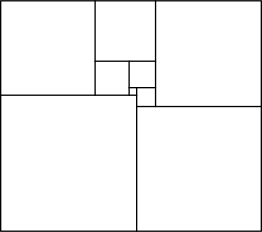
The diagram shows a rectangle that has been dissected into nine non-overlapping squares. Given that the width and the height of the rectangle are relatively prime positive integers, find the perimeter of the rectangle.
Respuesta: 260
Pista pequeña:
Sean y los lados de los dos cuadrados más pequeños, y expresa el lado de cada uno de los demás cuadrados en términos de ellos
Let the two smallest squares have sides and and express every other square’s side in terms of them
Pista grande:
Iguala las dos expresiones para el alto del rectángulo (lado izquierdo frente a lado derecho) para obtener
Equate the two expressions for the rectangle’s height (left side versus right side) to get
Solución:
Sea el lado del cuadrado más pequeño (en el centro) y el lado del cuadrado pequeño justo debajo y a su derecha. Siguiendo las longitudes de los bordes por la figura, los cuadrados restantes tienen lados luego luego luego (el cuadrado superior izquierdo). El cuadrado alto de la derecha abarca los tres anteriores a lo largo de su borde izquierdo menos los solapes, lo que da lado el cuadrado inferior derecho tiene lado y el cuadrado inferior izquierdo tiene lado
Midiendo el alto del rectángulo por sus lados izquierdo y derecho, lo que se simplifica a Tomando los menores enteros positivos, y los nueve cuadrados tienen lados y el rectángulo es Estas dimensiones son primas entre sí (cualquier escalado común lo rompería), y las áreas concuerdan: es igual a la suma de las áreas de los nueve cuadrados.
El perímetro es
Let the tiniest square (in the middle) have side and the small square just below and to its right have side Chasing edge lengths through the figure, the remaining squares have sides then then then (the top-left square). The tall square on the right spans the previous three along its left edge minus overlaps, giving side the bottom-right square has side and the bottom-left square has side
Measuring the rectangle’s height along its left and right sides, which simplifies to Taking the smallest positive integers, and the nine squares have sides and the rectangle is These dimensions are relatively prime (any common scaling would break that), and the areas check: equals the sum of the nine squares’ areas.
The perimeter is
5.
Cada una de dos cajas contiene canicas negras y blancas, y el número total de canicas en las dos cajas es Se saca una canica de cada caja al azar. La probabilidad de que ambas canicas sean negras es y la probabilidad de que ambas canicas sean blancas es donde y son enteros positivos primos entre sí. ¿Cuánto vale ?
Each of two boxes contains both black and white marbles, and the total number of marbles in the two boxes is One marble is taken out of each box randomly. The probability that both marbles are black is and the probability that both marbles are white is where and are relatively prime positive integers. What is
Respuesta: 26
Pista pequeña:
Si las cajas tienen y canicas, entonces es divisible por ya que la probabilidad negra-negra tiene denominador
If the boxes hold and marbles, then is divisible by since the black-black probability has denominator
Pista grande:
Con solo funcionan y ; halla las cantidades de negras cuyo producto sea
With only and work; find black counts whose product is
Solución:
Supongamos que las cajas tienen y canicas con y contienen y canicas negras. Entonces así que y como necesitamos que sea divisible por Comprobando para solo y dan un múltiplo de
Para tamaños y y como cada caja tiene además una canica blanca, y lo que obliga a Las cantidades de blancas son y así que la probabilidad blanca-blanca es Para tamaños y y obligan a Las cantidades de blancas son y lo que da de nuevo.
En cualquier caso la probabilidad es así que
Say the boxes hold and marbles with containing and black marbles. Then so and since we need to be divisible by Checking for only and give a multiple of
For sizes and and since each box also holds a white marble, and forcing The white counts are and so the white-white probability is For sizes and and force The white counts are and giving again.
Either way the probability is so
6.
¿Para cuántos pares ordenados de enteros se cumple que y que la media aritmética de y es exactamente mayor que la media geométrica de y ?
For how many ordered pairs of integers is it true that and that the arithmetic mean of and is exactly more than the geometric mean of and
Respuesta: 997
Pista pequeña:
La condición se reordena a , así que .
The condition rearranges to so
Pista grande:
Demuestra que debe ser un entero, de modo que e ; luego cuenta los con
Show must be an integer, so and count the with
Solución:
La condición es es decir, así que y (como ) Nota que es racional, por lo que también es racional, así que y son racionales, y una raíz cuadrada racional de un entero es un entero.
Por lo tanto, e para un entero positivo La restricción significa así que recorre y cada valor da un par válido.
Por lo tanto, hay pares ordenados.
The condition is that is, so and (as ) Note is rational, hence is rational too, so and are rational — and a rational square root of an integer is an integer.
Therefore and for a positive integer The constraint means so ranges over and each value gives a valid pair.
Hence there are ordered pairs.
7.
Supongamos que y son tres números positivos que satisfacen las ecuaciones y Entonces donde y son enteros positivos primos entre sí. Halla
Suppose that and are three positive numbers that satisfy the equations and Then where and are relatively prime positive integers. Find
Respuesta: 5
Pista pequeña:
Multiplica las tres expresiones y desarrolla.
Multiply the three expressions together and expand
Pista grande:
Como el producto es igual a más la suma de esas mismas tres expresiones.
Because the product equals plus the sum of the same three expressions
Solución:
Sea Desarrollando el producto de las tres expresiones, Como el lado izquierdo es y el lado derecho es
Así que lo que da Por lo tanto,
Let Expanding the product of all three expressions, Since the left side is and the right side is
So giving Thus
8.
Un recipiente con forma de cono circular recto mide pulgadas de alto y su base tiene un radio de pulgadas. El líquido sellado en su interior tiene pulgadas de profundidad cuando el cono se sostiene con la punta hacia abajo y su base horizontal. Cuando el cono se sostiene con la punta hacia arriba y su base horizontal, el líquido tiene pulgadas de profundidad, donde y son enteros positivos y no es divisible por el cubo de ningún número primo. Halla
A container in the shape of a right circular cone is inches tall and its base has a -inch radius. The liquid that is sealed inside is inches deep when the cone is held with its point down and its base horizontal. When the cone is held with its point up and its base horizontal, the liquid is inches deep, where and are positive integers and is not divisible by the cube of any prime number. Find
Respuesta: 52
Pista pequeña:
Con la punta hacia abajo, el líquido es un cono semejante al recipiente con razón así que llena del volumen.
Point down, the liquid is a cone similar to the container with ratio so it fills of the volume
Pista grande:
Con la punta hacia arriba, el espacio vacío es un cono semejante en la parte superior; su parte del volumen es así que toma una raíz cúbica para obtener su altura.
Point up, the empty space is a similar cone at the top; its share of the volume is so take a cube root to get its height
Solución:
Sostenido con la punta hacia abajo, el líquido forma un cono semejante al recipiente con razón así que su volumen es del volumen del recipiente.
Sostenido con la punta hacia arriba, el espacio vacío es un cono semejante en el vértice con del volumen, así que su altura es pulgadas. Por lo tanto, el líquido tiene pulgadas de profundidad.
Como no tiene factores cúbicos,
Held point down, the liquid forms a cone similar to the container with ratio so its volume is of the container’s volume.
Held point up, the empty space is a similar cone at the apex with of the volume, so its height is inches. The liquid is therefore inches deep.
Since is cube-free,
9.
El sistema de ecuaciones tiene dos soluciones y Halla
The system of equations has two solutions and Find
Respuesta: 25
Pista pequeña:
Sustituye para que cada ecuación sea polinómica en
Substitute to make each equation polynomial in
Pista grande:
Cada ecuación se factoriza: las dos primeras se convierten en y la tercera
Each equation factors: the first two become and the third
Solución:
Sea Usando la primera ecuación se convierte en que se factoriza como De forma similar, la segunda ecuación da y la tercera da
Dividiendo las dos primeras (nota que ) se obtiene y entonces la tercera ecuación da así que Si entonces así que e (en efecto funciona). Si entonces así que e (de ).
Por lo tanto,
Let Using the first equation becomes which factors as Similarly the second equation gives and the third gives
Dividing the first two (note ) yields and then the third equation gives so If then so and (indeed works). If then so and (from ).
Therefore
10.
Una sucesión de números tiene la propiedad de que, para todo entero entre y inclusive, el número es menor que la suma de los otros números. Dado que donde y son enteros positivos primos entre sí, halla
A sequence of numbers has the property that, for every integer between and inclusive, the number is less than the sum of the other numbers. Given that where and are relatively prime positive integers, find
Respuesta: 173
Pista pequeña:
Si es la suma de los números, la condición dice .
If is the sum of all numbers, the condition says
Pista grande:
Despeja en términos de y luego suma las ecuaciones para hallar
Solve for in terms of and then add up all equations to find
Solución:
Sea La condición dice así que para todo Sumando sobre así que y
Entonces que está en su forma más simple, así que
Let The condition says so for every Summing over so and
Then which is in lowest terms, so
11.
Sea la suma de todos los números de la forma donde y son divisores positivos de primos entre sí. ¿Cuál es el mayor entero que no excede ?
Let be the sum of all numbers of the form where and are relatively prime positive divisors of What is the greatest integer that does not exceed
Respuesta: 248
Pista pequeña:
Como y son coprimos, el primo aparece en a lo sumo uno de ellos, y lo mismo para
Since and are coprime, the prime appears in at most one of them, and likewise for
Pista grande:
Así que se factoriza como por la suma análoga con potencias de
So factors as times the analogous sum with s
Solución:
Escribe y con exponentes entre y La coprimalidad significa que y y estas dos restricciones son independientes. Así, cuando recorre todos los pares coprimos, el factor toma independientemente cada valor de exactamente una vez, y de forma similar Por lo tanto
Esto es igual a así que y el mayor entero que no lo excede es
Write and with exponents between and Coprimality means and and these two constraints are independent. So as runs over all coprime pairs, the factor independently takes each value in exactly once, and similarly for Hence
This equals so and the greatest integer not exceeding it is
12.
Dada una función para la cual se cumple para todo real, ¿cuál es la mayor cantidad de valores diferentes que pueden aparecer en la lista ?
Given a function for which holds for all real what is the largest number of different values that can appear in the list
Respuesta: 177
Pista pequeña:
Dos simetrías de reflexión se componen en una traslación: obliga a y de forma similar
Two reflection symmetries compose to a translation: forces and similarly
Pista grande:
Así que tiene periodo más la simetría cuenta los residuos módulo considerando ese emparejamiento
So has period plus the symmetry count residues mod up to that pairing
Solución:
Como para todo sustituyendo se obtiene del mismo modo da periodo Combinando, tiene periodo Reduciendo módulo la simetría se convierte en
Así que queda determinada por los residuos módulo con los residuos y obligados a compartir un valor. Este emparejamiento tiene exactamente dos puntos fijos, de y Por lo tanto, hay a lo sumo clases, y como cubre todos los residuos módulo la lista contiene a lo sumo valores diferentes.
Esto es alcanzable: satisface las tres simetrías dadas (cada uno de es módulo ), y dos enteros reciben valores iguales solo cuando sus residuos están emparejados. Así que la respuesta es
Since for all substituting gives likewise gives period Combining, has period Reducing mod the symmetry becomes
So is determined by residues mod with residues and forced to share a value. This pairing has exactly two fixed points, from and Hence there are at most classes, and since covers every residue mod the list contains at most different values.
This is achievable: satisfies all three given symmetries (each of is mod ), and two integers get equal values only when their residues are paired. So the answer is
13.
En medio de una vasta pradera, un camión de bomberos está estacionado en la intersección de dos carreteras rectas perpendiculares. El camión viaja a millas por hora por las carreteras y a millas por hora a través de la pradera. Considera el conjunto de puntos que el camión de bomberos puede alcanzar en seis minutos. El área de esta región es millas cuadradas, donde y son enteros positivos primos entre sí. Halla
In the middle of a vast prairie, a firetruck is stationed at the intersection of two perpendicular straight highways. The truck travels at miles per hour along the highways and at miles per hour across the prairie. Consider the set of points that can be reached by the firetruck within six minutes. The area of this region is square miles, where and are relatively prime positive integers. Find
Respuesta: 731
Pista pequeña:
En seis minutos el camión recorre millas por carretera o millas a través de la pradera. Trabaja en un cuadrante.
In six minutes the truck covers miles on highway or miles across the prairie. Work in one quadrant.
Pista grande:
Salir de la carretera en alcanza un disco de radio la unión de estos discos está limitada por la recta tangente desde a la circunferencia de radio
Leaving the highway at reaches a disk of radius the union of these disks is bounded by the tangent line from to the circle of radius
Solución:
En seis minutos el camión puede conducir millas por una carretera o millas a través de la pradera, y una ruta óptima es un tramo de carretera seguido de un segmento recto por la pradera. Trabaja en el primer cuadrante con las carreteras como ejes. Conducir hasta toma horas, dejando un alcance por la pradera de millas. Cuando va de a estos discos se encogen linealmente hasta un punto, así que su unión es el “cono”: la envolvente convexa del disco de radio centrado en el origen y el punto limitada por la recta tangente desde La longitud de la tangente es así que las razones son -- y la recta tangente es El eje da la región especular limitada por
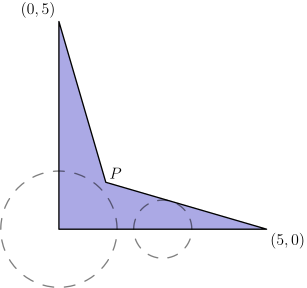
Las dos rectas tangentes se cruzan en que está a distancia del origen (fuera de la circunferencia), así que en el primer cuadrante el conjunto alcanzable es exactamente el cuadrilátero (no convexo) con vértices Dividiéndolo por la diagonal desde el origen hasta se obtienen dos triángulos, cada uno con área para un área por cuadrante de
La región completa son cuatro copias, con área millas cuadradas. Como la respuesta es
In six minutes the truck can drive miles on a highway or miles across the prairie, and an optimal route is a highway stretch followed by a straight prairie segment. Work in the first quadrant with the highways as axes. Driving to takes hours, leaving a prairie range of miles. As runs from to these disks shrink linearly to a point, so their union is the “cone”: the convex hull of the disk of radius about the origin and the point bounded by the tangent line from The tangent length is so the ratios are –– and the tangent line is The -axis gives the mirror-image region bounded by
The two tangent lines meet at which lies at distance from the origin — outside the circle — so in the first quadrant the reachable set is exactly the (non-convex) quadrilateral with vertices Splitting it along the diagonal from the origin to gives two triangles, each with area for a quadrant area of
The full region is four copies, with area square miles. Since the answer is
14.
En el triángulo se sabe que los ángulos y son congruentes. Los puntos y están sobre y respectivamente, de modo que El ángulo mide veces lo que mide el ángulo donde es un número real positivo. Halla el mayor entero que no excede
In triangle it is given that angles and are congruent. Points and lie on and respectively, so that Angle is times as large as angle where is a positive real number. Find the greatest integer that does not exceed
Respuesta: 571
Pista pequeña:
Sea y El triángulo isósceles da y
Let and Isosceles triangle gives and
Pista grande:
Con la ley de senos da y se reduce a
With the law of sines gives and reduces to
Solución:
Sea y escala de modo que En el triángulo los lados iguales dan así que y, por la ley de senos, En el triángulo así que
Como Por la identidad de producto a suma, así que la ecuación se reduce a Entonces o pero este último hace que sea negativo, así que
Ahora y así que y
Let and scale so In triangle the equal sides give so and, by the law of sines, In triangle so
Since By the product-to-sum identity, so the equation collapses to Then or but the latter makes negative, so
Now and so and
15.
Una pila de cartas está etiquetada con los enteros del al con enteros diferentes en cartas diferentes. Las cartas de la pila no están en orden numérico. Se retira la carta superior de la pila y se coloca sobre la mesa, y la siguiente carta se mueve al fondo de la pila. La nueva carta superior se retira de la pila y se coloca sobre la mesa, a la derecha de la carta que ya está ahí, y la siguiente carta de la pila se mueve al fondo de la pila. El proceso —colocar la carta superior a la derecha de las cartas que ya están sobre la mesa y mover la siguiente carta de la pila al fondo de la pila— se repite hasta que todas las cartas están sobre la mesa. Se observa que, leyendo de izquierda a derecha, las etiquetas de las cartas están ahora en orden ascendente: En la pila original de cartas, ¿cuántas cartas había encima de la carta etiquetada ?
A stack of cards is labelled with the integers from to with different integers on different cards. The cards in the stack are not in numerical order. The top card is removed from the stack and placed on the table, and the next card is moved to the bottom of the stack. The new top card is removed from the stack and placed on the table, to the right of the card already there, and the next card in the stack is moved to the bottom of the stack. The process — placing the top card to the right of the cards already on the table and moving the next card in the stack to the bottom of the stack — is repeated until all cards are on the table. It is found that, reading from left to right, the labels on the cards are now in ascending order: In the original stack of cards, how many cards were above the card labelled
Respuesta: 927
Pista pequeña:
Rastrea las posiciones originales en una cola: retira la carta del frente, luego envía la siguiente carta al fondo. La carta etiquetada es la -ésima que se retira.
Track original positions in a queue: remove the front card, then send the next card to the back. The card labelled is the -th one removed.
Pista grande:
Cada pasada retira uno de cada dos supervivientes: primero las posiciones impares, luego las posiciones luego y así sucesivamente. Sigue el proceso hasta las últimas dos cartas.
Each pass removes every other survivor: first the odd positions, then positions then and so on. Follow the process down to the last two cards.
Solución:
Numera las posiciones originales de (arriba) a (abajo) y colócalas en una cola. Cada paso retira la posición del frente (que recibe la siguiente etiqueta ) y envía el nuevo frente al fondo. Así que la carta etiquetada es la penúltima carta retirada, y debemos hallar qué posición original sobrevive tanto tiempo.
La primera pasada retira las posiciones impares (etiquetas a ) y, como termina enviando al fondo, la siguiente pasada empieza de nuevo retirando el frente de la cola Las pasadas sucesivas retiran por tanto (las posiciones ), luego luego luego (las posiciones ). Esa última pasada recorrió un número impar () de cartas, así que la alternancia se desplaza: los múltiplos de supervivientes quedan ahora en la cola como
Continuando el mismo patrón de retirada desde esa cola, las siguientes rondas retiran luego luego luego luego y las dos últimas cartas retiradas son y Así que la etiqueta corresponde a la carta en la posición original que tenía cartas encima.
Number the original positions (top) through (bottom) and put them in a queue. Each step removes the front position (which receives the next label ) and sends the new front to the back. So the card labelled is the next-to-last card removed, and we must find which original position survives that long.
The first pass removes the odd positions (labels through ) and, since it ends by sending to the back, the next pass again starts by removing the front of the queue Successive passes therefore remove (the positions ), then then then (the positions ). That last pass ran through an odd number () of cards, so the alternation shifts: the surviving multiples of now sit in the queue as
Continuing the same removal pattern from that queue, the next rounds remove then then then then and the final two cards removed are and So label goes to the card at original position which had cards above it.