
2017 AIME I Problema 15
Intenta el Problema 15 del 2017 AIME I a continuación y luego compara tu respuesta con la solución preparada profesionalmente de LIVE by Po-Shen Loh. También puedes intentar el examen cronometrado completo, ver todas las soluciones del 2017 AIME I, o revisar la clave de respuestas.
Todos los problemas se usan con el permiso legal oficial de la Mathematical Association of America (MAA).
15.
El área del menor triángulo equilátero con un vértice en cada uno de los lados del triángulo rectángulo de lados de longitud y como se muestra, es donde y son enteros positivos, y son primos entre sí, y no es divisible por el cuadrado de ningún primo. Halla
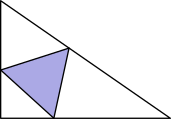
The area of the smallest equilateral triangle with one vertex on each of the sides of the right triangle with side lengths and as shown, is where and are positive integers, and are relatively prime, and is not divisible by the square of any prime. Find
Respuesta: 145
Pista pequeña:
Coloca los catetos sobre los ejes y deja que el lado entre los catetos vaya de a
Put the legs on the axes and let the side between the legs run from to
Pista grande:
Exigir que el tercer vértice esté sobre la hipotenusa da maximiza la combinación izquierda usando
Requiring the third vertex to lie on the hypotenuse gives maximize the left combination using
Solución:
Coloca el ángulo recto en el origen con vértices y de modo que la hipotenusa esté sobre la recta Sea el lado del triángulo equilátero entre los dos catetos con extremos y donde es la longitud del lado. Su punto medio es y moverse una distancia perpendicular al lado coloca el tercer vértice en
Sustituir este vértice en la ecuación de la hipotenusa y simplificar da El denominador es a lo sumo alcanzado para cierto valor admisible de así que la longitud mínima del lado satisface
El área mínima es así que
Place the right angle at the origin with vertices and so the hypotenuse lies on the line Let the equilateral triangle’s side between the two legs have endpoints and where is the side length. Its midpoint is and moving a distance perpendicular to the side places the third vertex at
Substituting this vertex into the hypotenuse equation and simplifying gives The denominator is at most attained for an admissible so the minimum side length satisfies
The minimum area is so
El Problema 15 en otros años
1983 AIME · 1984 AIME · 1985 AIME · 1986 AIME · 1987 AIME · 1988 AIME · 1989 AIME · 1990 AIME · 1991 AIME · 1992 AIME · 1993 AIME · 1994 AIME · 1995 AIME · 1996 AIME · 1997 AIME · 1998 AIME · 1999 AIME · 2000 AIME I · 2000 AIME II · 2001 AIME I · 2001 AIME II · 2002 AIME I · 2002 AIME II · 2003 AIME I · 2003 AIME II · 2004 AIME I · 2004 AIME II · 2005 AIME I · 2005 AIME II · 2006 AIME I · 2006 AIME II · 2007 AIME I · 2007 AIME II · 2008 AIME I · 2008 AIME II · 2009 AIME I · 2009 AIME II · 2010 AIME I · 2010 AIME II · 2011 AIME I · 2011 AIME II · 2012 AIME I · 2012 AIME II · 2013 AIME I · 2013 AIME II · 2014 AIME I · 2014 AIME II · 2015 AIME I · 2015 AIME II · 2016 AIME I · 2016 AIME II · 2017 AIME II · 2018 AIME I · 2018 AIME II · 2019 AIME I · 2019 AIME II · 2020 AIME I · 2020 AIME II · 2021 AIME I · 2021 AIME II · 2022 AIME I · 2022 AIME II · 2023 AIME I · 2023 AIME II · 2024 AIME I · 2024 AIME II · 2025 AIME I · 2025 AIME II · 2026 AIME I · 2026 AIME II