2002 AIME I Problema 15

A continuación está la solución preparada profesionalmente para el Problema 15 del 2002 AIME I, de LIVE by Po-Shen Loh. También puedes intentar el examen cronometrado completo, ver todas las soluciones del 2002 AIME I, o revisar la clave de respuestas.

Todos los problemas se usan con el permiso legal oficial de la Mathematical Association of America (MAA).

Conceptos:Geometría 3Dgeometría analíticafórmula de la distancia

Nivel de dificultad: 3160

15.

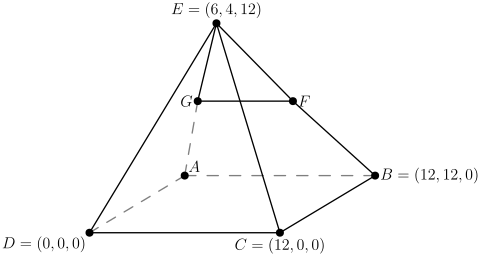
El poliedro ABCDEFGABCDEFG tiene seis caras. La cara ABCDABCD es un cuadrado con AB=12;AB = 12; la cara ABFGABFG es un trapecio con AB\overline{AB} paralelo a GF,\overline{GF}, BF=AG=8,BF = AG = 8, y GF=6;GF = 6; y la cara CDECDE cumple CE=DE=14.CE = DE = 14. Las otras tres caras son ADEG,ADEG, BCEF,BCEF, y EFG.EFG. La distancia de EE a la cara ABCDABCD es 12.12. Dado que EG2=pqr,EG^2 = p - q\sqrt{r}, donde p,p, q,q, y rr son enteros positivos y rr no es divisible por el cuadrado de ningún primo, halle p+q+r.p + q + r.

Polyhedron ABCDEFGABCDEFG has six faces. Face ABCDABCD is a square with AB=12;AB = 12; face ABFGABFG is a trapezoid with AB\overline{AB} parallel to GF,\overline{GF}, BF=AG=8,BF = AG = 8, and GF=6;GF = 6; and face CDECDE has CE=DE=14.CE = DE = 14. The other three faces are ADEG,ADEG, BCEF,BCEF, and EFG.EFG. The distance from EE to face ABCDABCD is 12.12. Given that EG2=pqr,EG^2 = p - q\sqrt{r}, where p,p, q,q, and rr are positive integers and rr is not divisible by the square of any prime, find p+q+r.p + q + r.

Solución:

Coloque D=(0,0,0),D = (0, 0, 0), C=(12,0,0),C = (12, 0, 0), B=(12,12,0),B = (12, 12, 0), A=(0,12,0),A = (0, 12, 0), y E=(x,y,12),E = (x, y, 12), usando la distancia dada de EE a la cara ABCD.ABCD. De CE=DECE = DE obtenemos x=6,x = 6, y luego DE=14DE = 14 da 36+y2+144=196,36 + y^2 + 144 = 196, así que y=4y = 4 y E=(6,4,12).E = (6, 4, 12).

En el trapecio ABFG,ABFG, GF\overline{GF} es paralelo a AB\overline{AB} con GF=6GF = 6 y AG=BF,AG = BF, así que GG y FF son simétricos respecto al plano x=6:x = 6: G=(3,y2,z2)G = (3, y_2, z_2) y F=(9,y2,z2).F = (9, y_2, z_2). La cara ADEGADEG es plana, y el plano que pasa por A,A, D,D, EE contiene toda la dirección del eje yy (tanto AA como DD tienen x=z=0x = z = 0), así que es el plano z=2x,z = 2x, que en efecto contiene a E.E. Por tanto z2=6.z_2 = 6. Ahora AG=8AG = 8 da 32+(y212)2+62=64,3^2 + (y_2 - 12)^2 + 6^2 = 64, así que y2=12±19.y_2 = 12 \pm \sqrt{19}.

Entonces EG2=32+(y24)2+62=45+(8±19)2=128±1619, \begin{aligned} EG^2 &= 3^2 + (y_2 - 4)^2 + 6^2 \\ &= 45 + \left(8 \pm \sqrt{19}\right)^2 \\ &= 128 \pm 16\sqrt{19}, \end{aligned} y la forma dada pqrp - q\sqrt{r} corresponde a 1281619.128 - 16\sqrt{19}. Así p+q+rp + q + r =128+16+19= 128 + 16 + 19 =163.= 163.

Place D=(0,0,0),D = (0, 0, 0), C=(12,0,0),C = (12, 0, 0), B=(12,12,0),B = (12, 12, 0), A=(0,12,0),A = (0, 12, 0), and E=(x,y,12),E = (x, y, 12), using the given distance from EE to face ABCD.ABCD. From CE=DECE = DE we get x=6,x = 6, and then DE=14DE = 14 gives 36+y2+144=196,36 + y^2 + 144 = 196, so y=4y = 4 and E=(6,4,12).E = (6, 4, 12).

In trapezoid ABFG,ABFG, GF\overline{GF} is parallel to AB\overline{AB} with GF=6GF = 6 and AG=BF,AG = BF, so GG and FF are symmetric about the plane x=6:x = 6: G=(3,y2,z2)G = (3, y_2, z_2) and F=(9,y2,z2).F = (9, y_2, z_2). Face ADEGADEG is planar, and the plane through A,A, D,D, EE contains the entire yy-axis direction (both AA and DD have x=z=0x = z = 0), so it is the plane z=2x,z = 2x, which indeed contains E.E. Hence z2=6.z_2 = 6. Now AG=8AG = 8 gives 32+(y212)2+62=64,3^2 + (y_2 - 12)^2 + 6^2 = 64, so y2=12±19.y_2 = 12 \pm \sqrt{19}.

Then EG2=32+(y24)2+62=45+(8±19)2=128±1619, \begin{aligned} EG^2 &= 3^2 + (y_2 - 4)^2 + 6^2 \\ &= 45 + \left(8 \pm \sqrt{19}\right)^2 \\ &= 128 \pm 16\sqrt{19}, \end{aligned} and the stated form pqrp - q\sqrt{r} corresponds to 1281619.128 - 16\sqrt{19}. Thus p+q+rp + q + r =128+16+19= 128 + 16 + 19 =163.= 163.

← Problema 14#14Examen completo

El Problema 15 en otros años