2008 AIME I Problema 15

A continuación está la solución preparada profesionalmente para el Problema 15 del 2008 AIME I, de LIVE by Po-Shen Loh. También puedes intentar el examen cronometrado completo, ver todas las soluciones del 2008 AIME I, o revisar la clave de respuestas.

Todos los problemas se usan con el permiso legal oficial de la Mathematical Association of America (MAA).

Conceptos:plegado de papelGeometría 3Dley de los senosTeorema de Pitágoras

Nivel de dificultad: 3370

15.

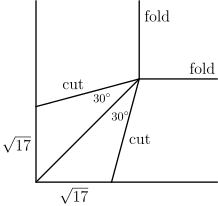
Una hoja de papel cuadrada tiene lados de longitud 100.100. De cada esquina se corta una cuña de la siguiente manera: en cada esquina, los dos cortes de la cuña comienzan cada uno a distancia 17\sqrt{17} de la esquina, y se encuentran sobre la diagonal formando un ángulo de 6060^\circ (ver la figura de abajo). Luego el papel se pliega hacia arriba a lo largo de las líneas que unen los vértices de cortes adyacentes. Cuando los dos bordes de un corte se encuentran, se pegan con cinta. El resultado es una bandeja de papel cuyos lados no forman ángulos rectos con la base. La altura de la bandeja, es decir, la distancia perpendicular entre el plano de la base y el plano formado por los bordes superiores, puede escribirse en la forma mn,\sqrt[n]{m}, donde mm y nn son enteros positivos, m<1000,m \lt 1000, y mm no es divisible por la nn-ésima potencia de ningún primo. Halla m+n.m + n.

A square piece of paper has sides of length 100.100. From each corner a wedge is cut in the following manner: at each corner, the two cuts for the wedge each start at distance 17\sqrt{17} from the corner, and they meet on the diagonal at an angle of 6060^\circ (see the figure below). The paper is then folded up along the lines joining the vertices of adjacent cuts. When the two edges of a cut meet, they are taped together. The result is a paper tray whose sides are not at right angles to the base. The height of the tray, that is, the perpendicular distance between the plane of the base and the plane formed by the upper edges, can be written in the form mn,\sqrt[n]{m}, where mm and nn are positive integers, m<1000,m \lt 1000, and mm is not divisible by the nnth power of any prime. Find m+n.m + n.

Solución:

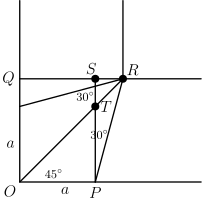
Coloca la esquina en el origen OO con los dos lados a lo largo de los ejes positivos, y escribe a=17.a = \sqrt{17}. El corte sobre el borde inferior comienza en P=(a,0),P = (a, 0), y los dos cortes se encuentran en RR sobre la diagonal y=x,y = x, formando cada uno un ángulo de 3030^\circ con la diagonal. En el triángulo OPR,OPR, ROP=45\angle ROP = 45^\circ y ORP=30,\angle ORP = 30^\circ, así que la ley de los senos da PR=OPsin45sin30=a2.PR = \frac{OP\sin 45^\circ}{\sin 30^\circ} = a\sqrt{2}. Las líneas de pliegue son las líneas horizontal y vertical que pasan por R.R. Sea SS el punto de la línea de pliegue horizontal directamente encima de P,P, y T=(a,a)T = (a, a) el punto donde la línea vertical que pasa por PP corta la diagonal. Como OPR=105,\angle OPR = 105^\circ, el segmento PRPR forma un ángulo de 7575^\circ con el borde inferior, así que SP=PRsin75=a26+24=a3+12,ST=SPPT=a3+12a=a312. \begin{aligned} SP &= PR\sin 75^\circ \\ &= a\sqrt{2} \cdot \frac{\sqrt{6} + \sqrt{2}}{4} \\ &= a\,\frac{\sqrt{3} + 1}{2}, \\ ST &= SP - PT \\ &= a\,\frac{\sqrt{3} + 1}{2} - a \\ &= a\,\frac{\sqrt{3} - 1}{2}. \end{aligned}

Cuando la tira inferior se pliega hacia arriba a lo largo de la línea horizontal que pasa por R,R, el punto PP se mantiene a distancia SPSP de S,S, moviéndose en el plano vertical que pasa por PP perpendicular a esa línea de pliegue. Por simetría, los dos bordes de corte pegados se encuentran por encima de la diagonal, así que PP aterriza en un punto PP' directamente encima de T,T, y PTP'T es la altura de la bandeja. Por el teorema de Pitágoras, PT2=PS2ST2=a2(3+12)2a2(312)2=a23. \begin{aligned} P'T^2 &= P'S^2 - ST^2 \\ &= a^2\left(\frac{\sqrt{3} + 1}{2}\right)^2 \\ &\quad {}- a^2\left(\frac{\sqrt{3} - 1}{2}\right)^2 \\ &= a^2\sqrt{3}. \end{aligned}

Así que la altura es a31/4a \cdot 3^{1/4} =1734= \sqrt{17} \cdot \sqrt[4]{3} =17234= \sqrt[4]{17^2 \cdot 3} =8674,= \sqrt[4]{867}, y m+n=867+4=871.m + n = 867 + 4 = 871.

Put the corner at the origin OO with the two sides along the positive axes, and write a=17.a = \sqrt{17}. The cut on the bottom edge starts at P=(a,0),P = (a, 0), and the two cuts meet at RR on the diagonal y=x,y = x, each making a 3030^\circ angle with the diagonal. In triangle OPR,OPR, ROP=45\angle ROP = 45^\circ and ORP=30,\angle ORP = 30^\circ, so the Law of Sines gives PR=OPsin45sin30=a2.PR = \frac{OP\sin 45^\circ}{\sin 30^\circ} = a\sqrt{2}. The fold lines are the horizontal and vertical lines through R.R. Let SS be the point of the horizontal fold line directly above P,P, and T=(a,a)T = (a, a) the point where the vertical line through PP meets the diagonal. Since OPR=105,\angle OPR = 105^\circ, segment PRPR makes a 7575^\circ angle with the bottom edge, so SP=PRsin75=a26+24=a3+12,ST=SPPT=a3+12a=a312. \begin{aligned} SP &= PR\sin 75^\circ \\ &= a\sqrt{2} \cdot \frac{\sqrt{6} + \sqrt{2}}{4} \\ &= a\,\frac{\sqrt{3} + 1}{2}, \\ ST &= SP - PT \\ &= a\,\frac{\sqrt{3} + 1}{2} - a \\ &= a\,\frac{\sqrt{3} - 1}{2}. \end{aligned}

When the bottom strip folds up along the horizontal line through R,R, point PP stays at distance SPSP from S,S, moving in the vertical plane through PP perpendicular to that fold line. By symmetry the two taped cut edges meet above the diagonal, so PP lands at a point PP' directly above T,T, and PTP'T is the height of the tray. By the Pythagorean theorem, PT2=PS2ST2=a2(3+12)2a2(312)2=a23. \begin{aligned} P'T^2 &= P'S^2 - ST^2 \\ &= a^2\left(\frac{\sqrt{3} + 1}{2}\right)^2 \\ &\quad {}- a^2\left(\frac{\sqrt{3} - 1}{2}\right)^2 \\ &= a^2\sqrt{3}. \end{aligned}

So the height is a31/4a \cdot 3^{1/4} =1734= \sqrt{17} \cdot \sqrt[4]{3} =17234= \sqrt[4]{17^2 \cdot 3} =8674,= \sqrt[4]{867}, and m+n=867+4=871.m + n = 867 + 4 = 871.

← Problema 14#14Examen completo

El Problema 15 en otros años