2010 AIME II Problema 15

A continuación está la solución preparada profesionalmente para el Problema 15 del 2010 AIME II, de LIVE by Po-Shen Loh. También puedes intentar el examen cronometrado completo, ver todas las soluciones del 2010 AIME II, o revisar la clave de respuestas.

Todos los problemas se usan con el permiso legal oficial de la Mathematical Association of America (MAA).

Conceptos:cuadrilátero cíclicoteorema de la bisectrizley de los senosrazón de áreas

Nivel de dificultad: 3700

15.

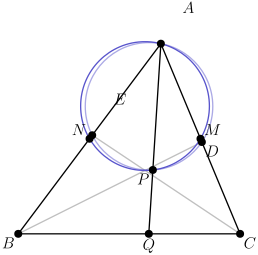
En el triángulo ABC,ABC, AC=13,AC = 13, BC=14,BC = 14, y AB=15.AB = 15. Los puntos MM y DD están en AC\overline{AC} con AM=MCAM = MC y ABD=DBC.\angle ABD = \angle DBC. Los puntos NN y EE están en AB\overline{AB} con AN=NBAN = NB y ACE=ECB.\angle ACE = \angle ECB. Sea PP el otro punto de intersección de las circunferencias circunscritas de AMN\triangle AMN y ADE.\triangle ADE. El rayo APAP corta a BC\overline{BC} en Q.Q. La razón BQCQ\frac{BQ}{CQ} se puede escribir en la forma mn,\frac{m}{n}, donde mm y nn son enteros positivos primos entre sí. Halla mn.m - n.

In triangle ABC,ABC, AC=13,AC = 13, BC=14,BC = 14, and AB=15.AB = 15. Points MM and DD lie on AC\overline{AC} with AM=MCAM = MC and ABD=DBC.\angle ABD = \angle DBC. Points NN and EE lie on AB\overline{AB} with AN=NBAN = NB and ACE=ECB.\angle ACE = \angle ECB. Let PP be the other point of intersection of the circumcircles of AMN\triangle AMN and ADE.\triangle ADE. Ray APAP meets BC\overline{BC} at Q.Q. The ratio BQCQ\frac{BQ}{CQ} can be written in the form mn,\frac{m}{n}, where mm and nn are relatively prime positive integers. Find mn.m - n.

Solución:

Por el teorema de la bisectriz, AE=132715AE = \frac{13}{27} \cdot 15 y CD=142913,CD = \frac{14}{29} \cdot 13, así que EE está en AN\overline{AN} y DD está en MC,\overline{MC}, con NE=ANAE=152659=518,MD=CMCD=13218229=1358. \begin{aligned} NE &= AN - AE = \frac{15}{2} - \frac{65}{9} \\ &= \frac{5}{18}, \\ MD &= CM - CD = \frac{13}{2} - \frac{182}{29} \\ &= \frac{13}{58}. \end{aligned}

Como AMPNAMPN es cíclico, ENP=ANP\angle ENP = \angle ANP =180AMP= 180^\circ - \angle AMP =DMP,= \angle DMP, y como AEPDAEPD es cíclico, NEP=180AEP\angle NEP = 180^\circ - \angle AEP =ADP= \angle ADP =MDP.= \angle MDP. Por tanto los triángulos ENPENP y DMPDMP son semejantes, así que NPMP=NEMD.\frac{NP}{MP} = \frac{NE}{MD}. Por la ley de los senos en los triángulos ANPANP y AMP,AMP, cuyos ángulos ANP\angle ANP y AMP\angle AMP son suplementarios, sinBAQsinCAQ=sinNAPsinMAP=NPMP=5/1813/58=145117. \begin{aligned} \frac{\sin\angle BAQ}{\sin\angle CAQ} &= \frac{\sin\angle NAP}{\sin\angle MAP} \\ &= \frac{NP}{MP} = \frac{5/18}{13/58} \\ &= \frac{145}{117}. \end{aligned}

Comparando las áreas de los triángulos ABQABQ y ACQ,ACQ, que comparten la ceviana AQ,\overline{AQ}, BQCQ=[ABQ][ACQ]=ABsinBAQACsinCAQ=1513145117=725507, \begin{aligned} \frac{BQ}{CQ} &= \frac{[ABQ]}{[ACQ]} \\ &= \frac{AB \sin\angle BAQ}{AC \sin\angle CAQ} \\ &= \frac{15}{13} \cdot \frac{145}{117} = \frac{725}{507}, \end{aligned} que está en su mínima expresión ya que 507=3132507 = 3 \cdot 13^2 y 725=5229.725 = 5^2 \cdot 29. Por tanto mn=725507=218.m - n = 725 - 507 = 218.

By the angle bisector theorem, AE=132715AE = \frac{13}{27} \cdot 15 and CD=142913,CD = \frac{14}{29} \cdot 13, so EE lies on AN\overline{AN} and DD lies on MC,\overline{MC}, with NE=ANAE=152659=518,MD=CMCD=13218229=1358. \begin{aligned} NE &= AN - AE = \frac{15}{2} - \frac{65}{9} \\ &= \frac{5}{18}, \\ MD &= CM - CD = \frac{13}{2} - \frac{182}{29} \\ &= \frac{13}{58}. \end{aligned}

Since AMPNAMPN is cyclic, ENP=ANP\angle ENP = \angle ANP =180AMP= 180^\circ - \angle AMP =DMP,= \angle DMP, and since AEPDAEPD is cyclic, NEP=180AEP\angle NEP = 180^\circ - \angle AEP =ADP= \angle ADP =MDP.= \angle MDP. Hence triangles ENPENP and DMPDMP are similar, so NPMP=NEMD.\frac{NP}{MP} = \frac{NE}{MD}. By the law of sines in triangles ANPANP and AMP,AMP, whose angles ANP\angle ANP and AMP\angle AMP are supplementary, sinBAQsinCAQ=sinNAPsinMAP=NPMP=5/1813/58=145117. \begin{aligned} \frac{\sin\angle BAQ}{\sin\angle CAQ} &= \frac{\sin\angle NAP}{\sin\angle MAP} \\ &= \frac{NP}{MP} = \frac{5/18}{13/58} \\ &= \frac{145}{117}. \end{aligned}

Comparing the areas of triangles ABQABQ and ACQ,ACQ, which share the cevian AQ,\overline{AQ}, BQCQ=[ABQ][ACQ]=ABsinBAQACsinCAQ=1513145117=725507, \begin{aligned} \frac{BQ}{CQ} &= \frac{[ABQ]}{[ACQ]} \\ &= \frac{AB \sin\angle BAQ}{AC \sin\angle CAQ} \\ &= \frac{15}{13} \cdot \frac{145}{117} = \frac{725}{507}, \end{aligned} which is in lowest terms since 507=3132507 = 3 \cdot 13^2 and 725=5229.725 = 5^2 \cdot 29. Thus mn=725507=218.m - n = 725 - 507 = 218.

← Problema 14#14Examen completo

El Problema 15 en otros años