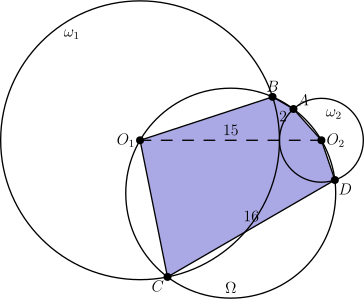
Dos circunferencias tangentes externamente ω1 y ω2 tienen centros O1 y O2, respectivamente. Una tercera circunferencia Ω que pasa por O1 y O2 corta a ω1 en B y C y a ω2 en A y D, como se muestra. Supón que AB=2,O1O2=15,CD=16, y ABO1CDO2 es un hexágono convexo. Halla el área de este hexágono.
Two externally tangent circles ω1 and ω2 have centers O1 and O2, respectively. A third circle Ω passing through O1 and O2 intersects ω1 at B and C and ω2 at A and D, as shown. Suppose that AB=2,O1O2=15,CD=16, and ABO1CDO2 is a convex hexagon. Find the area of this hexagon.
Los seis vértices están sobre Ω, y O1B=O1C=r1 y O2A=O2D=r2 son cuerdas de Ω con r1+r2=15
All six vertices lie on Ω, and O1B=O1C=r1 and O2A=O2D=r2 are chords of Ω with r1+r2=15
Pista grande:
Escribe cada cuerda como 2Rsin(la mitad de su arco), luego suma y resta las ecuaciones de 16 y 2 con transformación de suma a producto, usando ambos hechos que valen 15
Write each chord as 2Rsin(half its arc), then add and subtract the 16 and 2 equations with sum-to-product, using both facts worth 15
Solución:
Los seis vértices del hexágono están sobre Ω:O1 y O2 por hipótesis, y A,B,C,D como puntos de intersección con Ω. Sea R el radio de Ω, y sean los arcos determinados por los lados AB,BO1,O1C,CD,DO2,O2A iguales a 2α,2β,2β,2γ,2δ,2δ (los dos β porque las cuerdas BO1=O1C=r1, el radio de ω1, e igualmente O2A=O2D=r2), de modo que α+2β+γ+2δ=π. Cada cuerda es igual a 2Rsin(la mitad de su arco):2Rsinα=2,2Rsinγ=16, y la cuerda O1O2 subtiende 2β+2γ+2δ, dando 2Rsin(α+σ)=15 donde σ=β+δ. La tangencia externa da una segunda ecuación que vale 15:r1+r2=2R(sinβ+sinδ)=15.
Como γ=π−α−2σ, tenemos sinγ=sin(α+2σ). La transformación de suma a producto da entonces 18=2R[sin(α+2σ)+sinα]=4Rsin(α+σ)cosσ=30cosσ, así que cosσ=53, y de forma similar 14=4Rcos(α+σ)sinσ da Rcos(α+σ)=835. Combinando con 2Rsin(α+σ)=15 se obtiene 4R2=225+161225, así que R2=644825. Además 15=2R(sinβ+sinδ)=4Rsin2σcos2β−δ con sin2σ=51, así que cos2β−δ=4R155 y cos(β−δ)=8R21125−1.
Uniendo el centro de Ω con los seis vértices se divide el hexágono en seis triángulos, así que su área es 21R2⋅[sin2α+2sin2β+2sin2δ+sin2γ]. Ahora R2(sin2β+sin2δ)=2R2sinσcos(β−δ)=58(81125−R2)=8835, mientras que sin2α+sin2γ=−2sin2σcos(2(α+σ))=−2⋅2524⋅(−19395) ya que cos(2(α+σ))=1−4R22⋅225=−19395, así que 21R2(sin2α+sin2γ)=21⋅644825⋅965912=8285. El área es 8835+8285=140.
All six hexagon vertices lie on Ω:O1 and O2 by hypothesis, and A,B,C,D as intersection points with Ω. Let R be the radius of Ω, and let the arcs cut off by the sides AB,BO1,O1C,CD,DO2,O2A be 2α,2β,2β,2γ,2δ,2δ (the two β’s because chords BO1=O1C=r1, the radius of ω1, and likewise O2A=O2D=r2), so α+2β+γ+2δ=π. Each chord equals 2Rsin(half its arc):2Rsinα=2,2Rsinγ=16, and the chord O1O2 subtends 2β+2γ+2δ, giving 2Rsin(α+σ)=15 where σ=β+δ. External tangency gives a second equation worth 15:r1+r2=2R(sinβ+sinδ)=15.
Since γ=π−α−2σ, we have sinγ=sin(α+2σ). Sum-to-product then gives 18=2R[sin(α+2σ)+sinα]=4Rsin(α+σ)cosσ=30cosσ, so cosσ=53, and similarly 14=4Rcos(α+σ)sinσ gives Rcos(α+σ)=835. Combining with 2Rsin(α+σ)=15 yields 4R2=225+161225, so R2=644825. Also 15=2R(sinβ+sinδ)=4Rsin2σcos2β−δ with sin2σ=51, so cos2β−δ=4R155 and cos(β−δ)=8R21125−1.
Joining the center of Ω to the six vertices splits the hexagon into six triangles, so its area is 21R2⋅[sin2α+2sin2β+2sin2δ+sin2γ]. Now R2(sin2β+sin2δ)=2R2sinσcos(β−δ)=58(81125−R2)=8835, while sin2α+sin2γ=−2sin2σcos(2(α+σ))=−2⋅2524⋅(−19395) since cos(2(α+σ))=1−4R22⋅225=−19395, so 21R2(sin2α+sin2γ)=21⋅644825⋅965912=8285. The area is 8835+8285=140.