2016 AIME I Problema 15

A continuación está la solución preparada profesionalmente para el Problema 15 del 2016 AIME I, de LIVE by Po-Shen Loh. También puedes intentar el examen cronometrado completo, ver todas las soluciones del 2016 AIME I, o revisar la clave de respuestas.

Todos los problemas se usan con el permiso legal oficial de la Mathematical Association of America (MAA).

Conceptos:eje radicalpotencia de un puntopersecución de ángulossemejanza

Nivel de dificultad: 3700

15.

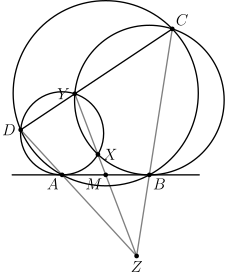
Las circunferencias ω1\omega_1 y ω2\omega_2 se cortan en los puntos XX y Y.Y. La recta \ell es tangente a ω1\omega_1 y ω2\omega_2 en AA y B,B, respectivamente, con la recta ABAB más cerca del punto XX que de Y.Y. La circunferencia ω\omega pasa por AA y BB cortando a ω1\omega_1 de nuevo en DAD \ne A y cortando a ω2\omega_2 de nuevo en CB.C \ne B. Los tres puntos C,C, Y,Y, DD son colineales, XC=67,XC = 67, XY=47,XY = 47, y XD=37.XD = 37. Halla AB2.AB^2.

Circles ω1\omega_1 and ω2\omega_2 intersect at points XX and Y.Y. Line \ell is tangent to ω1\omega_1 and ω2\omega_2 at AA and B,B, respectively, with line ABAB closer to point XX than to Y.Y. Circle ω\omega passes through AA and BB intersecting ω1\omega_1 again at DAD \ne A and intersecting ω2\omega_2 again at CB.C \ne B. The three points C,C, Y,Y, DD are collinear, XC=67,XC = 67, XY=47,XY = 47, and XD=37.XD = 37. Find AB2.AB^2.

Solución:

La recta ADAD es el eje radical de ω\omega y ω1,\omega_1, la recta BCBC el de ω\omega y ω2,\omega_2, y la recta XYXY el de ω1\omega_1 y ω2,\omega_2, así que las tres rectas se encuentran en el centro radical Z.Z. (No pueden ser paralelas: eso obligaría a una configuración simétrica con XC=XD.XC = XD.) Sea M=XYAB.M = XY \cap AB. La potencia de MM respecto a cada circunferencia da MA2=MXMY=MB2,MA^2 = MX \cdot MY = MB^2, así que MM es el punto medio de AB,\overline{AB}, con XX entre MM y Y.Y.

Como ADYXADYX es cíclico, XAZ=XYD,\angle XAZ = \angle XYD, y como BCYXBCYX es cíclico, XBZ=XYC;\angle XBZ = \angle XYC; al ser C,C, Y,Y, DD colineales estos suman 180,180^\circ, así que ZAXBZAXB es cíclico. El ángulo tangente-cuerda en BB da XYB=ABX=AZX,\angle XYB = \angle ABX = \angle AZX, así que BYZA,BY \parallel ZA, y simétricamente AYZB.AY \parallel ZB. Por lo tanto AYBZAYBZ es un paralelogramo, y como MM es el punto medio de la diagonal AB,\overline{AB}, también es el punto medio de ZY:\overline{ZY}: por lo tanto XZ=XM+MZXZ = XM + MZ =MX+MY.= MX + MY. Además XCZ=XYB=XZD\angle XCZ = \angle XYB = \angle XZD y (por el ángulo tangente-cuerda en AA) XZC=XAB=XYA\angle XZC = \angle XAB = \angle XYA =XDZ,= \angle XDZ, así que los triángulos XZCXZC y XDZXDZ son semejantes, dando XZ2=XCXD.XZ^2 = XC \cdot XD.

Juntando todo, AB2=4MA2=4MXMY=(MX+MY)2(MYMX)2=XZ2XY2=XCXDXY2, \begin{aligned} AB^2 &= 4MA^2 = 4\,MX \cdot MY \\ &= (MX + MY)^2 \\ &\quad {}- (MY - MX)^2 \\ &= XZ^2 - XY^2 \\ &= XC \cdot XD - XY^2, \end{aligned} lo cual es igual a 6737472=2479220967 \cdot 37 - 47^2 = 2479 - 2209 =270.= 270.

Line ADAD is the radical axis of ω\omega and ω1,\omega_1, line BCBC that of ω\omega and ω2,\omega_2, and line XYXY that of ω1\omega_1 and ω2,\omega_2, so the three lines meet at the radical center Z.Z. (They cannot be parallel: that would force a symmetric configuration with XC=XD.XC = XD.) Let M=XYAB.M = XY \cap AB. The power of MM with respect to each circle gives MA2=MXMY=MB2,MA^2 = MX \cdot MY = MB^2, so MM is the midpoint of AB,\overline{AB}, with XX between MM and Y.Y.

Since ADYXADYX is cyclic, XAZ=XYD,\angle XAZ = \angle XYD, and since BCYXBCYX is cyclic, XBZ=XYC;\angle XBZ = \angle XYC; as C,C, Y,Y, DD are collinear these add to 180,180^\circ, so ZAXBZAXB is cyclic. The tangent-chord angle at BB gives XYB=ABX=AZX,\angle XYB = \angle ABX = \angle AZX, so BYZA,BY \parallel ZA, and symmetrically AYZB.AY \parallel ZB. Hence AYBZAYBZ is a parallelogram, and since MM is the midpoint of diagonal AB,\overline{AB}, it is also the midpoint of ZY:\overline{ZY}: therefore XZ=XM+MZXZ = XM + MZ =MX+MY.= MX + MY. Moreover XCZ=XYB=XZD\angle XCZ = \angle XYB = \angle XZD and (by the tangent-chord angle at AA) XZC=XAB=XYA\angle XZC = \angle XAB = \angle XYA =XDZ,= \angle XDZ, so triangles XZCXZC and XDZXDZ are similar, giving XZ2=XCXD.XZ^2 = XC \cdot XD.

Putting it together, AB2=4MA2=4MXMY=(MX+MY)2(MYMX)2=XZ2XY2=XCXDXY2, \begin{aligned} AB^2 &= 4MA^2 = 4\,MX \cdot MY \\ &= (MX + MY)^2 \\ &\quad {}- (MY - MX)^2 \\ &= XZ^2 - XY^2 \\ &= XC \cdot XD - XY^2, \end{aligned} which equals 6737472=2479220967 \cdot 37 - 47^2 = 2479 - 2209 =270.= 270.

← Problema 14#14Examen completo

El Problema 15 en otros años