2017 AIME I Problema 15

A continuación está la solución preparada profesionalmente para el Problema 15 del 2017 AIME I, de LIVE by Po-Shen Loh. También puedes intentar el examen cronometrado completo, ver todas las soluciones del 2017 AIME I, o revisar la clave de respuestas.

Todos los problemas se usan con el permiso legal oficial de la Mathematical Association of America (MAA).

Conceptos:triángulo equiláterogeometría analíticaidentidad trigonométricaoptimización

Nivel de dificultad: 3370

15.

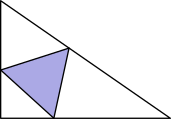
El área del menor triángulo equilátero con un vértice en cada uno de los lados del triángulo rectángulo de lados de longitud 23,2\sqrt{3}, 5,5, y 37,\sqrt{37}, como se muestra, es mpn,\frac{m\sqrt{p}}{n}, donde m,m, n,n, y pp son enteros positivos, mm y nn son primos entre sí, y pp no es divisible por el cuadrado de ningún primo. Halla m+n+p.m + n + p.

The area of the smallest equilateral triangle with one vertex on each of the sides of the right triangle with side lengths 23,2\sqrt{3}, 5,5, and 37,\sqrt{37}, as shown, is mpn,\frac{m\sqrt{p}}{n}, where m,m, n,n, and pp are positive integers, mm and nn are relatively prime, and pp is not divisible by the square of any prime. Find m+n+p.m + n + p.

Solución:

Coloca el ángulo recto en el origen con vértices (0,0),(0, 0), (5,0),(5, 0), y (0,23),(0, 2\sqrt{3}), de modo que la hipotenusa esté sobre la recta 23x+5y=103.2\sqrt{3}\,x + 5y = 10\sqrt{3}. Sea el lado del triángulo equilátero entre los dos catetos con extremos (scosθ,0)(s\cos\theta, 0) y (0,ssinθ),(0, s\sin\theta), donde ss es la longitud del lado. Su punto medio es s2(cosθ,sinθ),\frac{s}{2}(\cos\theta, \sin\theta), y moverse una distancia 32s\frac{\sqrt{3}}{2}s perpendicular al lado coloca el tercer vértice en s2\frac{s}{2} (cosθ+3sinθ, sinθ+3cosθ).\cdot\small\left(\cos\theta + \sqrt{3}\sin\theta,\ \sin\theta + \sqrt{3}\cos\theta\right).

Sustituir este vértice en la ecuación de la hipotenusa y simplificar da s=20373cosθ+11sinθ.s = \frac{20\sqrt{3}}{7\sqrt{3}\cos\theta + 11\sin\theta}. El denominador es a lo sumo (73)2+112\sqrt{(7\sqrt{3})^2 + 11^2} =268=267,= \sqrt{268} = 2\sqrt{67}, alcanzado para cierto valor admisible de θ,\theta, así que la longitud mínima del lado satisface s2=(103)267=30067.s^2 = \frac{(10\sqrt{3})^2}{67} = \frac{300}{67}.

El área mínima es 3430067=75367,\frac{\sqrt{3}}{4} \cdot \frac{300}{67} = \frac{75\sqrt{3}}{67}, así que m+n+p=75+67+3=145.m + n + p = 75 + 67 + 3 = 145.

Place the right angle at the origin with vertices (0,0),(0, 0), (5,0),(5, 0), and (0,23),(0, 2\sqrt{3}), so the hypotenuse lies on the line 23x+5y=103.2\sqrt{3}\,x + 5y = 10\sqrt{3}. Let the equilateral triangle's side between the two legs have endpoints (scosθ,0)(s\cos\theta, 0) and (0,ssinθ),(0, s\sin\theta), where ss is the side length. Its midpoint is s2(cosθ,sinθ),\frac{s}{2}(\cos\theta, \sin\theta), and moving a distance 32s\frac{\sqrt{3}}{2}s perpendicular to the side places the third vertex at s2\frac{s}{2} (cosθ+3sinθ, sinθ+3cosθ).\cdot\small\left(\cos\theta + \sqrt{3}\sin\theta,\ \sin\theta + \sqrt{3}\cos\theta\right).

Substituting this vertex into the hypotenuse equation and simplifying gives s=20373cosθ+11sinθ.s = \frac{20\sqrt{3}}{7\sqrt{3}\cos\theta + 11\sin\theta}. The denominator is at most (73)2+112\sqrt{(7\sqrt{3})^2 + 11^2} =268=267,= \sqrt{268} = 2\sqrt{67}, attained for an admissible θ,\theta, so the minimum side length satisfies s2=(103)267=30067.s^2 = \frac{(10\sqrt{3})^2}{67} = \frac{300}{67}.

The minimum area is 3430067=75367,\frac{\sqrt{3}}{4} \cdot \frac{300}{67} = \frac{75\sqrt{3}}{67}, so m+n+p=75+67+3=145.m + n + p = 75 + 67 + 3 = 145.

← Problema 14#14Examen completo

El Problema 15 en otros años