
Soluciones del 2017 AIME I
Desplázate hacia abajo para ver las soluciones preparadas profesionalmente de LIVE by Po-Shen Loh, imprime las soluciones en PDF, consulta la clave de respuestas, o haz el examen cronometrado completo.
Todos los problemas se usan con el permiso legal oficial de la Mathematical Association of America (MAA).
1.
Se marcan quince puntos distintos en los vértices y puntos más en el lado puntos más en el lado y puntos más en el lado Halla el número de triángulos con área positiva cuyos vértices están entre estos puntos.
Fifteen distinct points are designated on the vertices and other points on side other points on side and other points on side Find the number of triangles with positive area whose vertices are among these points.
Pista pequeña:
Cuenta todas las formas de elegir de los puntos, y luego descarta las elecciones que no forman un triángulo verdadero
Count all ways to choose of the points, then throw away the choices that fail to make a real triangle
Pista grande:
Una elección falla exactamente cuando los puntos están sobre un mismo lado; los lados contienen y de los puntos
A choice fails exactly when all points lie on one side; the sides contain and of the points
Solución:
Hay formas de elegir de los puntos. Una elección no produce un triángulo de área positiva exactamente cuando los puntos son colineales, lo que ocurre solo cuando los tres están sobre un mismo lado del triángulo. Incluyendo sus extremos, el lado contiene puntos, contiene y contiene lo que da ternas colineales.
El número de triángulos es
There are ways to choose of the points. A choice fails to give a triangle of positive area exactly when the points are collinear, which happens only when all three lie on one side of the triangle. Including its endpoints, side contains points, contains and contains giving collinear triples.
The number of triangles is
2.
Cuando cada uno de y se divide entre el entero positivo el residuo es siempre el entero positivo Cuando cada uno de y se divide entre el entero positivo el residuo es siempre el entero positivo Halla
When each of and is divided by the positive integer the remainder is always the positive integer When each of and is divided by the positive integer the remainder is always the positive integer Find
Pista pequeña:
Si dos números dejan el mismo residuo al dividirse entre entonces divide su diferencia
If two numbers leave the same remainder when divided by then divides their difference
Pista grande:
Así es un factor común de y y es un factor común de y
So is a common factor of and and is a common factor of and
Solución:
Los números que dejan residuos iguales al dividirse entre difieren por múltiplos de así que divide tanto a como a Como y debe superar el residuo positivo obtenemos y
De manera similar, divide tanto a como a y así que y que en efecto difiere de
La suma pedida es
Numbers leaving equal remainders upon division by differ by multiples of so divides both and Since and must exceed the positive remainder we get and
Similarly divides both and and so and which indeed differs from
The requested sum is
3.
Para un entero positivo sea el dígito de las unidades de Halla el residuo cuando se divide entre
For a positive integer let be the units digit of Find the remainder when is divided by
Pista pequeña:
es el dígito de las unidades de busca un patrón que se repita en estos dígitos
is the units digit of look for a repeating pattern in these digits
Pista grande:
Los dígitos se repiten con período y un período completo de valores suma
The digits repeat with period and one full period of values sums to
Solución:
Aquí es el dígito de las unidades del número triangular Como es un múltiplo de la sucesión es periódica con período Calculando un período, que suma
Como el total es más los primeros términos del período, que suman La suma es así que el residuo es
Here is the units digit of the triangular number Since is a multiple of the sequence is periodic with period Computing one period, which sums to
Since the total is plus the first terms of the period, which sum to The sum is so the remainder is
4.
Una pirámide tiene una base triangular con lados de longitud y Las tres aristas de la pirámide que van de las tres esquinas de la base al cuarto vértice de la pirámide tienen todas longitud El volumen de la pirámide es donde y son enteros positivos, y no es divisible por el cuadrado de ningún primo. Halla
A pyramid has a triangular base with side lengths and The three edges of the pyramid from the three corners of the base to the fourth vertex of the pyramid all have length The volume of the pyramid is where and are positive integers, and is not divisible by the square of any prime. Find
Pista pequeña:
Como las tres aristas laterales son iguales a el ápice está directamente sobre el circuncentro del triángulo de la base
Because all three lateral edges equal the apex lies directly above the circumcenter of the base triangle
Pista grande:
La base tiene área calcula su circunradio con y luego obtén la altura con el teorema de Pitágoras
The base has area compute its circumradius from then get the height by the Pythagorean theorem
Solución:
Como el ápice es equidistante de los tres vértices de la base, su pie es el circuncentro de la base. La base es isósceles con lados y su altura al lado de longitud es así que su área es y su circunradio es
La altura de la pirámide es así que el volumen es Entonces
Since the apex is equidistant from all three base vertices, its foot is the circumcenter of the base. The base is isosceles with sides and its altitude to the side of length is so its area is and its circumradius is
The height of the pyramid is so the volume is Then
5.
Un número racional escrito en base ocho es donde todos los dígitos son no nulos. El mismo número en base doce es Halla el número en base diez
A rational number written in base eight is where all digits are nonzero. The same number in base twelve is Find the base-ten number
Pista pequeña:
Las partes enteras deben coincidir: así que
The integer parts must match: so
Pista grande:
Solo o sirven; prueba cada uno en recordando que los dígitos son no nulos y menores que
Only or fit; test each in remembering digits are nonzero and less than
Solución:
Las partes enteras deben ser iguales: así que es decir Como y son dígitos no nulos en base ocho (a lo sumo ), las únicas opciones son y
Las partes fraccionarias también deben coincidir: es decir Para el lado derecho es lo que fuerza que no tiene solución con ambos dígitos no nulos y menores que Para el lado derecho es así que dando y
En efecto, y el número pedido es
The integer parts must be equal: so that is Since and are nonzero base-eight digits (at most ), the only options are and
The fractional parts must also match: i.e. For the right side is forcing which has no solution with both digits nonzero and less than For the right side is so giving and
Indeed and the requested number is
6.
Se circunscribe una circunferencia a un triángulo isósceles cuyos dos ángulos congruentes tienen medida en grados Se eligen dos puntos independientemente y de manera uniforme al azar sobre la circunferencia, y se traza una cuerda entre ellos. La probabilidad de que la cuerda corte al triángulo es Halla la diferencia entre el mayor y el menor valor posible de
A circle is circumscribed around an isosceles triangle whose two congruent angles have degree measure Two points are chosen independently and uniformly at random on the circle, and a chord is drawn between them. The probability that the chord intersects the triangle is Find the difference between the largest and smallest possible values of
Pista pequeña:
Los vértices dividen la circunferencia en arcos de y grados, y la cuerda no toca al triángulo exactamente cuando ambos puntos caen en el mismo arco
The vertices cut the circle into arcs of and degrees, and the chord misses the triangle exactly when both points land in the same arc
Pista grande:
Con la probabilidad de no tocar da una ecuación cuadrática con dos raíces válidas
With the miss probability gives a quadratic with two valid roots
Solución:
Cada ángulo inscrito del triángulo subtiende un arco del doble de su medida, así que los vértices dividen la circunferencia en arcos de y grados. La cuerda no corta al triángulo exactamente cuando ambos puntos aleatorios caen en el mismo arco, lo que tiene probabilidad
Haciendo esto se lee que se simplifica a con raíces y Estas dan y ambos ángulos de base legítimos de un triángulo isósceles.
La diferencia pedida es
Each inscribed angle of the triangle subtends an arc of twice its measure, so the vertices split the circle into arcs of and degrees. The chord fails to intersect the triangle exactly when both random points fall in the same arc, which has probability
Setting this reads which simplifies to with roots and These give and both legitimate base angles of an isosceles triangle.
The requested difference is
7.
Para enteros no negativos y con sea Sea la suma de todos los donde y son enteros no negativos con Halla el residuo cuando se divide entre
For nonnegative integers and with let Let denote the sum of all where and are nonnegative integers with Find the remainder when is divided by
Pista pequeña:
Reemplaza por de modo que con cada término se convierte en con
Replace by so with each term becomes with
Pista grande:
Elegir y elementos de tres conjuntos disjuntos de elementos, sobre todos los cuenta los subconjuntos de elementos de un conjunto de elementos
Choosing and elements from three disjoint -element sets, over all counts the -element subsets of an -element set
Solución:
Por la simetría sustituir convierte la suma en
Cada término cuenta las formas de elegir elementos de un conjunto de elementos, de un segundo, y de un tercero. Sumado sobre todos los esto cuenta cada forma de elegir elementos del conjunto combinado de elementos, así que
El residuo al dividir entre es
By the symmetry substituting turns the sum into
Each term counts the ways to choose elements from one -element set, from a second, and from a third. Summed over all this counts every way to choose elements from the combined -element set, so
The remainder upon division by is
8.
Se eligen dos números reales y independientemente y de manera uniforme al azar del intervalo Sean y dos puntos en el plano con Sean y puntos en el mismo lado de la recta tales que las medidas en grados de y son y respectivamente, y y son ambos ángulos rectos. La probabilidad de que es igual a donde y son enteros positivos primos entre sí. Halla
Two real numbers and are chosen independently and uniformly at random from the interval Let and be two points in the plane with Let and be points on the same side of line such that the degree measures of and are and respectively, and and are both right angles. The probability that is equal to where and are relatively prime positive integers. Find
Pista pequeña:
Los ángulos rectos en y colocan ambos puntos sobre la circunferencia de diámetro que tiene radio
The right angles at and place both points on the circle with diameter which has radius
Pista grande:
El ángulo inscrito da así que la condición es halla el área de esa región en el cuadrado
The inscribed angle gives so the condition is find that region’s area in the square
Solución:
Como tanto como están sobre la circunferencia de diámetro cuyo radio es El ángulo es un ángulo inscrito en esta circunferencia, así que la cuerda satisface Como la condición es decir equivale a
En el cuadrado de pares igualmente probables, la región consta de dos triángulos rectángulos con catetos así que la probabilidad es
Por lo tanto
Since both and lie on the circle with diameter whose radius is The angle is an inscribed angle in this circle, so the chord satisfies Because the condition i.e. is equivalent to
In the square of equally likely pairs the region consists of two right triangles with legs so the probability is
Therefore
9.
Sea y para cada entero sea Halla el menor tal que sea múltiplo de
Let and for each integer let Find the least such that is a multiple of
Pista pequeña:
Como la recurrencia se reduce a
Since the recurrence collapses to
Pista grande:
Necesitas que divida a Los factores difieren en así que no puede dividir a ambos; separa casos según a qué factor dividen y .
You need to divide The factors differ by so cannot divide both; split cases by which factor and divide.
Solución:
Como la recurrencia da así que Necesitamos que divida a Uno de y es par, así que esto es lo mismo que exigir que y dividan cada uno al producto. Como los dos factores difieren en no pueden ser ambos múltiplos de
Así que debe dividir por completo a un factor y al otro (o bien un factor es divisible entre ). Revisando los casos: divide a por primera vez en divide a por primera vez en divide a con dividiendo a por primera vez en y divide a con dividiendo a por primera vez en
El menor es donde es en efecto múltiplo de
Because the recurrence gives so We need to divide One of and is even, so this is the same as requiring and each to divide the product. Since the two factors differ by they cannot both be multiples of
So must divide one factor entirely and the other (or one factor is divisible by ). Checking the cases: divides first at divides first at divides with dividing first at and divides with dividing first at
The least is where is indeed a multiple of
10.
Sean y donde Sea el único número complejo con las propiedades de que es un número real y la parte imaginaria de es la mayor posible. Halla la parte real de
Let and where Let be the unique complex number with the properties that is a real number and the imaginary part of is the greatest possible. Find the real part of
Pista pequeña:
El producto dado es una razón doble; es real exactamente cuando está sobre la circunferencia que pasa por y
The given product is a cross-ratio; it is real exactly when lies on the circle through and
Pista grande:
El punto de una circunferencia con mayor parte imaginaria se sitúa directamente sobre el centro, así que interseca dos mediatrices para hallar el centro
The point of a circle with greatest imaginary part sits directly above the center, so intersect two perpendicular bisectors to find the center
Solución:
El argumento de es el ángulo y el argumento de es el ángulo entre y Su producto es real exactamente cuando estos ángulos son iguales o suplementarios, lo que por el teorema del ángulo inscrito ocurre exactamente cuando y son concíclicos. Así que está sobre la circunferencia circunscrita de y
El segmento de a es vertical, así que su mediatriz es la recta horizontal El segmento de a tiene pendiente y punto medio así que su mediatriz es Haciendo se obtiene así que el centro es
El punto de la circunferencia con parte imaginaria máxima está directamente sobre el centro, así que la parte real de es
The argument of is the angle and the argument of is the angle between and Their product is real exactly when these angles are equal or supplementary, which by the inscribed angle theorem happens exactly when and are concyclic. So lies on the circumcircle of and
The segment from to is vertical, so its perpendicular bisector is the horizontal line The segment from to has slope and midpoint so its perpendicular bisector is Setting gives so the center is
The point of the circle with maximal imaginary part is directly above the center, so the real part of is
11.
Considera las disposiciones de los números en un arreglo Para cada disposición, sean y las medianas de los números en las filas y respectivamente, y luego sea la mediana de Sea el número de disposiciones para las que Halla el residuo cuando se divide entre
Consider arrangements of the numbers in a array. For each such arrangement, let and be the medians of the numbers in rows and respectively, and then let be the median of Let be the number of arrangements for which Find the remainder when is divided by
Pista pequeña:
Renombra cada número menor que como L y cada mayor como G. Para el número debe ser la mediana de alguna fila, así que su fila se lee L5G en algún orden.
Rename each number less than as L and each greater as G. For the number must be a row median, so its row reads L5G in some order.
Pista grande:
Las otras dos filas necesitan medianas en lados opuestos de LLL con GGG, o LLG con LGG. Cuenta los patrones de letras, y luego multiplica por para los valores reales.
The other two rows need medians on opposite sides of LLL with GGG, or LLG with LGG. Count letter patterns, then multiply by for actual values.
Solución:
Renombra cada uno de como L y cada uno de como G. Si no es la mediana de ninguna fila, entonces ninguna mediana de fila es igual a así que Por lo tanto la fila de debe contener una L y una G (leyéndose L5G en algún orden), y las otras dos filas deben aportar una mediana por debajo de y una por encima. Con las tres L y las tres G restantes, esas filas son LLL y GGG, o LLG y LGG.
Cuenta las disposiciones de letras: los tres tipos de fila se pueden asignar a las filas y de maneras, y la fila L5G se puede ordenar de maneras. En el primer caso LLL y GGG tienen ordenamiento cada uno, dando patrones; en el segundo, LLG y LGG tienen ordenamientos cada uno, dando patrones. Eso es patrones de letras en total.
Finalmente las cuatro L se pueden llenar con de maneras y las cuatro G con de maneras, así que cuyo residuo módulo es
Rename each of as L and each of as G. If is not a row median, then no row median equals so Thus ’s row must contain one L and one G (reading L5G in some order), and the other two rows must supply one median below and one above. With the remaining three L’s and three G’s, those rows are either LLL and GGG, or LLG and LGG.
Count arrangements of letters: the three row types can be assigned to rows and in ways, and the L5G row can be ordered in ways. In the first case LLL and GGG have ordering each, giving patterns; in the second, LLG and LGG each have orderings, giving patterns. That is letter patterns in all.
Finally the four L’s can be filled with in ways and the four G’s with in ways, so whose remainder mod is
12.
Llamamos a un conjunto libre de productos si no existen (no necesariamente distintos) tales que Por ejemplo, el conjunto vacío y el conjunto son libres de productos, mientras que los conjuntos y no son libres de productos. Halla el número de subconjuntos libres de productos del conjunto
Call a set product-free if there do not exist (not necessarily distinct) such that For example, the empty set and the set are product-free, whereas the sets and are not product-free. Find the number of product-free subsets of the set
Pista pequeña:
nunca puede aparecer (ya que ), y si el elemento más pequeño es al menos todo producto de dos elementos supera
can never appear (since ), and if the least element is at least every product of two elements exceeds
Pista grande:
Con elemento más pequeño o solo importan unos pocos conflictos: y Trata y por separado.
With least element or only a few conflicts matter: and Handle and separately.
Solución:
Como ningún conjunto libre de productos contiene a Separa según el elemento más pequeño Si todo producto de dos elementos es al menos así que todo subconjunto de sirve: subconjuntos, incluyendo el conjunto vacío.
Si entonces (pues ), mientras que y no tienen restricción ( opciones cada uno). Entre las restricciones y dejan exactamente , es decir, opciones. Entre la restricción deja opciones. Eso da conjuntos. Si entonces (pues ), y se puede añadir cualquier subconjunto de ya que todos los demás productos superan conjuntos.
En total hay subconjuntos libres de productos.
Since no product-free set contains Split by the least element If any product of two elements is at least so every subset of works: subsets, including the empty set.
If then (as ), while and are unrestricted ( choices each). Among the constraints and leave exactly — choices. Among the constraint leaves choices. That gives sets. If then (as ), and any subset of may be added since all other products exceed sets.
In total there are product-free subsets.
13.
Para todo sea el menor entero positivo con la siguiente propiedad: para todo siempre hay un cubo perfecto en el rango Halla el residuo cuando se divide entre
For every let be the least positive integer with the following property: For every there is always a perfect cube in the range Find the remainder when is divided by
Pista pequeña:
La razón de cubos consecutivos es que decrece a medida que crece, así que solo un pequeño puede tener
The ratio of consecutive cubes is which shrinks as grows, so only small can have
Pista grande:
para todo para halla el último donde el intervalo se salta un cubo, usando huecos como y
for every for find the last where the interval skips a cube, using gaps like and
Solución:
Si entonces el intervalo contiene el cubo siempre que es decir Como para todo todo tiene
Para falla ya que no contiene ningún cubo, pero para el intervalo sirve: cubre y cubre Así que Para falla (ningún cubo en ), mientras que cubre y cubre así que Para falla (ningún cubo en ), mientras que cubre y cubre así que
Por lo tanto y el residuo es
If then the interval contains the cube as long as i.e. Since for all every has
For fails since contains no cube, but for the interval works: covers and covers So For fails (no cube in ), while covers and covers so For fails (no cube in ), while covers and covers so
Therefore and the remainder is
14.
Sean y que satisfacen y Halla el residuo cuando se divide entre
Let and satisfy and Find the remainder when is divided by
Pista pequeña:
Exponencia dos veces para convertir la primera ecuación en y luego reescríbela como para
Exponentiate twice to turn the first equation into then rewrite it as for
Pista grande:
es creciente, así que escribir da resuelto por Luego calcula módulo y módulo
is increasing, so writing gives solved by Then compute mod and mod
Solución:
Exponenciando dos veces la primera ecuación: se convierte en así que es decir Haciendo el lado derecho es y el lado izquierdo es así que por la monotonía estricta de obtenemos Escribiendo esto dice que es creciente en y se satisface con en efecto Así que
La segunda ecuación da Aquí así que
Claramente Por el teorema de Euler así que el inverso de Como obtenemos El único residuo módulo que es módulo y módulo es
Exponentiating the first equation twice: becomes so i.e. Setting the right side is and the left side is so by the strict monotonicity of we get Writing this says which is increasing in and satisfied by indeed So
The second equation gives Here so
Clearly By Euler’s theorem so the inverse of Since we get The unique residue mod that is mod and mod is
15.
El área del menor triángulo equilátero con un vértice en cada uno de los lados del triángulo rectángulo de lados de longitud y como se muestra, es donde y son enteros positivos, y son primos entre sí, y no es divisible por el cuadrado de ningún primo. Halla
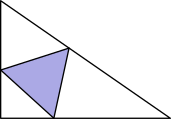
The area of the smallest equilateral triangle with one vertex on each of the sides of the right triangle with side lengths and as shown, is where and are positive integers, and are relatively prime, and is not divisible by the square of any prime. Find
Pista pequeña:
Coloca los catetos sobre los ejes y deja que el lado entre los catetos vaya de a
Put the legs on the axes and let the side between the legs run from to
Pista grande:
Exigir que el tercer vértice esté sobre la hipotenusa da maximiza la combinación izquierda usando
Requiring the third vertex to lie on the hypotenuse gives maximize the left combination using
Solución:
Coloca el ángulo recto en el origen con vértices y de modo que la hipotenusa esté sobre la recta Sea el lado del triángulo equilátero entre los dos catetos con extremos y donde es la longitud del lado. Su punto medio es y moverse una distancia perpendicular al lado coloca el tercer vértice en
Sustituir este vértice en la ecuación de la hipotenusa y simplificar da El denominador es a lo sumo alcanzado para cierto valor admisible de así que la longitud mínima del lado satisface
El área mínima es así que
Place the right angle at the origin with vertices and so the hypotenuse lies on the line Let the equilateral triangle’s side between the two legs have endpoints and where is the side length. Its midpoint is and moving a distance perpendicular to the side places the third vertex at
Substituting this vertex into the hypotenuse equation and simplifying gives The denominator is at most attained for an admissible so the minimum side length satisfies
The minimum area is so