2009 AIME I Problema 15

A continuación está la solución preparada profesionalmente para el Problema 15 del 2009 AIME I, de LIVE by Po-Shen Loh. También puedes intentar el examen cronometrado completo, ver todas las soluciones del 2009 AIME I, o revisar la clave de respuestas.

Todos los problemas se usan con el permiso legal oficial de la Mathematical Association of America (MAA).

Conceptos:circunferencia inscrita, incentro e inradiocuadrilátero cíclicoley de los cosenosoptimización

Nivel de dificultad: 3500

15.

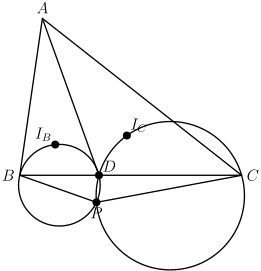
En el triángulo ABC,ABC, AB=10,AB = 10, BC=14,BC = 14, y CA=16.CA = 16. Sea DD un punto en el interior de BC.\overline{BC}. Sean IBI_B e ICI_C los incentros de los triángulos ABDABD y ACD,ACD, respectivamente. Las circunferencias circunscritas de los triángulos BIBDBI_BD y CICDCI_CD se cortan en dos puntos distintos PP y D.D. El área máxima posible de BPC\triangle BPC puede expresarse en la forma abc,a - b\sqrt{c}, donde a,a, b,b, y cc son enteros positivos y cc no es divisible por el cuadrado de ningún primo. Halla a+b+c.a + b + c.

In triangle ABC,ABC, AB=10,AB = 10, BC=14,BC = 14, and CA=16.CA = 16. Let DD be a point in the interior of BC.\overline{BC}. Let IBI_B and ICI_C denote the incenters of triangles ABDABD and ACD,ACD, respectively. The circumcircles of triangles BIBDBI_BD and CICDCI_CD meet at distinct points PP and D.D. The maximum possible area of BPC\triangle BPC can be expressed in the form abc,a - b\sqrt{c}, where a,a, b,b, and cc are positive integers and cc is not divisible by the square of any prime. Find a+b+c.a + b + c.

Solución:

En el triángulo ABDABD el incentro cumple BIBD=90+BAD2,\angle B I_B D = 90^\circ + \frac{\angle BAD}{2}, y análogamente CICD=90+DAC2,\angle C I_C D = 90^\circ + \frac{\angle DAC}{2}, así que estos dos ángulos suman 180+BAC2.180^\circ + \frac{\angle BAC}{2}. La ley de cosenos da cosBAC=102+16214221016=12,\cos \angle BAC = \frac{10^2 + 16^2 - 14^2}{2 \cdot 10 \cdot 16} = \frac{1}{2}, así que BAC=60\angle BAC = 60^\circ y la suma es 210.210^\circ.

El segundo punto de intersección PP está en el lado opuesto de BC\overline{BC} respecto de los incentros (si estuviera en el mismo lado, los dos cuadriláteros cíclicos obligarían a BPC=210>180\angle BPC = 210^\circ \gt 180^\circ). Entonces BIBDPBI_BDP y CICDPCI_CDP son cuadriláteros cíclicos convexos, así que BPC=BPD+DPC=(180BIBD)+(180CICD)=360210=150, \begin{aligned} \angle BPC &= \angle BPD + \angle DPC \\ &= \left(180^\circ - \angle BI_BD\right) \\ &\quad {}+ \left(180^\circ - \angle CI_CD\right) \\ &= 360^\circ - 210^\circ = 150^\circ, \end{aligned} independiente de D.D. Por tanto PP se mueve a lo largo de un arco circular fijo que pasa por BB y C.C.

El área del triángulo BPCBPC se maximiza en el punto medio del arco, donde BP=PC=x.BP = PC = x. La ley de cosenos da 142=2x2+3x2,14^2 = 2x^2 + \sqrt{3}\,x^2, así que x2=1962+3=196(23),x^2 = \frac{196}{2 + \sqrt{3}} = 196\left(2 - \sqrt{3}\right), y el área es 12x2sin150=49(23)\frac{1}{2}x^2 \sin 150^\circ = 49\left(2 - \sqrt{3}\right) =98493.= 98 - 49\sqrt{3}. Por tanto a+b+c=98+49+3=150.a + b + c = 98 + 49 + 3 = 150.

In triangle ABDABD the incenter satisfies BIBD=90+BAD2,\angle B I_B D = 90^\circ + \frac{\angle BAD}{2}, and likewise CICD=90+DAC2,\angle C I_C D = 90^\circ + \frac{\angle DAC}{2}, so these two angles sum to 180+BAC2.180^\circ + \frac{\angle BAC}{2}. The law of cosines gives cosBAC=102+16214221016=12,\cos \angle BAC = \frac{10^2 + 16^2 - 14^2}{2 \cdot 10 \cdot 16} = \frac{1}{2}, so BAC=60\angle BAC = 60^\circ and the sum is 210.210^\circ.

The second intersection point PP lies on the opposite side of BC\overline{BC} from the incenters (were it on the same side, the two cyclic quadrilaterals would force BPC=210>180\angle BPC = 210^\circ \gt 180^\circ). Then BIBDPBI_BDP and CICDPCI_CDP are convex cyclic quadrilaterals, so BPC=BPD+DPC=(180BIBD)+(180CICD)=360210=150, \begin{aligned} \angle BPC &= \angle BPD + \angle DPC \\ &= \left(180^\circ - \angle BI_BD\right) \\ &\quad {}+ \left(180^\circ - \angle CI_CD\right) \\ &= 360^\circ - 210^\circ = 150^\circ, \end{aligned} independent of D.D. Hence PP moves along a fixed circular arc through BB and C.C.

The area of triangle BPCBPC is maximized at the midpoint of the arc, where BP=PC=x.BP = PC = x. The law of cosines gives 142=2x2+3x2,14^2 = 2x^2 + \sqrt{3}\,x^2, so x2=1962+3=196(23),x^2 = \frac{196}{2 + \sqrt{3}} = 196\left(2 - \sqrt{3}\right), and the area is 12x2sin150=49(23)\frac{1}{2}x^2 \sin 150^\circ = 49\left(2 - \sqrt{3}\right) =98493.= 98 - 49\sqrt{3}. Thus a+b+c=98+49+3=150.a + b + c = 98 + 49 + 3 = 150.

← Problema 14#14Examen completo

El Problema 15 en otros años