1997 AIME Problema 15

A continuación está la solución preparada profesionalmente para el Problema 15 del 1997 AIME, de LIVE by Po-Shen Loh. También puedes intentar el examen cronometrado completo, ver todas las soluciones del 1997 AIME, o revisar la clave de respuestas.

Todos los problemas se usan con el permiso legal oficial de la Mathematical Association of America (MAA).

Conceptos:triángulo equiláterotrigonometríaoptimización

Nivel de dificultad: 3160

15.

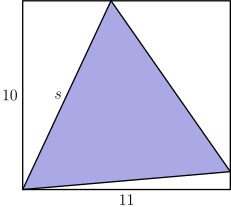
Los lados del rectángulo ABCDABCD tienen longitudes 1010 y 11.11. Se dibuja un triángulo equilátero de modo que ningún punto del triángulo quede fuera de ABCD.ABCD. El área máxima posible de tal triángulo se puede escribir en la forma pqr,p\sqrt{q} - r, donde p,p, q,q, y rr son enteros positivos, y qq no es divisible por el cuadrado de ningún número primo. Halla p+q+r.p + q + r.

The sides of rectangle ABCDABCD have lengths 1010 and 11.11. An equilateral triangle is drawn so that no point of the triangle lies outside ABCD.ABCD. The maximum possible area of such a triangle can be written in the form pqr,p\sqrt{q} - r, where p,p, q,q, and rr are positive integers, and qq is not divisible by the square of any prime number. Find p+q+r.p + q + r.

Solución:

Coloca el rectángulo con esquinas (0,0),(0, 0), (11,0),(11, 0), (11,10),(11, 10), (0,10).(0, 10). Un triángulo equilátero maximal se puede agrandar a menos que quede sujeto por el rectángulo, y la posición extrema tiene un vértice en una esquina, digamos el origen, con los otros dos vértices s(cosθ,sinθ)s(\cos\theta, \sin\theta) y s(cos(θ+60),sin(θ+60))s\bigl(\cos(\theta + 60^\circ), \sin(\theta + 60^\circ)\bigr) tocando los lados opuestos x=11x = 11 y y=10:y = 10: scosθ=11,ssin(θ+60)=10. \begin{aligned} s\cos\theta &= 11, \\ s\sin(\theta + 60^\circ) &= 10. \end{aligned}

Dividiendo, 11sin(θ+60)=10cosθ,11\sin(\theta + 60^\circ) = 10\cos\theta, y al desarrollar el lado izquierdo se obtiene 112sinθ+1132cosθ=10cosθ,\frac{11}{2}\sin\theta + \frac{11\sqrt{3}}{2}\cos\theta = 10\cos\theta, así que tanθ=2011311\tan\theta = \frac{20 - 11\sqrt{3}}{11} (cerca de 4.9,4.9^\circ, una inclinación válida). Entonces s2=121cos2θ=121(1+tan2θ)=121+(20113)2=8844403. \begin{aligned} s^2 &= \frac{121}{\cos^2\theta} \\ &= 121\left(1 + \tan^2\theta\right) \\ &= 121 + \left(20 - 11\sqrt{3}\right)^2 \\ &= 884 - 440\sqrt{3}. \end{aligned}

El área es 34s2=34(8844403)\frac{\sqrt{3}}{4}s^2 = \frac{\sqrt{3}}{4}\left(884 - 440\sqrt{3}\right) =221333052.8,= 221\sqrt{3} - 330 \approx 52.8, lo que en efecto supera al triángulo no inclinado de lado 10.10. Por lo tanto p+q+rp + q + r =221+3+330=554.= 221 + 3 + 330 = 554.

Place the rectangle with corners (0,0),(0, 0), (11,0),(11, 0), (11,10),(11, 10), (0,10).(0, 10). A maximal equilateral triangle can be enlarged unless it is pinned by the rectangle, and the extremal position has one vertex at a corner, say the origin, with the other two vertices s(cosθ,sinθ)s(\cos\theta, \sin\theta) and s(cos(θ+60),sin(θ+60))s\bigl(\cos(\theta + 60^\circ), \sin(\theta + 60^\circ)\bigr) touching the far sides x=11x = 11 and y=10:y = 10: scosθ=11,ssin(θ+60)=10. \begin{aligned} s\cos\theta &= 11, \\ s\sin(\theta + 60^\circ) &= 10. \end{aligned}

Dividing, 11sin(θ+60)=10cosθ,11\sin(\theta + 60^\circ) = 10\cos\theta, and expanding the left side gives 112sinθ+1132cosθ=10cosθ,\frac{11}{2}\sin\theta + \frac{11\sqrt{3}}{2}\cos\theta = 10\cos\theta, so tanθ=2011311\tan\theta = \frac{20 - 11\sqrt{3}}{11} (about 4.9,4.9^\circ, a legal tilt). Then s2=121cos2θ=121(1+tan2θ)=121+(20113)2=8844403. \begin{aligned} s^2 &= \frac{121}{\cos^2\theta} \\ &= 121\left(1 + \tan^2\theta\right) \\ &= 121 + \left(20 - 11\sqrt{3}\right)^2 \\ &= 884 - 440\sqrt{3}. \end{aligned}

The area is 34s2=34(8844403)\frac{\sqrt{3}}{4}s^2 = \frac{\sqrt{3}}{4}\left(884 - 440\sqrt{3}\right) =221333052.8,= 221\sqrt{3} - 330 \approx 52.8, which indeed beats the untilted triangle of side 10.10. Thus p+q+rp + q + r =221+3+330=554.= 221 + 3 + 330 = 554.

← Problema 14#14Examen completo

El Problema 15 en otros años