
Problemas del 1997 AIME
¡Desplázate hacia abajo y presiona Iniciar para intentar el examen! O ve al PDF imprimible, la clave de respuestas, o las soluciones profesionales preparadas por LIVE by Po-Shen Loh.
Todos los problemas se usan con el permiso legal oficial de la Mathematical Association of America (MAA).
O salta directamente a un solo problema con su solución: 1 · 2 · 3 · 4 · 5 · 6 · 7 · 8 · 9 · 10 · 11 · 12 · 13 · 14 · 15
¿Quieres aprender de forma profesional con clases interactivas en video?
Con tiempo
3:00:00
1.
¿Cuántos de los enteros entre y inclusive, se pueden expresar como la diferencia de los cuadrados de dos enteros no negativos?
How many of the integers between and inclusive, can be expressed as the difference of the squares of two nonnegative integers?
Respuesta: 750
Pista pequeña:
Factoriza y observa que los dos factores siempre tienen la misma paridad
Factor and note the two factors always have the same parity
Pista grande:
Todos los impares y los múltiplos de son representables; los números que exceden en a un múltiplo de no lo son
Odd numbers and multiples of are all achievable; numbers that are more than a multiple of are not
Solución:
Escribe Los factores y difieren en el número par así que tienen la misma paridad. Si ambos son impares, es impar; si ambos son pares, es divisible por Por lo tanto, ningún entero es diferencia de dos cuadrados.
Recíprocamente, todo número impar es igual a y todo múltiplo de digamos es igual a (con ya que ).
Entre y hay números impares y múltiplos de lo que da un total de
Write The factors and differ by the even number so they have the same parity. If both are odd, is odd; if both are even, is divisible by Hence no integer is a difference of two squares.
Conversely, every odd number equals and every multiple of say equals (with since ).
Between and there are odd numbers and multiples of for a total of
2.
Las nueve líneas horizontales y nueve líneas verticales de un tablero forman rectángulos, de los cuales son cuadrados. El número se puede escribir en la forma donde y son enteros positivos primos entre sí. Halla
The nine horizontal and nine vertical lines on an checkerboard form rectangles, of which are squares. The number can be written in the form where and are relatively prime positive integers. Find
Respuesta: 125
Pista pequeña:
Un rectángulo queda determinado al elegir de las líneas horizontales y de las líneas verticales
A rectangle is determined by choosing of the horizontal lines and of the vertical lines
Pista grande:
Hay cuadrados de tamaño suma desde hasta
There are squares of size sum over to
Solución:
Un rectángulo queda determinado al elegir dos de las nueve líneas horizontales y dos de las nueve líneas verticales, así que
Un cuadrado se puede colocar en posiciones, así que
Entonces que ya está en su forma más simple, así que
A rectangle is determined by choosing two of the nine horizontal lines and two of the nine vertical lines, so
A square can be placed in positions, so
Then which is in lowest terms, so
3.
Sarah pretendía multiplicar un número de dos cifras por un número de tres cifras, pero omitió el signo de multiplicación y simplemente colocó el número de dos cifras a la izquierda del número de tres cifras, formando así un número de cinco cifras. Este número es exactamente nueve veces el producto que Sarah debería haber obtenido. ¿Cuál es la suma del número de dos cifras y el número de tres cifras?
Sarah intended to multiply a two-digit number and a three-digit number, but she left out the multiplication sign and simply placed the two-digit number to the left of the three-digit number, thereby forming a five-digit number. This number is exactly nine times the product Sarah should have obtained. What is the sum of the two-digit number and the three-digit number?
Respuesta: 126
Pista pequeña:
Si el número de dos cifras es y el número de tres cifras es el número de cinco cifras es
If the two-digit number is and the three-digit number is the five-digit number is
Pista grande:
Reescribe como como el factor debe dividir a
Rewrite as since the factor must divide
Solución:
Sea el número de dos cifras y el número de tres cifras. La condición es que se reordena como Como el número debe dividir a
Como por hipótesis, tiene dos cifras, va desde hasta y El único divisor de en ese rango congruente con módulo es lo que da y que en efecto es un número de tres cifras. Comprobación:
La suma pedida es
Let be the two-digit number and the three-digit number. The condition is which rearranges to Since the number must divide
For a two-digit runs from to and The only divisor of in that range congruent to modulo is giving and which is indeed a three-digit number. Check:
The requested sum is
4.
Los círculos de radios y son mutuamente tangentes externamente, donde y son enteros positivos primos entre sí. Halla
Circles of radii and are mutually externally tangent, where and are relatively prime positive integers. Find
Respuesta: 17
Pista pequeña:
Los dos centros de radio están a distancia y los otros dos centros están ambos sobre la mediatriz de ese segmento
The two radius- centers are apart, and the other two centers both lie on the perpendicular bisector of that segment
Pista grande:
Los triángulos rectángulos dan distancias y descarta que los centros estén en lados opuestos antes de restarlas
Right triangles give midpoint distances and rule out opposite sides before subtracting them
Solución:
Los círculos de radio tienen centros y de modo que y sea el punto medio. El círculo de radio tiene centro que cumple así que está sobre la mediatriz de a distancia de Del mismo modo, el cuarto círculo, de radio tiene su centro sobre la misma mediatriz con así que
Los centros y no pueden estar en lados opuestos de eso daría y por tanto pero al elevar al cuadrado se obtendría en contradicción con Tampoco puede estar más allá de pues entonces obligaría a lo cual es incompatible con Por tanto, está entre y y la tangencia externa con el círculo de radio da Entonces y al elevar al cuadrado se obtiene así que y
Por lo tanto
Let the radius- circles have centers and so and let be the midpoint. The radius- circle’s center satisfies so lies on the perpendicular bisector of at distance from Likewise the fourth circle, of radius has its center on the same perpendicular bisector with so
The centers and cannot lie on opposite sides of that would give hence but squaring would yield contrary to Nor can lie beyond since then would force which is incompatible with Thus lies between and and external tangency to the radius- circle gives Then and squaring yields so and
Thus
5.
El número se puede expresar como un decimal de cuatro cifras donde y representan dígitos, cualquiera de los cuales podría ser cero. Se desea aproximar mediante una fracción cuyo numerador sea o y cuyo denominador sea un entero. La fracción de ese tipo más cercana a es ¿Cuál es el número de valores posibles de ?
The number can be expressed as a four-place decimal where and represent digits, any of which could be zero. It is desired to approximate by a fraction whose numerator is or and whose denominator is an integer. The closest such fraction to is What is the number of possible values for
Respuesta: 417
Pista pequeña:
Halla las fracciones con numerador o más cercanas a a cada lado
Find the fractions with numerator or closest to on each side
Pista grande:
debe estar más cerca de que de y así que está entre los puntos medios y cuenta los decimales de cuatro cifras en ese rango
must be closer to than to or count four-place decimals between and
Solución:
Entre las fracciones con numerador o los vecinos más cercanos de son por debajo (nótese que ) y por encima (nótese que ); ningún otro candidato queda entre ellos. Así que es la única fracción más cercana a exactamente cuando está más cerca de que de y es decir, cuando queda estrictamente entre los puntos medios y
Los decimales de cuatro cifras en ese intervalo son y hay de ellos.
Among fractions with numerator or the closest neighbors of are below (note ) and above (note ); no other candidate lies between them. So is the unique closest fraction to exactly when is closer to than to both and i.e. when lies strictly between the midpoints and
The four-place decimals in that interval are and there are of them.
6.
El punto está en el exterior del polígono regular de lados y es un triángulo equilátero. ¿Cuál es el mayor valor de para el cual y son vértices consecutivos de un polígono regular?
Point is in the exterior of the regular -sided polygon and is an equilateral triangle. What is the largest value of for which and are consecutive vertices of a regular polygon?
Respuesta: 42
Pista pequeña:
El ángulo interior del -ágono, el ángulo de y juntos completan en
The -gon’s interior angle, the angle, and together fill at
Pista grande:
Igualar al ángulo interior de un -ágono regular da así que debe dividir a
Setting equal to the interior angle of a regular -gon gives so must divide
Solución:
Como está fuera del -ágono, los ángulos en —el ángulo interior el ángulo equilátero y —completan una vuelta entera, así que Además ya que ambos son iguales al lado del -ágono.
Para que sean vértices consecutivos de un -ágono regular, este ángulo debe ser el ángulo interior del -ágono: que se simplifica a así que
Por lo tanto debe dividir a y la mayor opción es es decir (con ).
Since is outside the -gon, the angles at — the interior angle the equilateral angle and — fill a full revolution, so Also since both equal the side of the -gon.
For to be consecutive vertices of a regular -gon, this angle must be the -gon’s interior angle: which simplifies to so
Thus must divide and the largest choice is i.e. (with ).
7.
Un automóvil viaja hacia el este a de milla por minuto por una carretera larga y recta. Al mismo tiempo, una tormenta circular, cuyo radio es de millas, se mueve hacia el sureste a de milla por minuto. En el instante el centro de la tormenta está millas al norte del automóvil. En el instante minutos, el automóvil entra en el círculo de la tormenta, y en el instante minutos, el automóvil sale del círculo de la tormenta. Halla
A car travels due east at mile per minute on a long, straight road. At the same time, a circular storm, whose radius is miles, moves southeast at mile per minute. At time the center of the storm is miles due north of the car. At time minutes, the car enters the storm circle, and at time minutes, the car leaves the storm circle. Find
Respuesta: 198
Pista pequeña:
Establece coordenadas: el automóvil está en y el centro de la tormenta en
Set up coordinates: the car is at and the storm center at
Pista grande:
La entrada y la salida ocurren cuando la distancia al cuadrado es igual a eso es una ecuación cuadrática en así que usa las fórmulas de Vieta para
Entering and leaving happen when the squared distance equals that is a quadratic in so use Vieta’s formulas for
Solución:
Coloca el automóvil en el origen en con el este como la dirección positiva del eje y el norte como la dirección positiva del eje . En el instante el automóvil está en y el centro de la tormenta, que se mueve hacia el sureste a velocidad (con componentes hacia el este y hacia el sur), está en
El automóvil está en la frontera de la tormenta cuando la distancia al cuadrado es Es decir, o bien
Las raíces son y así que por las fórmulas de Vieta y
Put the car at the origin at with east as the positive -direction and north as the positive -direction. At time the car is at and the storm center, moving southeast at speed (components east and south), is at
The car is on the storm boundary when the squared distance is that is or
The roots are and so by Vieta’s formulas and
8.
¿Cuántos arreglos distintos, cuyas entradas son todas y , tienen la propiedad de que la suma de las entradas en cada fila es y la suma de las entradas en cada columna es ?
How many different arrays whose entries are all ’s and ’s have the property that the sum of the entries in each row is and the sum of the entries in each column is
Respuesta: 90
Pista pequeña:
Registra cada fila por el par de columnas que contienen sus y divide en casos según cómo la fila se superpone con la fila
Record each row by the pair of columns holding its ’s, and split into cases by how row overlaps row
Pista grande:
Cuando las filas y comparten o columnas, cuenta de cuántas maneras las filas y pueden completar las columnas
When rows and share or columns, count how many ways rows and can finish the columns
Solución:
Cada fila debe contener dos y dos , así que identifica cada fila con el par de columnas que contienen sus ; cada columna debe terminar elegida por exactamente dos filas. Hay opciones para la fila Clasifica según cómo la fila se superpone con la fila
Si la fila usa el mismo par ( manera), esas dos columnas quedan llenas, así que las filas y deben usar ambas el par complementario: forma de completar. Si la fila usa el par complementario ( manera), hasta ahora cada columna tiene un así que las filas y solo necesitan ser un par complementario entre sí: opciones para la fila la fila queda determinada, dando formas de completar. Si la fila comparte exactamente una columna con la fila ( maneras), una columna queda llena, dos tienen un y una queda vacía; las filas y deben tomar cada una la columna vacía junto con una de las dos columnas medio llenas, así que hay formas de completar.
El total es
Each row must contain two ’s and two ’s, so identify each row with the pair of columns holding its ’s; each column must end up chosen by exactly two rows. There are choices for row Classify by how row overlaps row
If row uses the same pair ( way), those two columns are full, so rows and must both use the complementary pair: completion. If row uses the complementary pair ( way), every column has one so far, so rows and need only be a complementary pair themselves: choices for row row forced, giving completions. If row shares exactly one column with row ( ways), one column is full, two have one and one is empty; rows and must each take the empty column together with one of the two half-filled columns, so there are completions.
The total is
9.
Dado un número real no negativo sea la parte fraccionaria de es decir, donde denota el mayor entero menor o igual que Supón que es positivo, y Halla el valor de
Given a nonnegative real number let denote the fractional part of that is, where denotes the greatest integer less than or equal to Suppose that is positive, and Find the value of
Respuesta: 233
Pista pequeña:
Como y la condición dice que
Since and the condition says
Pista grande:
La cúbica se factoriza con raíz usa repetidamente para reducir
The cubic factors with root use repeatedly to reduce
Solución:
De obtenemos así que y mientras que La condición se convierte en es decir que se factoriza como Como obtenemos la razón áurea, y en efecto está en
Usando repetidamente: y También a partir de
Por lo tanto
From we get so and while The condition becomes i.e. which factors as Since we get the golden ratio, and indeed lies in
Using repeatedly: and Also from
Therefore
10.
Cada carta de una baraja tiene el dibujo de una forma: círculo, cuadrado o triángulo, que está pintada en uno de tres colores: rojo, azul o verde. Además, cada color se aplica en uno de tres tonos: claro, medio u oscuro. La baraja tiene cartas, con cada combinación de forma, color y tono representada. Un conjunto de tres cartas de la baraja se llama complementario si todas las afirmaciones siguientes son verdaderas:
• Las tres cartas tienen o bien cada una una forma distinta, o bien las tres la misma forma.
• Las tres cartas tienen o bien cada una un color distinto, o bien las tres el mismo color.
• Las tres cartas tienen o bien cada una un tono distinto, o bien las tres el mismo tono.
¿Cuántos conjuntos complementarios distintos de tres cartas hay?
Every card in a deck has a picture of one shape — circle, square, or triangle, which is painted in one of the three colors — red, blue, or green. Furthermore, each color is applied in one of three shades — light, medium, or dark. The deck has cards, with every shape-color-shade combination represented. A set of three cards from the deck is called complementary if all of the following statements are true:
• Either each of the three cards has a different shape or all three of the cards have the same shape.
• Either each of the three cards has a different color or all three of the cards have the same color.
• Either each of the three cards has a different shade or all three of the cards have the same shade.
How many different complementary three-card sets are there?
Respuesta: 117
Pista pequeña:
Comprueba que cualquier par de cartas distintas se completa a un conjunto complementario mediante exactamente una tercera carta
Check that any two distinct cards are completed to a complementary set by exactly one third card
Pista grande:
Cuenta los pares de cartas, luego averigua cuántos pares distintos dan lugar al mismo conjunto de tres cartas
Count pairs of cards, then figure out how many different pairs give rise to the same three-card set
Solución:
Dadas dos cartas distintas cualesquiera, hay exactamente una carta que las completa a un conjunto complementario: en cada atributo, si las dos cartas coinciden, la tercera carta debe compartir ese valor, y si difieren, la tercera debe tomar el único valor restante. La carta que las completa es distinta de ambas (las dos cartas dadas difieren en algún atributo, y en ese atributo la tercera carta difiere de cada una).
Así que los pares de cartas se extienden cada uno a un conjunto complementario, y cada conjunto complementario es producido por de estos pares. El número de conjuntos es
Given any two distinct cards, there is exactly one card completing them to a complementary set: in each attribute, if the two cards agree, the third card must share that value, and if they differ, the third must take the one remaining value. The completing card is distinct from both (the two given cards differ somewhere, and in that attribute the third card differs from each).
So the pairs of cards each extend to one complementary set, and each complementary set is produced by of these pairs. The number of sets is
11.
Sea ¿Cuál es el mayor entero que no excede a ?
Let What is the greatest integer that does not exceed
Respuesta: 241
Pista pequeña:
Multiplica el numerador y el denominador por y aplica la suma telescópica usando identidades de producto a suma
Multiply numerator and denominator by and telescope using product-to-sum identities
Pista grande:
La identidad de suma a producto convierte el resultado en que la fórmula del ángulo medio evalúa exactamente
Sum-to-product turns the result into which the half-angle formula evaluates exactly
Solución:
Multiplica el numerador y el denominador por Como y ambas sumas se telescopan: En el último paso se usaron las identidades de suma a producto.
Por la fórmula del ángulo medio, Como se tiene Por lo tanto, el mayor entero que no excede a es
Multiply numerator and denominator by Since and both sums telescope: using the sum-to-product identities in the last step.
By the half-angle formula, Since we have Therefore the greatest integer not exceeding is
12.
La función definida por donde y son números reales no nulos, tiene las propiedades y para todos los valores excepto Halla el único número que no está en el rango de
The function defined by where and are nonzero real numbers, has the properties and for all values except Find the unique number that is not in the range of
Respuesta: 58
Pista pequeña:
significa que es su propia inversa; comparar coeficientes obliga a
means is its own inverse; comparing coefficients forces
Pista grande:
y son las raíces de y el valor que falta es la asíntota horizontal
and are the roots of and the missing value is the horizontal asymptote
Solución:
Al componer, y esto es igual a de manera idéntica solo si Como obtenemos así que
Un punto fijo cumple es decir cuyas raíces son y Por las fórmulas de Vieta, así que
Por último, está en el rango exactamente cuando tiene solución, es decir Esto se resuelve para salvo que y cuando el lado derecho es no nulo (de lo contrario, la expresión fraccionaria lineal sería degenerada, en contradicción con sus dos puntos fijos distintos). Así que el único número que no está en el rango es
Composing, and this equals identically only if Since we get so
A fixed point satisfies i.e. whose roots are and By Vieta’s formulas, so
Finally, is in the range exactly when has a solution, i.e. This solves for unless and when the right side is nonzero (otherwise the fractional-linear expression would be degenerate, contrary to its two distinct fixed points). So the unique number not in the range is
13.
Sea el conjunto de puntos del plano cartesiano que satisfacen Si se construyera un modelo de con alambre de grosor despreciable, la longitud total de alambre necesaria sería donde y son enteros positivos y no es divisible por el cuadrado de ningún número primo. Halla
Let be the set of points in the Cartesian plane that satisfy If a model of were built from wire of negligible thickness, then the total length of wire required would be where and are positive integers and is not divisible by the square of any prime number. Find
Respuesta: 66
Pista pequeña:
Para la expresión es igual a y para es igual a
For the expression equals and for it equals
Pista grande:
La gráfica es una unión de rombos cuenta los posibles centros y multiplica por el perímetro de un rombo
The graph is a union of diamonds count the possible centers and multiply by one diamond’s perimeter
Solución:
Sea de modo que la ecuación es La función es par, y para en así que en y para que es demasiado grande. Así que en el rango relevante, donde es el más cercano de esos cuatro valores a
Por lo tanto es la unión de las circunferencias en la métrica del taxista Estas se encuentran solo en puntos aislados. Cada una es un cuadrado (rombo) con diagonal por lo que su lado es y su perímetro
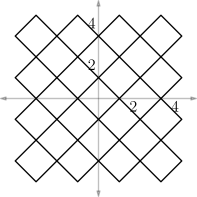
La longitud total es así que
Let so the equation is The function is even, and for on so on and for which is too large. So on the relevant range, where is the nearest of those four values to
Therefore is the union of the taxicab circles which meet only at isolated points. Each is a square (diamond) with diagonal hence side and perimeter
The total length is so
14.
Sean y raíces distintas, elegidas al azar, de la ecuación Sea la probabilidad de que donde y son enteros positivos primos entre sí. Halla
Let and be distinct, randomly chosen roots of the equation Let be the probability that where and are relatively prime positive integers. Find
Respuesta: 582
Pista pequeña:
Fija si entonces
Fix if then
Pista grande:
Como cuenta los con o
Since count with or
Solución:
Por simetría rotacional podemos fijar y tomar con uniforme en Entonces Además, así que el umbral es
La condición se cumple exactamente cuando está a menos de de o de es decir o Eso da valores favorables de
La probabilidad es y es primo, así que
By rotational symmetry we may fix and let with uniform in Then Also so the threshold is
The condition holds exactly when is within of or of i.e. or That gives favorable values of
The probability is and is prime, so
15.
Los lados del rectángulo tienen longitudes y Se dibuja un triángulo equilátero de modo que ningún punto del triángulo quede fuera de El área máxima posible de tal triángulo se puede escribir en la forma donde y son enteros positivos, y no es divisible por el cuadrado de ningún número primo. Halla
The sides of rectangle have lengths and An equilateral triangle is drawn so that no point of the triangle lies outside The maximum possible area of such a triangle can be written in the form where and are positive integers, and is not divisible by the square of any prime number. Find
Respuesta: 554
Pista pequeña:
El triángulo más grande está inclinado, con un vértice en una esquina del rectángulo y los otros dos en los lados opuestos
The largest triangle is tilted, with one vertex at a corner of the rectangle and the other two on the far sides
Pista grande:
Si el lado forma un ángulo con el lado de longitud se tiene y despeja
With side tilted above the length- side, and solve for
Solución:
Mediante una reflexión o una rotación de la configuración, podemos tomar un lado del triángulo equilátero formando un ángulo con el lado de longitud del rectángulo. En esta orientación, un triángulo de lado tiene extensiones horizontal y vertical y respectivamente. Por lo tanto, La primera cota crece con y la segunda decrece, así que el mínimo de ambas es máximo cuando son iguales. Esta cota se alcanza colocando un vértice en una esquina y los otros dos en los lados opuestos, lo que da
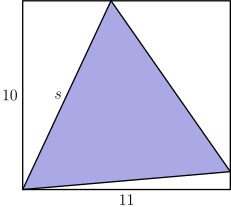
Dividiendo, y al desarrollar el lado izquierdo se obtiene así que (cerca de una inclinación válida). Entonces
El área es lo que en efecto supera al triángulo no inclinado de lado Por lo tanto
By reflecting or rotating the configuration, take one side of the equilateral triangle to make an angle with the length- side of the rectangle. A triangle of side in this orientation has horizontal and vertical spans and respectively. Hence The first bound increases with and the second decreases, so their minimum is largest when they are equal. This bound is attainable by putting one vertex at a corner and the other two on the far sides, giving
Dividing, and expanding the left side gives so (about a legal tilt). Then
The area is which indeed beats the untilted triangle of side Thus