1997 AIME Problema 13

A continuación está la solución preparada profesionalmente para el Problema 13 del 1997 AIME, de LIVE by Po-Shen Loh. También puedes intentar el examen cronometrado completo, ver todas las soluciones del 1997 AIME, o revisar la clave de respuestas.

Todos los problemas se usan con el permiso legal oficial de la Mathematical Association of America (MAA).

Conceptos:valor absolutogeometría analíticaperímetro

Nivel de dificultad: 2920

13.

Sea SS el conjunto de puntos del plano cartesiano que satisfacen x21+y21=1. \begin{aligned} &\Bigl|\bigl||x| - 2\bigr| - 1\Bigr| \\ &\quad {}+ \Bigl|\bigl||y| - 2\bigr| - 1\Bigr| = 1. \end{aligned} Si se construyera un modelo de SS con alambre de grosor despreciable, la longitud total de alambre necesaria sería ab,a\sqrt{b}, donde aa y bb son enteros positivos y bb no es divisible por el cuadrado de ningún número primo. Halla a+b.a + b.

Let SS be the set of points in the Cartesian plane that satisfy x21+y21=1. \begin{aligned} &\Bigl|\bigl||x| - 2\bigr| - 1\Bigr| \\ &\quad {}+ \Bigl|\bigl||y| - 2\bigr| - 1\Bigr| = 1. \end{aligned} If a model of SS were built from wire of negligible thickness, then the total length of wire required would be ab,a\sqrt{b}, where aa and bb are positive integers and bb is not divisible by the square of any prime number. Find a+b.a + b.

Solución:

Sea f(t)=t21,f(t) = \bigl|\,||t| - 2| - 1\,\bigr|, de modo que la ecuación es f(x)+f(y)=1.f(x) + f(y) = 1. La función ff es par, y para t0:t \ge 0: en [0,2],[0, 2], t21=(2t)1||t| - 2| - 1 = (2 - t) - 1 =1t,= 1 - t, así que f(t)=t1;f(t) = |t - 1|; en [2,4],[2, 4], f(t)=t3;f(t) = |t - 3|; y para t>4,t \gt 4, f(t)=t3>1,f(t) = t - 3 \gt 1, que es demasiado grande. Así que en el rango relevante, f(t)=taf(t) = |t - a| donde a{3,1,1,3}a \in \{-3, -1, 1, 3\} es el más cercano de esos cuatro valores a t.t.

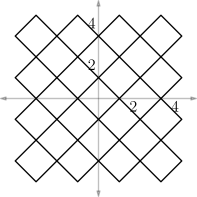
Por lo tanto SS es la unión de las 1616 circunferencias en la métrica del taxista xa+yb=1,a,b{3,1,1,3}, \begin{aligned} &|x - a| + |y - b| = 1, \\ &\qquad a, b \in \{-3, -1, 1, 3\}, \end{aligned} que se encuentran solo en puntos aislados. Cada una es un cuadrado (rombo) con diagonal 2,2, por lo que su lado es 2\sqrt{2} y su perímetro 42.4\sqrt{2}.

La longitud total es 1642=642,16 \cdot 4\sqrt{2} = 64\sqrt{2}, así que a+b=64+2=66.a + b = 64 + 2 = 66.

Let f(t)=t21,f(t) = \bigl|\,||t| - 2| - 1\,\bigr|, so the equation is f(x)+f(y)=1.f(x) + f(y) = 1. The function ff is even, and for t0:t \ge 0: on [0,2],[0, 2], t21=(2t)1||t| - 2| - 1 = (2 - t) - 1 =1t,= 1 - t, so f(t)=t1;f(t) = |t - 1|; on [2,4],[2, 4], f(t)=t3;f(t) = |t - 3|; and for t>4,t \gt 4, f(t)=t3>1,f(t) = t - 3 \gt 1, which is too large. So on the relevant range, f(t)=taf(t) = |t - a| where a{3,1,1,3}a \in \{-3, -1, 1, 3\} is the nearest of those four values to t.t.

Therefore SS is the union of the 1616 taxicab circles xa+yb=1,a,b{3,1,1,3}, \begin{aligned} &|x - a| + |y - b| = 1, \\ &\qquad a, b \in \{-3, -1, 1, 3\}, \end{aligned} which meet only at isolated points. Each is a square (diamond) with diagonal 2,2, hence side 2\sqrt{2} and perimeter 42.4\sqrt{2}.

The total length is 1642=642,16 \cdot 4\sqrt{2} = 64\sqrt{2}, so a+b=64+2=66.a + b = 64 + 2 = 66.

← Problema 12#12Examen completoProblema 14#14 →

El Problema 13 en otros años