2023 AIME I Problema 13

A continuación está la solución preparada profesionalmente para el Problema 13 del 2023 AIME I, de LIVE by Po-Shen Loh. También puedes intentar el examen cronometrado completo, ver todas las soluciones del 2023 AIME I, o revisar la clave de respuestas.

Todos los problemas se usan con el permiso legal oficial de la Mathematical Association of America (MAA).

Conceptos:vectordeterminantevolumen

Nivel de dificultad: 3160

13.

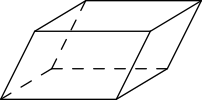
Cada cara de dos paralelepípedos no congruentes es un rombo cuyas diagonales tienen longitudes 21\sqrt{21} y 31.\sqrt{31}. La razón entre el volumen del mayor de los dos poliedros y el volumen del menor es mn,\frac{m}{n}, donde mm y nn son enteros positivos primos entre sí. Halla m+n.m + n. Un paralelepípedo es un sólido con seis caras paralelogramas como el que se muestra a continuación.

Each face of two noncongruent parallelepipeds is a rhombus whose diagonals have lengths 21\sqrt{21} and 31.\sqrt{31}. The ratio of the volume of the larger of the two polyhedra to the volume of the smaller is mn,\frac{m}{n}, where mm and nn are relatively prime positive integers. Find m+n.m + n. A parallelepiped is a solid with six parallelogram faces such as the one shown below.

Solución:

Un rombo con diagonales 21\sqrt{21} y 31\sqrt{31} tiene lado 214+314=13,\sqrt{\frac{21}{4} + \frac{31}{4}} = \sqrt{13}, así que los tres vectores de arista u,\mathbf{u}, v,\mathbf{v}, w\mathbf{w} tienen todos longitud al cuadrado 13.13. En la cara generada por u\mathbf{u} y v\mathbf{v} las diagonales son u±v,\mathbf{u} \pm \mathbf{v}, con u±v2=26±2uv;|\mathbf{u} \pm \mathbf{v}|^2 = 26 \pm 2\,\mathbf{u}\cdot\mathbf{v}; al hacer corresponder con {21,31}\{21, 31\} se obtiene uv=±52,\mathbf{u}\cdot\mathbf{v} = \pm\frac{5}{2}, y análogamente para los otros dos pares.

El volumen al cuadrado es el determinante de Gram V2=det(13xyx13zyz13)=219713(x2+y2+z2)+2xyz=21979754+2xyz \begin{aligned} V^2 &= \det\begin{pmatrix} 13 & x & y \\ x & 13 & z \\ y & z & 13 \end{pmatrix} \\ &= 2197 - 13(x^2 + y^2 + z^2) \\ &\quad {}+ 2xyz \\ &= 2197 - \frac{975}{4} \\ &\quad {}+ 2xyz \end{aligned} con x,y,z{±52}.x, y, z \in \left\{\pm\frac{5}{2}\right\}. Negar un vector de arista invierte los signos de dos de x,y,z,x, y, z, así que solo importa el signo de xyzxyz: 2xyz=±1254,2xyz = \pm\frac{125}{4}, dando V2=79384V^2 = \frac{7938}{4} o 76884.\frac{7688}{4}.

La razón de los volúmenes es 79387688=39693844=6362,\sqrt{\frac{7938}{7688}} = \sqrt{\frac{3969}{3844}} = \frac{63}{62}, ya en su forma más simple, así que m+n=63+62=125.m + n = 63 + 62 = 125.

A rhombus with diagonals 21\sqrt{21} and 31\sqrt{31} has side 214+314=13,\sqrt{\frac{21}{4} + \frac{31}{4}} = \sqrt{13}, so the three edge vectors u,\mathbf{u}, v,\mathbf{v}, w\mathbf{w} all have squared length 13.13. In the face spanned by u\mathbf{u} and v\mathbf{v} the diagonals are u±v,\mathbf{u} \pm \mathbf{v}, with u±v2=26±2uv;|\mathbf{u} \pm \mathbf{v}|^2 = 26 \pm 2\,\mathbf{u}\cdot\mathbf{v}; matching {21,31}\{21, 31\} gives uv=±52,\mathbf{u}\cdot\mathbf{v} = \pm\frac{5}{2}, and likewise for the other two pairs.

The squared volume is the Gram determinant V2=det(13xyx13zyz13)=219713(x2+y2+z2)+2xyz=21979754+2xyz \begin{aligned} V^2 &= \det\begin{pmatrix} 13 & x & y \\ x & 13 & z \\ y & z & 13 \end{pmatrix} \\ &= 2197 - 13(x^2 + y^2 + z^2) \\ &\quad {}+ 2xyz \\ &= 2197 - \frac{975}{4} \\ &\quad {}+ 2xyz \end{aligned} with x,y,z{±52}.x, y, z \in \left\{\pm\frac{5}{2}\right\}. Negating an edge vector flips the signs of two of x,y,z,x, y, z, so only the sign of xyzxyz matters: 2xyz=±1254,2xyz = \pm\frac{125}{4}, giving V2=79384V^2 = \frac{7938}{4} or 76884.\frac{7688}{4}.

The ratio of the volumes is 79387688=39693844=6362,\sqrt{\frac{7938}{7688}} = \sqrt{\frac{3969}{3844}} = \frac{63}{62}, already in lowest terms, so m+n=63+62=125.m + n = 63 + 62 = 125.

← Problema 12#12Examen completoProblema 14#14 →

El Problema 13 en otros años