2010 AIME I Problema 13

A continuación está la solución preparada profesionalmente para el Problema 13 del 2010 AIME I, de LIVE by Po-Shen Loh. También puedes intentar el examen cronometrado completo, ver todas las soluciones del 2010 AIME I, o revisar la clave de respuestas.

Todos los problemas se usan con el permiso legal oficial de la Mathematical Association of America (MAA).

Conceptos:sector circulardescomposición de áreassemejanza

Nivel de dificultad: 3270

13.

El rectángulo ABCDABCD y un semicírculo de diámetro AB\overline{AB} son coplanares y tienen interiores que no se traslapan. Sea R\mathcal{R} la región encerrada por el semicírculo y el rectángulo. La recta \ell corta al semicírculo, al segmento AB,\overline{AB}, y al segmento CD\overline{CD} en puntos distintos N,N, U,U, y T,T, respectivamente. La recta \ell divide la región R\mathcal{R} en dos regiones con áreas en razón 1:2.1 : 2. Suponga que AU=84,AU = 84, AN=126,AN = 126, y UB=168.UB = 168. Entonces DADA puede representarse como mn,m\sqrt{n}, donde mm y nn son enteros positivos y nn no es divisible por el cuadrado de ningún primo. Halle m+n.m + n.

Rectangle ABCDABCD and a semicircle with diameter AB\overline{AB} are coplanar and have nonoverlapping interiors. Let R\mathcal{R} denote the region enclosed by the semicircle and the rectangle. Line \ell meets the semicircle, segment AB,\overline{AB}, and segment CD\overline{CD} at distinct points N,N, U,U, and T,T, respectively. Line \ell divides region R\mathcal{R} into two regions with areas in the ratio 1:2.1 : 2. Suppose that AU=84,AU = 84, AN=126,AN = 126, and UB=168.UB = 168. Then DADA can be represented as mn,m\sqrt{n}, where mm and nn are positive integers and nn is not divisible by the square of any prime. Find m+n.m + n.

Solución:

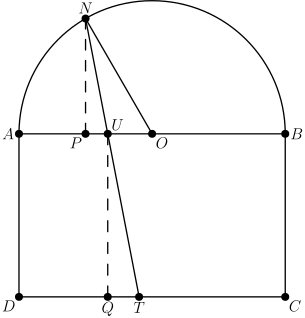
Aquí AB=84+168=252,AB = 84 + 168 = 252, así que el semicírculo tiene centro OO (el punto medio de AB\overline{AB}) y radio 126.126. Como AN=AO=ON=126,AN = AO = ON = 126, el triángulo AONAON es equilátero, así que AON=60\angle AON = 60^\circ y el sector AONAON es exactamente un tercio del semicírculo. Del mismo modo, si QQ es el pie de la perpendicular desde UU a DC,\overline{DC}, entonces AU:UB=1:2AU : UB = 1 : 2 hace que el rectángulo AUQDAUQD sea un tercio del rectángulo ABCD.ABCD.

La parte de R\mathcal{R} del lado de AA respecto de \ell es igual a (sector AONAON) - [NUO][NUO] ++ (rectángulo AUQDAUQD) ++ [UQT].[UQT]. Como esto debe ser un tercio de R,\mathcal{R}, necesitamos [NUO]=[UQT].[NUO] = [UQT]. Sea PP el pie de la perpendicular desde NN a AB.\overline{AB}. En el triángulo 3030-6060-9090 NOP,NOP, OP=63OP = 63 y NP=633,NP = 63\sqrt{3}, así que UP=8463=21UP = 84 - 63 = 21 y UO=12684=42.UO = 126 - 84 = 42. Los triángulos NUPNUP y TUQTUQ son triángulos rectángulos semejantes (ángulos opuestos por el vértice en UU), así que [UQT][NUP]=(UQNP)2,[NUO][NUP]=UOUP=2, \begin{aligned} \frac{[UQT]}{[NUP]} &= \left(\frac{UQ}{NP}\right)^2, \\ \frac{[NUO]}{[NUP]} &= \frac{UO}{UP} = 2, \end{aligned} esto último porque ambos triángulos tienen altura NPNP sobre las bases UOUO y UP.UP.

Igualar las áreas de los dos triángulos da (UQNP)2=2,\left(\frac{UQ}{NP}\right)^2 = 2, así que DA=UQ=NP2=6332=636, \begin{aligned} DA = UQ &= NP\sqrt{2} \\ &= 63\sqrt{3} \cdot \sqrt{2} \\ &= 63\sqrt{6}, \end{aligned} y m+n=63+6=69.m + n = 63 + 6 = 69.

Here AB=84+168=252,AB = 84 + 168 = 252, so the semicircle has center OO (the midpoint of AB\overline{AB}) and radius 126.126. Since AN=AO=ON=126,AN = AO = ON = 126, triangle AONAON is equilateral, so AON=60\angle AON = 60^\circ and sector AONAON is exactly one third of the semicircle. Likewise, if QQ is the foot of the perpendicular from UU to DC,\overline{DC}, then AU:UB=1:2AU : UB = 1 : 2 makes rectangle AUQDAUQD one third of rectangle ABCD.ABCD.

The part of R\mathcal{R} on the AA-side of \ell equals (sector AONAON) - [NUO][NUO] ++ (rectangle AUQDAUQD) ++ [UQT].[UQT]. Since this must be one third of R,\mathcal{R}, we need [NUO]=[UQT].[NUO] = [UQT]. Let PP be the foot of the perpendicular from NN to AB.\overline{AB}. In the 3030-6060-9090 triangle NOP,NOP, OP=63OP = 63 and NP=633,NP = 63\sqrt{3}, so UP=8463=21UP = 84 - 63 = 21 and UO=12684=42.UO = 126 - 84 = 42. Triangles NUPNUP and TUQTUQ are similar right triangles (vertical angles at UU), so [UQT][NUP]=(UQNP)2,[NUO][NUP]=UOUP=2, \begin{aligned} \frac{[UQT]}{[NUP]} &= \left(\frac{UQ}{NP}\right)^2, \\ \frac{[NUO]}{[NUP]} &= \frac{UO}{UP} = 2, \end{aligned} the latter because both triangles have height NPNP over bases UOUO and UP.UP.

Setting the two triangle areas equal gives (UQNP)2=2,\left(\frac{UQ}{NP}\right)^2 = 2, so DA=UQ=NP2=6332=636, \begin{aligned} DA = UQ &= NP\sqrt{2} \\ &= 63\sqrt{3} \cdot \sqrt{2} \\ &= 63\sqrt{6}, \end{aligned} and m+n=63+6=69.m + n = 63 + 6 = 69.

← Problema 12#12Examen completoProblema 14#14 →

El Problema 13 en otros años