
Problemas del 2010 AIME I
¡Desplázate hacia abajo y presiona Iniciar para intentar el examen! O ve al PDF imprimible, la clave de respuestas, o las soluciones profesionales preparadas por LIVE by Po-Shen Loh.
Todos los problemas se usan con el permiso legal oficial de la Mathematical Association of America (MAA).
O salta directamente a un solo problema con su solución: 1 · 2 · 3 · 4 · 5 · 6 · 7 · 8 · 9 · 10 · 11 · 12 · 13 · 14 · 15
¿Quieres aprender de forma profesional con clases interactivas en video?
Con tiempo
3:00:00
1.
Maya enumera todos los divisores positivos de Luego selecciona al azar dos divisores distintos de esta lista. Sea la probabilidad de que exactamente uno de los divisores seleccionados sea un cuadrado perfecto. La probabilidad puede expresarse en la forma donde y son enteros positivos primos entre sí. Halle
Maya lists all the positive divisors of She then randomly selects two distinct divisors from this list. Let be the probability that exactly one of the selected divisors is a perfect square. The probability can be expressed in the form where and are relatively prime positive integers. Find
Respuesta: 107
Pista pequeña:
Factorice tiene divisores
Factor it has divisors
Pista grande:
Un divisor es un cuadrado perfecto exactamente cuando los cuatro exponentes son pares, así que de los divisores son cuadrados. Cuente los pares que usan un cuadrado y un no cuadrado.
A divisor is a perfect square exactly when all four exponents are even, so of the divisors are squares. Count pairs using one square and one non-square.
Solución:
Como tiene divisores positivos. Un divisor es un cuadrado perfecto exactamente cuando cada uno de sus cuatro exponentes es o lo que da cuadrados perfectos y no cuadrados.
La probabilidad de elegir uno de cada tipo es así que
Since it has positive divisors. A divisor is a perfect square exactly when each of its four exponents is or giving perfect squares and non-squares.
The probability of picking one of each is so
2.
Halle el residuo al dividir entre
Find the remainder when is divided by
Respuesta: 109
Pista pequeña:
Todo factor a partir del tercero termina en al menos tres cifras , así que es
Every factor from the third one on ends in at least three s, so it is
Pista grande:
Cuente cuántos factores son y determine si ese número es par o impar; solo queda calcular
Count how many factors are and check whether that count is odd or even; only remains to compute
Solución:
Trabaje módulo Todo factor a partir del tercero termina en al menos tres cifras , así que cada uno es Hay factores en total, de modo que de ellos son
Por lo tanto, el producto satisface así que el residuo es
Work modulo Every factor from the third one on ends in at least three s, so each is There are factors in all, hence of them are
The product is therefore so the remainder is
3.
Suponga que y La cantidad puede expresarse como un número racional donde y son enteros positivos primos entre sí. Halle
Suppose that and The quantity can be expressed as a rational number where and are relatively prime positive integers. Find
Respuesta: 529
Pista pequeña:
Sustituya en y tome la raíz -ésima de ambos lados
Substitute into and take th roots of both sides
Pista grande:
La ecuación se convierte en así que lo que da
The equation becomes so which gives
Solución:
Sustituir en da Tomando raíces -ésimas (las cantidades aquí son positivas), así que al dividir entre se obtiene es decir,
Entonces y Como la respuesta es
Substituting into gives Taking th roots (the quantities here are positive), so dividing by yields that is,
Then and Since the answer is
4.
Jackie y Phil tienen dos monedas justas y una tercera moneda que sale cara con probabilidad Jackie lanza las tres monedas y luego Phil lanza las tres monedas. Sea la probabilidad de que Jackie obtenga el mismo número de caras que Phil, donde y son enteros positivos primos entre sí. Halle
Jackie and Phil have two fair coins and a third coin that comes up heads with probability Jackie flips the three coins, and then Phil flips the three coins. Let be the probability that Jackie gets the same number of heads as Phil, where and are relatively prime positive integers. Find
Respuesta: 515
Pista pequeña:
Calcule la probabilidad de que un jugador saque caras; las cuatro tienen denominador
Compute the probability that one player flips heads; all four have denominator
Pista grande:
Los dos jugadores son independientes e idénticos, así que la probabilidad de que coincidan es la suma de los cuadrados de esas cuatro probabilidades
The two players are independent and identical, so the probability they match is the sum of the squares of those four probabilities
Solución:
Sea la probabilidad de que un jugador saque caras. Separando según las dos monedas justas y la moneda sesgada,
Los lanzamientos de Jackie y Phil son independientes y con la misma distribución, así que la probabilidad de que sus conteos de caras coincidan es Por lo tanto,
Let be the probability that one player flips heads. Splitting according to the two fair coins and the biased coin,
Jackie’s and Phil’s flips are independent with the same distribution, so the probability that their head counts agree is Thus
5.
Los enteros positivos y satisfacen y Halle el número de valores posibles de
Positive integers and satisfy and Find the number of possible values of
Respuesta: 501
Pista pequeña:
Factorice:
Factor:
Pista grande:
La igualdad obliga a así que luego halle el rango de permitido por y
Equality forces so then find the range of allowed by and
Solución:
Factorizando, ya que y Se cumple la igualdad, así que es decir, y Entonces da
La condición significa así que y significa así que Todo en este rango funciona, mediante
El conteo es
Factoring, since and Equality holds, so that is, and Then gives
The condition means so and means so Every in this range works, via
The count is
6.
Sea un polinomio cuadrático con coeficientes reales que satisface para todos los números reales y suponga que Halle
Let be a quadratic polynomial with real coefficients satisfying for all real numbers and suppose Find
Respuesta: 406
Pista pequeña:
Complete el cuadrado: ambas cuadráticas de cota valen y con vértice común
Complete the square: both bounding quadratics equal and with common vertex
Pista grande:
es no negativo en todas partes y cero en así que es use para hallar
is nonnegative everywhere and zero at so it is use to find
Solución:
Completando el cuadrado, la condición queda En ambas cotas valen así que La cuadrática es no negativa para todo y se anula en así que es una raíz doble: para alguna constante
De obtenemos Entonces
Completing the square, the condition reads At both bounds equal so The quadratic is nonnegative for all and vanishes at so is a double root: for some constant
From we get Then
7.
Se dice que una terna ordenada de conjuntos es mínimamente intersecante si y Por ejemplo, es una terna mínimamente intersecante. Sea el número de ternas ordenadas mínimamente intersecantes de conjuntos para las que cada conjunto es un subconjunto de Halle el residuo cuando se divide entre
Nota: representa el número de elementos en el conjunto
Define an ordered triple of sets to be minimally intersecting if and For example, is a minimally intersecting triple. Let be the number of minimally intersecting ordered triples of sets for which each set is a subset of Find the remainder when is divided by
Note: represents the number of elements in the set
Respuesta: 760
Pista pequeña:
Las tres intersecciones por pares son elementos individuales que deben ser distintos ya que la intersección triple es vacía
The three pairwise intersections are single elements which must be distinct since the triple intersection is empty
Pista grande:
Después de colocar de maneras, cada elemento restante puede ir a exactamente uno de los tres conjuntos o a ninguno
After placing in ways, each remaining element may go into exactly one of the three sets or into none
Solución:
Escriba y Como los elementos son distintos, y pueden elegirse de maneras.
Cada uno de los elementos restantes no debe crear más intersecciones por pares, así que puede pertenecer a exactamente uno de o a ninguno de ellos: opciones cada uno, para asignaciones.
Por lo tanto, y el residuo al dividir entre es
Write and Since the elements are distinct, and they can be chosen in ways.
Each of the remaining elements must not create any further pairwise intersections, so it can belong to exactly one of or to none of them: choices each, for assignments.
Hence and the remainder upon division by is
8.
Para un número real sea el mayor entero menor o igual que Sea la región del plano coordenado formada por los puntos tales que La región está completamente contenida en un disco de radio (un disco es la unión de un círculo y su interior). El valor mínimo de puede escribirse como donde y son enteros y no es divisible por el cuadrado de ningún primo. Halle
For a real number let denote the greatest integer less than or equal to Let denote the region in the coordinate plane consisting of points such that The region is completely contained in a disk of radius (a disk is the union of a circle and its interior). The minimum value of can be written as where and are integers and is not divisible by the square of any prime. Find
Respuesta: 132
Pista pequeña:
debe ser uno de los pares de enteros cuyos cuadrados suman así que es una unión de cuadrados unitarios
must be one of the integer pairs with squares summing to so is a union of unit squares
Pista grande:
es simétrica respecto de así que el mejor disco está centrado ahí; halle la esquina de cuadrado más lejana de ese centro
is symmetric about so the best disk is centered there; find the square corner farthest from that center
Solución:
Como y son enteros cuyos cuadrados suman el par es uno de los pares Por tanto, es la unión de los cuadrados unitarios cuyas esquinas inferiores izquierdas son esos puntos.
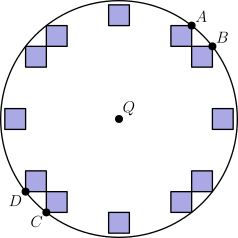
Sea la clausura de Todo disco cerrado que contiene a también contiene a así que ambos conjuntos tienen el mismo radio mínimo de cobertura. La aplicación permuta los cuadrados unitarios cerrados de por lo que es simétrico bajo una rotación de alrededor de Si su punto opuesto también está en Todo disco que contiene ambos extremos de tiene radio al menos Por tanto, ningún disco envolvente puede tener radio menor que la mayor distancia de a
Esa mayor distancia se alcanza en esquinas como y y al revisar las esquinas de los doce cuadrados cerrados se obtiene El disco centrado en con este radio contiene cada cuadrado, así que alcanza la cota inferior.
Por tanto, el radio mínimo es y
Since and are integers whose squares sum to the pair is one of the pairs So is the union of the unit squares whose lower-left corners are these points.
Let be the closure of Any closed disk containing also contains so the two sets have the same minimum enclosing radius. The map permutes the closed unit squares in so is symmetric under rotation about If its opposite point also lies in Every disk containing both endpoints of has radius at least Thus no enclosing disk can have radius smaller than the greatest distance from to
That greatest distance is attained at square corners such as and and checking the corners of all twelve closed squares gives The disk centered at with this radius contains every square, so it attains the lower bound.
Hence the minimum radius is and
9.
Sea una solución real del sistema de ecuaciones El mayor valor posible de puede escribirse en la forma donde y son enteros positivos primos entre sí. Halle
Let be a real solution of the system of equations The greatest possible value of can be written in the form where and are relatively prime positive integers. Find
Respuesta: 158
Pista pequeña:
Sume a cada ecuación y ponga así
Add to each equation and set so
Pista grande:
Multiplicar las tres da que en realidad es una cuadrática en note que
Multiplying the three gives which is really a quadratic in note
Solución:
Sumar a cada ecuación da y Sea Multiplicar las tres ecuaciones produce así que es decir, cuyas raíces son y Cada raíz es alcanzable: las raíces cúbicas de entonces sí tienen producto
Sumando las ecuaciones originales, que se maximiza con la raíz mayor Por lo tanto,
Adding to each equation gives and Let Multiplying the three equations yields so i.e. whose roots are and Each root is achievable: the cube roots of then really do have product
Adding the original equations, which is maximized by the larger root Thus
10.
Sea el número de maneras de escribir en la forma donde los son enteros, y Un ejemplo de tal representación es Halle
Let be the number of ways to write in the form where the ’s are integers, and An example of such a representation is Find
Respuesta: 202
Pista pequeña:
Divida cada coeficiente en dígitos: con
Split each coefficient into digits: with
Pista grande:
Los son los dígitos de un número y los de un número y la condición es exactamente cuente los posibles
The are the digits of a number and the of a number and the condition is exactly count the possible
Solución:
Escriba cada coeficiente como con dígitos todo entero se descompone así de manera única. Poniendo y (leídos como números en base ), la condición se convierte en
Recíprocamente, cualesquiera enteros no negativos con satisfacen y así que cada uno tiene a lo sumo cuatro dígitos; esos dígitos recuperan los y y por tanto los Así que las representaciones corresponden exactamente a elecciones de con y
Write each coefficient as with digits every integer splits this way uniquely. Setting and (read as base- numbers), the condition becomes
Conversely, any nonnegative integers with satisfy and so each has at most four digits; those digits recover the and hence the So representations correspond exactly to choices of with and
11.
Sea la región formada por el conjunto de puntos del plano coordenado que satisfacen a la vez y Cuando se hace girar alrededor de la recta cuya ecuación es el volumen del sólido resultante es donde y son enteros positivos, y son primos entre sí, y no es divisible por el cuadrado de ningún primo. Halle
Let be the region consisting of the set of points in the coordinate plane that satisfy both and When is revolved around the line whose equation is the volume of the resulting solid is where and are positive integers, and are relatively prime, and is not divisible by the square of any prime. Find
Respuesta: 365
Pista pequeña:
La región es un triángulo con un lado sobre el eje de revolución halle sus tres vértices
The region is a triangle with one side on the axis of revolution find its three vertices
Pista grande:
Al girar se obtienen dos conos que comparten una base: volumen total donde es la distancia del vértice fuera del eje a la recta
Revolving gives two cones sharing a base: total volume where is the distance from the off-axis vertex to the line
Solución:
La condición significa para y para Al intersecar con el semiplano queda el triángulo con vértices y sobre la recta y ápice
El lado está sobre el eje de revolución, y el pie de la perpendicular desde a la recta, a saber está entre y Así que el sólido está formado por dos conos que comparten una base de radio y cuyas alturas suman y su volumen es Aquí
El volumen es así que
The condition means for and for Intersecting with the half-plane leaves the triangle with vertices and on the line and apex
Side lies on the axis of revolution, and the foot of the perpendicular from to the line, namely lies between and So the solid is two cones sharing a base of radius with heights summing to and its volume is Here
The volume is so
12.
Sea un entero y sea Halle el menor valor de tal que para toda partición de en dos subconjuntos, al menos uno de los subconjuntos contiene enteros y (no necesariamente distintos) tales que
Nota: una partición de es un par de conjuntos tales que y
Let be an integer and let Find the smallest value of such that for every partition of into two subsets, at least one of the subsets contains integers and (not necessarily distinct) such that
Note: a partition of is a pair of sets such that and
Respuesta: 243
Pista pequeña:
Pruebe particiones en dos subconjuntos que mantengan separados los números pequeños y sus productos por pares, como separar de
Try two-subset partitions that keep small numbers and their pairwise products apart, such as separating from
Pista grande:
Para la cota superior, siga las potencias de una vez que y quedan forzados en subconjuntos distintos, coloque y y una potencia más crea una contradicción
For the upper bound, follow the powers of once and are forced into different subsets, place and and one more power creates a contradiction
Solución:
Primero, funciona. Suponga que se particiona en y sin que ninguno contenga un producto, y digamos que Entonces debe estar en así que debe estar en y luego debe estar en Ahora considere si entonces pone un producto en si entonces pone uno en En cualquier caso llegamos a una contradicción.
Para la partición y evita productos: dos elementos de se multiplican dando algo en cualquier producto que involucre un elemento de es al menos y dos elementos de se multiplican dando al menos
Por lo tanto, el menor con esta propiedad es
First, works. Suppose were partitioned into and with neither containing a product, and say Then must lie in so must lie in and then must lie in Now consider if then puts a product in if then puts one in Either way we reach a contradiction.
For the partition and avoids products: two elements of multiply to something in any product involving an element of is at least and two elements of multiply to at least
Hence the smallest such is
13.
El rectángulo y un semicírculo de diámetro son coplanares y tienen interiores que no se superponen. Sea la región encerrada por el semicírculo y el rectángulo. La recta corta al semicírculo, al segmento y al segmento en puntos distintos y respectivamente. La recta divide la región en dos regiones con áreas en razón Suponga que y Entonces puede representarse como donde y son enteros positivos y no es divisible por el cuadrado de ningún primo. Halle
Rectangle and a semicircle with diameter are coplanar and have nonoverlapping interiors. Let denote the region enclosed by the semicircle and the rectangle. Line meets the semicircle, segment and segment at distinct points and respectively. Line divides region into two regions with areas in the ratio Suppose that and Then can be represented as where and are positive integers and is not divisible by the square of any prime. Find
Respuesta: 69
Pista pequeña:
Con el centro satisface así que el triángulo es equilátero y el sector es un tercio del semicírculo
With the center satisfies so triangle is equilateral and sector is one third of the semicircle
Pista grande:
Como divide el rectángulo también en razón los dos triángulos pequeños que recorta a cada lado de deben tener áreas iguales
Since splits the rectangle in ratio as well, the two small triangles that cuts off on either side of must have equal areas
Solución:
Aquí así que el semicírculo tiene centro (el punto medio de ) y radio Como el triángulo es equilátero, así que y el sector es exactamente un tercio del semicírculo. Del mismo modo, si es el pie de la perpendicular desde a entonces hace que el rectángulo sea un tercio del rectángulo
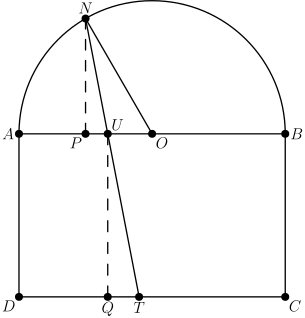
La parte de del lado de respecto de es igual a (sector ) (rectángulo ) Como esto debe ser un tercio de necesitamos Sea el pie de la perpendicular desde a En el triángulo -- y así que y Los triángulos y son triángulos rectángulos semejantes (ángulos opuestos por el vértice en ), así que esto último porque ambos triángulos tienen altura sobre las bases y
Igualar las áreas de los dos triángulos da así que y
Here so the semicircle has center (the midpoint of ) and radius Since triangle is equilateral, so and sector is exactly one third of the semicircle. Likewise, if is the foot of the perpendicular from to then makes rectangle one third of rectangle
The part of on the -side of equals (sector ) (rectangle ) Since this must be one third of we need Let be the foot of the perpendicular from to In the -- triangle and so and Triangles and are similar right triangles (vertical angles at ), so the latter because both triangles have height over bases and
Setting the two triangle areas equal gives so and
14.
Para cada entero positivo sea Halle el mayor valor de para el cual
Nota: es el mayor entero menor o igual que
For each positive integer let Find the largest value of for which
Note: is the greatest integer less than or equal to
Respuesta: 109
Pista pequeña:
Cada término nunca decrece a medida que crece, así que es no decreciente; calcule como referencia
Each term never decreases as grows, so is nondecreasing; compute as a baseline
Pista grande:
Para apenas mayor que cuente los con y los con para ver exactamente cuándo alcanza
For slightly above count the with and the with to see exactly when reaches
Solución:
Cada término es no decreciente en así que es no decreciente y basta localizar dónde supera Para los productos van de a dando para para y para así que
Para como y los términos son para para y para Para ahora así que diez términos valen y
Por monotonía, el mayor válido es
Each term is nondecreasing in so is nondecreasing and we just locate where it passes For the products run from to giving for for and for so
For since and the terms are for for and for For now so ten terms equal and
By monotonicity, the largest valid is
15.
En con y sea un punto sobre tal que los círculos inscritos de y tienen radios iguales. Sean y enteros positivos primos entre sí tales que Halle
In with and let be a point on such that the incircles of and have equal radii. Let and be positive relatively prime integers such that Find
Respuesta: 45
Pista pequeña:
Escribiendo el área como tenemos Por lo tanto, radios inscritos iguales significan que las áreas y los perímetros de los dos triángulos están en la misma razón, y ambas razones son iguales a
Writing the area as we have Thus equal inradii mean the two triangles’ areas and perimeters are in the same ratio, and both ratios equal
Pista grande:
Ponga la condición de perímetros da y el teorema de Stewart sobre la ceviana da una segunda expresión para
Set the perimeter condition gives and Stewart’s theorem on cevian gives a second expression for
Solución:
Sea Los triángulos y comparten la altura desde así que Como el radio inscrito de un triángulo es su área dividida entre su semiperímetro, radios inscritos iguales también obligan a . De obtenemos y como la ecuación de perímetros se simplifica a así que y obliga a
El teorema de Stewart sobre la ceviana da así que Igualar esto a y quitar denominadores produce que se simplifica a
Las raíces son y y solo supera (entonces ). Por lo tanto,
Let Triangles and share the altitude from so Since the inradius of a triangle is its area divided by its semiperimeter, equal inradii force as well. From we get and since the perimeter equation simplifies to so and forces
Stewart’s theorem on cevian gives so Setting this equal to and clearing denominators yields which simplifies to
The roots are and and only exceeds (then ). Hence