2010 AIME I Problema 8

Intenta el Problema 8 del 2010 AIME I a continuación y luego compara tu respuesta con la solución preparada profesionalmente de LIVE by Po-Shen Loh. También puedes intentar el examen cronometrado completo, ver todas las soluciones del 2010 AIME I, o revisar la clave de respuestas.

Todos los problemas se usan con el permiso legal oficial de la Mathematical Association of America (MAA).

8.

Para un número real a,a, sea ⌊a⌋\lfloor a \rfloor el mayor entero menor o igual que a.a. Sea R\mathcal{R} la región del plano coordenado formada por los puntos (x,y)(x, y) tales que ⌊x⌋2+⌊y⌋2=25.\lfloor x \rfloor^2 + \lfloor y \rfloor^2 = 25. La región R\mathcal{R} está completamente contenida en un disco de radio rr (un disco es la unión de un círculo y su interior). El valor mínimo de rr puede escribirse como mn,\frac{\sqrt{m}}{n}, donde mm y nn son enteros y mm no es divisible por el cuadrado de ningún primo. Halle m+n.m + n.
For a real number a,a, let ⌊a⌋\lfloor a \rfloor denote the greatest integer less than or equal to a.a. Let R\mathcal{R} denote the region in the coordinate plane consisting of points (x,y)(x, y) such that ⌊x⌋2+⌊y⌋2=25.\lfloor x \rfloor^2 + \lfloor y \rfloor^2 = 25. The region R\mathcal{R} is completely contained in a disk of radius rr (a disk is the union of a circle and its interior). The minimum value of rr can be written as mn,\frac{\sqrt{m}}{n}, where mm and nn are integers and mm is not divisible by the square of any prime. Find m+n.m + n.
Respuesta: 132
Conceptos:funciones piso y techopunto reticularfórmula de la distanciasimetría
Nivel de dificultad: 2840
Pista pequeña:
(⌊x⌋,⌊y⌋)(\lfloor x \rfloor, \lfloor y \rfloor) debe ser uno de los 1212 pares de enteros cuyos cuadrados suman 25,25, así que R\mathcal{R} es una unión de 1212 cuadrados unitarios
(⌊x⌋,⌊y⌋)(\lfloor x \rfloor, \lfloor y \rfloor) must be one of the 1212 integer pairs with squares summing to 25,25, so R\mathcal{R} is a union of 1212 unit squares
Pista grande:
R\mathcal{R} es simétrica respecto de (12,12),\left(\frac{1}{2}, \frac{1}{2}\right), así que el mejor disco está centrado ahí; halle la esquina de cuadrado más lejana de ese centro
R\mathcal{R} is symmetric about (12,12),\left(\frac{1}{2}, \frac{1}{2}\right), so the best disk is centered there; find the square corner farthest from that center
Solución:
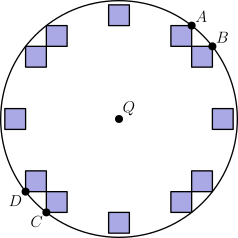
Como ⌊x⌋\lfloor x \rfloor y ⌊y⌋\lfloor y \rfloor son enteros cuyos cuadrados suman 25,25, el par (⌊x⌋,⌊y⌋)(\lfloor x \rfloor, \lfloor y \rfloor) es uno de los 1212 pares (±5,0),(\pm 5, 0), (0,±5),(0, \pm 5), (±3,±4),(\pm 3, \pm 4), (±4,±3).(\pm 4, \pm 3). Por tanto, R\mathcal{R} es la unión de los 1212 cuadrados unitarios cuyas esquinas inferiores izquierdas son esos puntos.
Sea KK la clausura de R.\mathcal{R}. Todo disco cerrado que contiene a R\mathcal{R} también contiene a K,K, así que ambos conjuntos tienen el mismo radio mínimo de cobertura. La aplicación (x,y)↦(1−x,1−y)(x, y) \mapsto (1 - x, 1 - y) permuta los cuadrados unitarios cerrados de K,K, por lo que KK es simétrico bajo una rotación de 180∘180^\circ alrededor de Q=(12,12).Q = \left(\frac{1}{2}, \frac{1}{2}\right). Si X∈K,X \in K, su punto opuesto X′=2Q−XX' = 2Q-X también está en K.K. Todo disco que contiene ambos extremos de XX′‾\overline{XX'} tiene radio al menos XX′2=XQ.\frac{XX'}{2} = XQ. Por tanto, ningún disco envolvente puede tener radio menor que la mayor distancia de QQ a K.K.
Esa mayor distancia se alcanza en esquinas como A=(4,5)A = (4, 5) y B=(5,4),B = (5, 4), y al revisar las esquinas de los doce cuadrados cerrados se obtiene QA=QB=(92)2+(72)2=1302.\begin{aligned} QA = QB &= \sqrt{\left(\tfrac{9}{2}\right)^2 + \left(\tfrac{7}{2}\right)^2} \\ &= \frac{\sqrt{130}}{2}. \end{aligned} El disco centrado en QQ con este radio contiene cada cuadrado, así que alcanza la cota inferior.
Por tanto, el radio mínimo es r=1302,r = \frac{\sqrt{130}}{2}, y m+n=130+2=132.m + n = 130 + 2 = 132.
Since ⌊x⌋\lfloor x \rfloor and ⌊y⌋\lfloor y \rfloor are integers whose squares sum to 25,25, the pair (⌊x⌋,⌊y⌋)(\lfloor x \rfloor, \lfloor y \rfloor) is one of the 1212 pairs (±5,0),(\pm 5, 0), (0,±5),(0, \pm 5), (±3,±4),(\pm 3, \pm 4), (±4,±3).(\pm 4, \pm 3). So R\mathcal{R} is the union of the 1212 unit squares whose lower-left corners are these points.
Let KK be the closure of R.\mathcal{R}. Any closed disk containing R\mathcal{R} also contains K,K, so the two sets have the same minimum enclosing radius. The map (x,y)↦(1−x,1−y)(x, y) \mapsto (1 - x, 1 - y) permutes the closed unit squares in K,K, so KK is symmetric under 180∘180^\circ rotation about Q=(12,12).Q = \left(\frac{1}{2}, \frac{1}{2}\right). If X∈K,X \in K, its opposite point X′=2Q−XX' = 2Q-X also lies in K.K. Every disk containing both endpoints of XX′‾\overline{XX'} has radius at least XX′2=XQ.\frac{XX'}{2} = XQ. Thus no enclosing disk can have radius smaller than the greatest distance from QQ to K.K.
That greatest distance is attained at square corners such as A=(4,5)A = (4, 5) and B=(5,4),B = (5, 4), and checking the corners of all twelve closed squares gives QA=QB=(92)2+(72)2=1302.\begin{aligned} QA = QB &= \sqrt{\left(\tfrac{9}{2}\right)^2 + \left(\tfrac{7}{2}\right)^2} \\ &= \frac{\sqrt{130}}{2}. \end{aligned} The disk centered at QQ with this radius contains every square, so it attains the lower bound.
Hence the minimum radius is r=1302,r = \frac{\sqrt{130}}{2}, and m+n=130+2=132.m + n = 130 + 2 = 132.
Problema 7#7
Examen completo

El Problema 8 en otros años