2006 AIME II Problema 8

A continuación está la solución preparada profesionalmente para el Problema 8 del 2006 AIME II, de LIVE by Po-Shen Loh. También puedes intentar el examen cronometrado completo, ver todas las soluciones del 2006 AIME II, o revisar la clave de respuestas.

Todos los problemas se usan con el permiso legal oficial de la Mathematical Association of America (MAA).

Conceptos:combinacionessimetríaanálisis por casos

Nivel de dificultad: 2390

8.

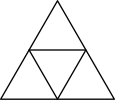
Hay un suministro ilimitado de triángulos equiláteros congruentes hechos de papel de colores. Cada triángulo es de un color sólido, con el mismo color en ambas caras del papel. Se construye un triángulo equilátero grande con cuatro de estos triángulos de papel, como se muestra. Dos triángulos grandes se consideran distinguibles si no es posible colocar uno sobre el otro, usando traslaciones, rotaciones y/o reflexiones, de modo que sus triángulos pequeños correspondientes sean del mismo color. Dado que hay seis colores diferentes de triángulos para elegir, ¿cuántos triángulos equiláteros grandes distinguibles se pueden construir?

There is an unlimited supply of congruent equilateral triangles made of colored paper. Each triangle is a solid color with the same color on both sides of the paper. A large equilateral triangle is constructed from four of these paper triangles as shown. Two large triangles are considered distinguishable if it is not possible to place one on the other, using translations, rotations, and/or reflections, so that their corresponding small triangles are of the same color. Given that there are six different colors of triangles from which to choose, how many distinguishable large equilateral triangles can be constructed?

Solución:

Las rotaciones y reflexiones del triángulo grande realizan toda permutación de los tres triángulos de las esquinas mientras dejan fijo el triángulo central. Así que dos triángulos grandes son indistinguibles exactamente cuando tienen el mismo color central y el mismo multiconjunto de tres colores de esquina.

Cuenta los multiconjuntos de colores de esquina de entre seis colores: los tres iguales (66 formas), exactamente dos iguales (65=306 \cdot 5 = 30 formas, eligiendo el color repetido y luego el distinto), o los tres distintos ((63)=20\binom{6}{3} = 20 formas). Eso da 6+30+20=566 + 30 + 20 = 56 multiconjuntos.

Con 66 opciones independientes para el color central, el total es 656=336.6 \cdot 56 = 336.

The rotations and reflections of the large triangle realize every permutation of the three corner triangles while fixing the center triangle. So two large triangles are indistinguishable exactly when they have the same center color and the same multiset of three corner colors.

Count the multisets of corner colors from six colors: all three the same (66 ways), exactly two the same (65=306 \cdot 5 = 30 ways, choosing the repeated color and then the different one), or all three different ((63)=20\binom{6}{3} = 20 ways). That is 6+30+20=566 + 30 + 20 = 56 multisets.

With 66 independent choices for the center color, the total is 656=336.6 \cdot 56 = 336.

← Problema 7#7Examen completoProblema 9#9 →

El Problema 8 en otros años