
Soluciones del 2006 AIME II
Desplázate hacia abajo para ver las soluciones preparadas profesionalmente de LIVE by Po-Shen Loh, imprime las soluciones en PDF, consulta la clave de respuestas, o haz el examen cronometrado completo.
Todos los problemas se usan con el permiso legal oficial de la Mathematical Association of America (MAA).
1.
En el hexágono convexo los seis lados son congruentes, y son ángulos rectos, y y son congruentes. El área de la región hexagonal es Halla
In convex hexagon all six sides are congruent, and are right angles, and and are congruent. The area of the hexagonal region is Find
Pista pequeña:
Cada uno de los ángulos mide Traza las diagonales y
Each of angles measures Draw diagonals and
Pista grande:
Estas diagonales dividen el hexágono en dos triángulos rectángulos isósceles y un rectángulo con lados y
These diagonals cut the hexagon into two right isosceles triangles and a rectangle with side lengths and
Solución:
Los ángulos de un hexágono suman así que cada uno de los cuatro ángulos congruentes mide grados. Sea Las diagonales y recortan los triángulos rectángulos isósceles y cada uno con catetos e hipotenusa y los ángulos de garantizan que la pieza restante es un rectángulo con lados y
Por lo tanto, el área es así que y
The angles of a hexagon sum to so each of the four congruent angles measures degrees. Let The diagonals and cut off the right isosceles triangles and each with legs and hypotenuse and the angles guarantee that the remaining piece is a rectangle with sides and
Hence the area is so and
2.
Las longitudes de los lados de un triángulo de área positiva son y donde es un entero positivo. Halla el número de valores posibles de
The lengths of the sides of a triangle with positive area are and where is a positive integer. Find the number of possible values for
Pista pequeña:
Las tres longitudes deben satisfacer la desigualdad triangular; dos de las tres condiciones acotan por ambos lados.
The three lengths must satisfy the triangle inequality; two of the three conditions bound from both sides.
Pista grande:
así que
so
Solución:
La desigualdad triangular exige y es decir La desigualdad restante, es automática porque y
Así que lo que para enteros significa Eso da valores posibles de
The triangle inequality requires and that is The remaining inequality, is automatic because and
So which for integers means That gives possible values of
3.
Sea el producto de los primeros enteros impares positivos. Halla el mayor entero tal que sea divisible por
Let be the product of the first positive odd integers. Find the largest integer such that is divisible by
Pista pequeña:
Cuenta cuántos de son divisibles por luego por por y por
Count how many of are divisible by then by by and by
Pista grande:
Cada capa de divisibilidad añade un factor más por cada término que sobrevive, así que es la suma de los cuatro recuentos.
Each divisibility layer adds one more factor of per surviving term, so is the sum of the four counts.
Solución:
así que es el número total de factores de entre los números impares hasta Los múltiplos impares de son y hay de ellos. Los múltiplos impares de son de ellos. Los múltiplos impares de son de ellos. El único múltiplo impar de que no supera es mismo, y no hay múltiplos de
Cada capa aporta un factor adicional de así que
so is the total number of factors of among the odd numbers up to The odd multiples of are and there are of them. The odd multiples of are of them. The odd multiples of are of them. The only odd multiple of at most is itself, and there are no multiples of
Each layer contributes one additional factor of so
4.
Sea una permutación de para la cual y Un ejemplo de tal permutación es Halla el número de tales permutaciones.
Let be a permutation of for which and An example of such a permutation is Find the number of such permutations.
Pista pequeña:
es menor que los otros once términos, así que
is less than all eleven other terms, so
Pista grande:
Una vez que eliges cuáles cinco de los números restantes ocupan las primeras cinco posiciones, el orden de ambas mitades queda determinado.
Once you choose which five of the remaining numbers fill the first five slots, the order of both halves is forced.
Solución:
El término es menor que cualquier otro término de la permutación, así que Ahora elige cuáles cinco de los números restantes ocupan las posiciones a deben aparecer en orden decreciente, de modo que su disposición queda determinada, y los otros seis números deben llenar las posiciones a en orden creciente, lo que también queda determinado.
Cada elección de los cinco números da exactamente una permutación válida, así que el conteo es
The term is smaller than every other term of the permutation, so Now choose which five of the remaining numbers occupy positions through they must appear in decreasing order, so their arrangement is forced, and the other six numbers must fill positions through in increasing order, which is also forced.
Every choice of the five numbers gives exactly one valid permutation, so the count is
5.
Al lanzar cierto dado injusto de seis caras numeradas y la probabilidad de obtener la cara es mayor que la probabilidad de obtener la cara opuesta a la cara es menor que la probabilidad de obtener cada una de las demás caras es y la suma de los números en cada par de caras opuestas es Al lanzar dos de estos dados, la probabilidad de obtener una suma de es Dado que la probabilidad de obtener la cara es donde y son enteros positivos primos entre sí, halla
When rolling a certain unfair six-sided die with faces numbered and the probability of obtaining face is greater than the probability of obtaining the face opposite face is less than the probability of obtaining each of the other faces is and the sum of the numbers on each pair of opposite faces is When two such dice are rolled, the probability of obtaining a sum of is Given that the probability of obtaining face is where and are relatively prime positive integers, find
Pista pequeña:
Escribe la probabilidad de la cara como de modo que la cara opuesta tiene probabilidad
Write the probability of face as so the opposite face has probability
Pista grande:
Una suma de siempre proviene de un par de caras opuestas:
A sum of always comes from a pair of opposite faces:
Solución:
Sea la probabilidad de la cara igual a de modo que la cara opuesta a tiene probabilidad (las seis probabilidades deben sumar ). Como las caras opuestas suman un total de ocurre exactamente cuando los dos dados muestran un par de caras opuestas. De los seis pares ordenados que suman cuatro usan solo caras ordinarias, y dos emparejan con su opuesta. Así
Como esto da así que La probabilidad de la cara es y
Let the probability of face be so the face opposite has probability (the six probabilities must sum to ). Since opposite faces sum to a total of occurs exactly when the two dice show a pair of opposite faces. Of the six ordered pairs that sum to four use only ordinary faces, and two pair with its opposite. Thus
Since this gives so The probability of face is and
6.
El cuadrado tiene lados de longitud Los puntos y están en y respectivamente, de modo que es equilátero. Un cuadrado con vértice tiene lados paralelos a los de y un vértice en La longitud del lado de este cuadrado más pequeño es donde y son enteros positivos y no es divisible por el cuadrado de ningún primo. Halla
Square has sides of length Points and are on and respectively, so that is equilateral. A square with vertex has sides that are parallel to those of and a vertex on The length of a side of this smaller square is where and are positive integers and is not divisible by the square of any prime. Find
Pista pequeña:
Si la condición de equilátero da así que
If the equilateral condition gives so
Pista grande:
Con en el origen, la recta es y el vértice opuesto del cuadrado pequeño es y debe estar sobre ella.
With at the origin, line is and the small square’s far corner must lie on it.
Solución:
Coloca Por la simetría del triángulo equilátero respecto a la diagonal tenemos Sea de modo que Entonces y e igualándolos se obtiene así que (tomando la raíz menor que ).
Por lo tanto y la recta es Si el cuadrado más pequeño tiene lado su vértice opuesto a es que debe estar sobre la recta
Así que y
Place By the symmetry of the equilateral triangle across diagonal we have Let so Then and and setting them equal gives so (taking the root less than ).
Thus and line is If the smaller square has side its vertex opposite is which must lie on line
So and
7.
Halla el número de pares ordenados de enteros positivos tales que y tanto como tengan representaciones decimales sin el dígito cero.
Find the number of ordered pairs of positive integers such that and neither nor has a zero digit.
Pista pequeña:
Cuenta en su lugar los pares prohibidos. Si termina en lo mismo sucede con lo que da con
Count the bad pairs instead. If ends in then so does giving with
Pista grande:
Si ninguno de los dos números termina en un dígito cero solo puede ser el dígito central de un número , y entonces el dígito de las decenas del otro número es
If neither number ends in a zero digit can only be a middle digit — and then the other number’s tens digit is
Solución:
Hay pares en total (); cuenta los prohibidos. Si tiene dígito de las unidades entonces también, y escribiendo se obtiene con esos son pares prohibidos.
Ahora supón que ambos dígitos de las unidades son distintos de cero. Entonces un número del par tiene un dígito cero exactamente cuando es un número de tres dígitos de la forma con (un número de uno o dos dígitos con dígito de las unidades no nulo no tiene dígito cero). Si entonces tiene dígito de las decenas así que tampoco es de esa forma. Por lo tanto los pares prohibidos aquí son aquellos en que exactamente uno de es igual a pares.
El número total de pares prohibidos es así que la respuesta es
There are pairs in all (); count the forbidden ones. If has units digit so does and writing gives with that is forbidden pairs.
Now suppose both units digits are nonzero. Then a number in the pair has a zero digit exactly when it is a three-digit number of the form with (a one- or two-digit number with nonzero units digit has no zero digit). If then has tens digit so is not also of that form. Hence the forbidden pairs here are those where exactly one of equals pairs.
The total number of forbidden pairs is so the answer is
8.
Hay un suministro ilimitado de triángulos equiláteros congruentes hechos de papel de colores. Cada triángulo es de un color sólido, con el mismo color en ambas caras del papel. Se construye un triángulo equilátero grande con cuatro de estos triángulos de papel, como se muestra. Dos triángulos grandes se consideran distinguibles si no es posible colocar uno sobre el otro, usando traslaciones, rotaciones y/o reflexiones, de modo que sus triángulos pequeños correspondientes sean del mismo color. Dado que hay seis colores diferentes de triángulos para elegir, ¿cuántos triángulos equiláteros grandes distinguibles se pueden construir?
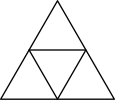
There is an unlimited supply of congruent equilateral triangles made of colored paper. Each triangle is a solid color with the same color on both sides of the paper. A large equilateral triangle is constructed from four of these paper triangles as shown. Two large triangles are considered distinguishable if it is not possible to place one on the other, using translations, rotations, and/or reflections, so that their corresponding small triangles are of the same color. Given that there are six different colors of triangles from which to choose, how many distinguishable large equilateral triangles can be constructed?
Pista pequeña:
Las rotaciones y reflexiones pueden permutar arbitrariamente los tres triángulos de las esquinas, así que solo importan el color del centro y el multiconjunto de colores de las esquinas.
Rotations and reflections can permute the three corner triangles arbitrarily, so only the center color and the multiset of corner colors matter.
Pista grande:
Cuenta los multiconjuntos de tres colores de esquina de entre seis: todos iguales, exactamente dos iguales, todos distintos. Luego multiplica por las opciones para el centro.
Count the multisets of three corner colors from six: all alike, exactly two alike, all different. Then multiply by the choices for the center.
Solución:
Las rotaciones y reflexiones del triángulo grande realizan toda permutación de los tres triángulos de las esquinas mientras dejan fijo el triángulo central. Así que dos triángulos grandes son indistinguibles exactamente cuando tienen el mismo color central y el mismo multiconjunto de tres colores de esquina.
Cuenta los multiconjuntos de colores de esquina de entre seis colores: los tres iguales ( formas), exactamente dos iguales ( formas, eligiendo el color repetido y luego el distinto), o los tres distintos ( formas). Eso da multiconjuntos.
Con opciones independientes para el color central, el total es
The rotations and reflections of the large triangle realize every permutation of the three corner triangles while fixing the center triangle. So two large triangles are indistinguishable exactly when they have the same center color and the same multiset of three corner colors.
Count the multisets of corner colors from six colors: all three the same ( ways), exactly two the same ( ways, choosing the repeated color and then the different one), or all three different ( ways). That is multisets.
With independent choices for the center color, the total is
9.
Las circunferencias y tienen sus centros en y y tienen radios y respectivamente. La recta es una tangente interior común a y y tiene pendiente positiva, y la recta es una tangente interior común a y y tiene pendiente negativa. Dado que las rectas y se cortan en y que donde y son enteros positivos y no es divisible por el cuadrado de ningún primo, halla
Circles and have their centers at and and have radii and respectively. Line is a common internal tangent to and and has a positive slope, and line is a common internal tangent to and and has a negative slope. Given that lines and intersect at and that where and are positive integers and is not divisible by the square of any prime, find
Pista pequeña:
Una tangente interior común cruza el segmento que une los centros en el punto que lo divide en la razón de los radios.
A common internal tangent crosses the segment joining the centers at the point that divides it in the ratio of the radii.
Pista grande:
es y es iguálalas y racionaliza.
is and is set them equal and rationalize.
Solución:
Una tangente interior común corta el segmento entre los centros en el punto que lo divide en la razón de los radios. Para y ese punto es a distancia de Si forma un ángulo con el eje , entonces así que y es Para y el punto es a distancia de aquí así que la pendiente es y es
Igualando las dos expresiones y multiplicando por se obtiene así que y
Así que
A common internal tangent meets the segment between the centers at the point dividing it in the ratio of the radii. For and that point is at distance from If makes angle with the -axis, then so and is For and the point is at distance from here so the slope is and is
Setting the two expressions equal and multiplying by gives so and
Thus
10.
Siete equipos juegan un torneo de fútbol en el que cada equipo juega contra cada uno de los demás exactamente una vez. No hay empates, cada equipo tiene una probabilidad del de ganar cada partido que juega, y los resultados de los partidos son independientes. En cada partido, el ganador recibe punto y el perdedor obtiene puntos. Los puntos totales se acumulan para decidir las posiciones de los equipos. En el primer partido del torneo, el equipo vence al equipo La probabilidad de que el equipo termine con más puntos que el equipo es donde y son enteros positivos primos entre sí. Halla
Seven teams play a soccer tournament in which each team plays every other team exactly once. No ties occur, each team has a chance of winning each game it plays, and the outcomes of the games are independent. In each game, the winner is awarded point and the loser gets points. The total points are accumulated to decide the ranks of the teams. In the first game of the tournament, team beats team The probability that team finishes with more points than team is where and are relatively prime positive integers. Find
Pista pequeña:
empieza con un punto de ventaja y nunca vuelve a jugar contra , así que termina por delante exactamente cuando el equipo gana al menos tantos de sus partidos restantes como
starts one point ahead and never plays again, so finishes ahead exactly when wins at least as many of its remaining games as does.
Pista grande:
La probabilidad de que los recuentos de victorias restantes sean iguales es por simetría, los demás resultados se reparten equitativamente entre los equipos.
The chance the remaining win counts are equal is by symmetry the other outcomes split evenly between the teams.
Solución:
Los equipos y tienen cada uno partidos restantes, ninguno entre sí, así que los resultados son igualmente probables. Como ya lidera por un punto, termina con más puntos exactamente cuando gana al menos tantos partidos restantes como .
El número de resultados con recuentos de victorias iguales es Por simetría, los otros resultados se reparten por igual entre aquellos en los que gana más partidos y aquellos en los que gana más.
Así que la probabilidad es y
Teams and each have games left, none against each other, so all outcomes are equally likely. Since already leads by one point, finishes with more points exactly when wins at least as many remaining games as does.
The number of outcomes with equal win counts is By symmetry, the other outcomes split evenly between winning more and winning more.
So the probability is and
11.
Una sucesión se define como sigue: y, para todo entero positivo Dado que y halla el residuo cuando se divide entre
A sequence is defined as follows: and, for all positive integers Given that and find the remainder when is divided by
Pista pequeña:
Calcula las primeras sumas parciales y compáralas con la propia sucesión para detectar un patrón.
Compute the first several partial sums and compare them with the sequence itself to spot a pattern.
Pista grande:
La inducción usando la recurrencia muestra
Induction using the recurrence shows
Solución:
Sea Afirmamos que lo cual se cumple para ya que Si se cumple para entonces por la recurrencia, lo que completa la inducción.
Por lo tanto cuyo residuo al dividir entre es
Let We claim which holds for since If it holds for then by the recurrence, completing the induction.
Therefore whose remainder upon division by is
12.
El equilátero está inscrito en una circunferencia de radio Prolonga más allá de hasta el punto de modo que y prolonga más allá de hasta el punto de modo que Por traza una recta paralela a y por traza una recta paralela a Sea la intersección de y Sea el punto de la circunferencia que es colineal con y y distinto de Dado que el área de se puede expresar en la forma donde y son enteros positivos, y son primos entre sí, y no es divisible por el cuadrado de ningún primo, halla
Equilateral is inscribed in a circle of radius Extend through to point so that and extend through to point so that Through draw a line parallel to and through draw a line parallel to Let be the intersection of and Let be the point on the circle that is collinear with and and distinct from Given that the area of can be expressed in the form where and are positive integers, and are relatively prime, and is not divisible by the square of any prime, find
Pista pequeña:
es un paralelogramo, así que halla y por la ley de cosenos.
is a parallelogram, so find and by the law of cosines.
Pista grande:
Los ángulos inscritos muestran con razón donde
Inscribed angles show with ratio where
Solución:
Por construcción, es un paralelogramo con y Por lo tanto y por la ley de cosenos,
Como está en la circunferencia, los ángulos inscritos dan (ambos subtienden el arco ) y (ambos subtienden el arco ); y porque Así que con razón El lado de un triángulo equilátero inscrito en una circunferencia de radio es
Por lo tanto, y
By construction is a parallelogram with and Hence and by the law of cosines,
Since lies on the circle, inscribed angles give (both subtend arc ) and (both subtend arc ); and because So with ratio The side of an equilateral triangle inscribed in a circle of radius is
Therefore and
13.
¿Cuántos enteros menores que se pueden escribir como suma de enteros impares positivos consecutivos, de modo que esto sea posible para exactamente valores de ?
How many integers less than can be written as the sum of consecutive positive odd integers for exactly values of
Pista pequeña:
Una suma de números impares consecutivos es una diferencia de cuadrados: es igual a
A sum of consecutive odd numbers is a difference of squares: it equals
Pista grande:
Así que cuenta las factorizaciones con de igual paridad: exactamente cinco ocurren cuando (caso impar) o (caso par) tiene o divisores.
So count factorizations with of equal parity: exactly five occur when (odd case) or (even case) has or divisors.
Solución:
La suma desde el -ésimo hasta el -ésimo entero impar positivo es Escribiendo y las representaciones de corresponden exactamente a las factorizaciones con y de la misma paridad (entonces ). Así que necesitamos que tenga exactamente tales factorizaciones.
Si es impar, todo par de divisores sirve, así que necesita o divisores, es decir o con primos impares distintos. Por debajo de y son imposibles, da y y da cinco valores impares.
Si es par, ambos factores deben ser pares, así que y las factorizaciones corresponden a los pares de divisores de sin restricción de paridad; necesitamos con o divisores. Con divisores: Con divisores (): Eso da valores pares, para un total de
The sum of the th through th positive odd integers is Writing and the representations of correspond exactly to the factorizations with and of the same parity (then ). So we need to have exactly such factorizations.
If is odd, every divisor pair works, so needs or divisors, i.e. or with distinct odd primes. Below and are impossible, gives and and gives five odd values.
If is even, both factors must be even, so and the factorizations correspond to divisor pairs of with no parity restriction; we need with or divisors. With divisors: With divisors (): That is even values, for a total of
14.
Sea la suma de los recíprocos de los dígitos no nulos de los enteros desde hasta inclusive. Halla el menor entero positivo para el cual es un entero.
Let be the sum of the reciprocals of the nonzero digits of the integers from to inclusive. Find the smallest positive integer for which is an integer.
Pista pequeña:
Rellena con ceros a la izquierda: entre los enteros menores que cada dígito aparece con la misma frecuencia, y cada dígito no nulo aparece veces.
Pad with leading zeros: among the integers below every digit appears equally often — each nonzero digit times.
Pista grande:
así que necesitas que sea divisible por ; comprueba qué factores de no puede aportar la potencia de .
so you need to be divisible by — check which factors of the power of cannot supply.
Solución:
Escribe los enteros desde hasta como cadenas de dígitos con ceros a la izquierda. Cada una de las posiciones de dígito toma cada valor de dígito con la misma frecuencia, así que cada dígito no nulo aparece veces. Sumando el dígito del propio ,
Como la suma es un entero exactamente cuando es divisible por Ahora y para el factor aporta dejando la condición de que sea divisible por (una potencia de no tiene factores ni ). Para los productos no son múltiplos de
Por lo tanto, la solución más pequeña es
Write the integers from to as -digit strings with leading zeros. Each of the digit positions takes each digit value equally often, so each nonzero digit appears times. Adding the digit of itself,
Since the sum is an integer exactly when is divisible by Now and for the factor supplies leaving the condition that be divisible by (a power of has no factors of or ). For the products are not multiples of
The smallest solution is therefore
15.
Sean y números reales que satisfacen y tales que donde y son enteros positivos, y no es divisible por el cuadrado de ningún primo. Halla
Given that and are real numbers that satisfy and that where and are positive integers, and is not divisible by the square of any prime, find
Pista pequeña:
Interpreta como un cateto de un triángulo rectángulo con hipotenusa y el otro cateto
Interpret as a leg of a right triangle with hypotenuse and other leg
Pista grande:
Construye un triángulo con lados cuyas alturas son Entonces con área usa la fórmula de Herón.
Build a triangle with sides whose altitudes are Then with area use Heron.
Solución:
Cada radical es el cateto de un triángulo rectángulo con hipotenusa y el otro cateto Así que la primera ecuación dice: en un triángulo con la altura desde tiene longitud y su pie divide en las dos longitudes radicales. Las otras ecuaciones dicen que las alturas a los lados y son y
Si es el área de este triángulo, entonces da y de igual modo y Estos son proporcionales a y así que el triángulo es acutángulo y los pies de las alturas sí caen dentro de los lados. La fórmula de Herón con da así que y
Entonces así que
Each radical is the leg of a right triangle with hypotenuse and other leg So the first equation says: in a triangle with the altitude from has length and its foot splits into the two radical lengths. The other equations say the altitudes to sides and are and
If is the area of this triangle, then gives and likewise and These are proportional to and so the triangle is acute and the altitude feet do land inside the sides. Heron’s formula with gives so and
Then so