2011 AIME I Problema 8

A continuación está la solución preparada profesionalmente para el Problema 8 del 2011 AIME I, de LIVE by Po-Shen Loh. También puedes intentar el examen cronometrado completo, ver todas las soluciones del 2011 AIME I, o revisar la clave de respuestas.

Todos los problemas se usan con el permiso legal oficial de la Mathematical Association of America (MAA).

Conceptos:Fórmula de Herónsemejanzaoptimización

Nivel de dificultad: 3060

8.

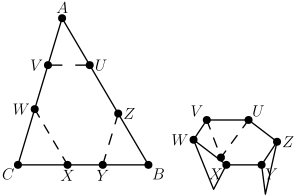
En ABC,\triangle ABC, BC=23,BC = 23, CA=27,CA = 27, y AB=30.AB = 30. Los puntos VV y WW están sobre AC\overline{AC} con VV sobre AW,\overline{AW}, los puntos XX y YY están sobre BC\overline{BC} con XX sobre CY,\overline{CY}, y los puntos ZZ y UU están sobre AB\overline{AB} con ZZ sobre BU.\overline{BU}. Además, los puntos se ubican de modo que UVBC,\overline{UV} \parallel \overline{BC}, WXAB,\overline{WX} \parallel \overline{AB}, y YZCA.\overline{YZ} \parallel \overline{CA}. Luego se hacen pliegues en ángulo recto a lo largo de UV,\overline{UV}, WX,\overline{WX}, y YZ.\overline{YZ}. La figura resultante se coloca sobre un piso nivelado para formar una mesa con patas triangulares. Sea hh la máxima altura posible de una mesa construida a partir de ABC\triangle ABC cuya superficie sea paralela al piso. Entonces hh se puede escribir en la forma kmn,\frac{k\sqrt{m}}{n}, donde kk y nn son enteros positivos primos entre sí y mm es un entero positivo no divisible por el cuadrado de ningún primo. Halla k+m+n.k + m + n.

In ABC,\triangle ABC, BC=23,BC = 23, CA=27,CA = 27, and AB=30.AB = 30. Points VV and WW are on AC\overline{AC} with VV on AW,\overline{AW}, points XX and YY are on BC\overline{BC} with XX on CY,\overline{CY}, and points ZZ and UU are on AB\overline{AB} with ZZ on BU.\overline{BU}. In addition, the points are positioned so that UVBC,\overline{UV} \parallel \overline{BC}, WXAB,\overline{WX} \parallel \overline{AB}, and YZCA.\overline{YZ} \parallel \overline{CA}. Right angle folds are then made along UV,\overline{UV}, WX,\overline{WX}, and YZ.\overline{YZ}. The resulting figure is placed on a level floor to make a table with triangular legs. Let hh be the maximum possible height of a table constructed from ABC\triangle ABC whose top is parallel to the floor. Then hh can be written in the form kmn,\frac{k\sqrt{m}}{n}, where kk and nn are relatively prime positive integers and mm is a positive integer that is not divisible by the square of any prime. Find k+m+n.k + m + n.

Solución:

Escribe a=BC=23,a = BC = 23, b=CA=27,b = CA = 27, c=AB=30,c = AB = 30, y sea KK el área de ABC.\triangle ABC. Por la fórmula de Herón con semiperímetro 40,40, K=40171310K = \sqrt{40 \cdot 17 \cdot 13 \cdot 10} =20221.= 20\sqrt{221}. Cuando la esquina en un vértice se dobla hacia abajo en ángulo recto, la solapa cuelga hasta una profundidad igual a la distancia de ese vértice a la línea de pliegue, así que para una superficie de mesa nivelada de altura h,h, cada línea de pliegue debe estar a distancia hh de su vértice.

La solapa en AA es semejante a ABC\triangle ABC con razón h2K/a=ha2K\frac{h}{2K/a} = \frac{ha}{2K} (dividiendo hh entre la distancia de AA a BC\overline{BC}), así que ocupa AU=cha2KAU = c \cdot \frac{ha}{2K} del lado AB;\overline{AB}; de igual modo la solapa en BB ocupa BZ=chb2KBZ = c \cdot \frac{hb}{2K} del mismo lado. Los dos pliegues caben sin cruzarse exactamente cuando AU+BZc,AU + BZ \le c, es decir, h(a+b)2K.h(a + b) \le 2K. Los otros dos lados dan h(b+c)2Kh(b + c) \le 2K y h(c+a)2K.h(c + a) \le 2K.

La restricción determinante proviene de la suma mayor, b+c=57,b + c = 57, así que la altura máxima es h=2K57=4022157,h = \frac{2K}{57} = \frac{40\sqrt{221}}{57}, y k+m+n=40+221+57k + m + n = 40 + 221 + 57 =318.= 318.

Write a=BC=23,a = BC = 23, b=CA=27,b = CA = 27, c=AB=30,c = AB = 30, and let KK be the area of ABC.\triangle ABC. By Heron's formula with semiperimeter 40,40, K=40171310K = \sqrt{40 \cdot 17 \cdot 13 \cdot 10} =20221.= 20\sqrt{221}. When the corner at a vertex is folded down at a right angle, the flap hangs to a depth equal to the distance from that vertex to the fold line, so for a level tabletop of height h,h, each fold line must lie at distance hh from its vertex.

The flap at AA is similar to ABC\triangle ABC with ratio h2K/a=ha2K\frac{h}{2K/a} = \frac{ha}{2K} (dividing hh by the distance from AA to BC\overline{BC}), so it uses up AU=cha2KAU = c \cdot \frac{ha}{2K} of side AB;\overline{AB}; likewise the flap at BB uses BZ=chb2KBZ = c \cdot \frac{hb}{2K} of the same side. The two folds fit without crossing exactly when AU+BZc,AU + BZ \le c, that is, h(a+b)2K.h(a + b) \le 2K. The other two sides give h(b+c)2Kh(b + c) \le 2K and h(c+a)2K.h(c + a) \le 2K.

The binding constraint comes from the largest sum, b+c=57,b + c = 57, so the maximum height is h=2K57=4022157,h = \frac{2K}{57} = \frac{40\sqrt{221}}{57}, and k+m+n=40+221+57k + m + n = 40 + 221 + 57 =318.= 318.

← Problema 7#7Examen completoProblema 9#9 →

El Problema 8 en otros años