
Soluciones del 2011 AIME I
Desplázate hacia abajo para ver las soluciones preparadas profesionalmente de LIVE by Po-Shen Loh, imprime las soluciones en PDF, consulta la clave de respuestas, o haz el examen cronometrado completo.
Todos los problemas se usan con el permiso legal oficial de la Mathematical Association of America (MAA).
1.
El frasco contiene cuatro litros de una solución con % de ácido. El frasco contiene cinco litros de una solución con % de ácido. El frasco contiene un litro de una solución con % de ácido. Del frasco se agregan litros de la solución al frasco , y el resto de la solución del frasco se agrega al frasco . Al final, tanto el frasco como el frasco contienen soluciones con % de ácido. Dado que y son enteros positivos primos entre sí, halla
Jar contains four liters of a solution that is % acid. Jar contains five liters of a solution that is % acid. Jar contains one liter of a solution that is % acid. From jar , liters of the solution is added to jar , and the remainder of the solution in jar is added to jar . At the end both jar and jar contain solutions that are % acid. Given that and are relatively prime positive integers, find
Pista pequeña:
Imagina verter los tres frascos juntos: el resultado son litros que deben tener % de ácido, lo que determina
Imagine pouring all three jars together: the result is liters that must be % acid, which determines
Pista grande:
Conocido , sea la cantidad agregada al frasco e iguala el ácido del frasco a la mitad de su nuevo volumen
With known, let be the amount added to jar and set jar ’s acid equal to half of its new volume
Solución:
Si se combinaran los tres frascos, el resultado serían litros con % de ácido, ya que los dos frascos finales tienen ambos % de ácido. Por lo tanto, el ácido total es de litros, así que lo que da
Ahora sea el número de litros vertidos del frasco al frasco . El frasco contiene entonces litros con litros de ácido, así que lo que da por lo que
Así, y
If all three jars were combined, the result would be liters of % acid, since both final jars are % acid. The total acid is therefore liters, so which gives
Now let be the number of liters poured from jar into jar . Jar then holds liters containing liters of acid, so giving so
Thus and
2.
En el rectángulo y Los puntos y están dentro del rectángulo de modo que y la recta corta al segmento La longitud se puede expresar en la forma donde y son enteros positivos y no es divisible por el cuadrado de ningún primo. Halla
In rectangle and Points and lie inside rectangle so that and line intersects segment The length can be expressed in the form where and are positive integers and is not divisible by the square of any prime. Find
Pista pequeña:
Como escribe y para un vector unitario
Since write and for one unit vector
Pista grande:
obliga a que y estén a la misma altura, lo que da entonces es una diferencia de coordenadas
forces and to the same height, giving then is a difference of -coordinates
Solución:
Coloca Como existe un vector unitario con tal que y la recta va hacia abajo y a la izquierda para poder cruzar mientras que apunta hacia arriba y a la derecha, hacia el interior del rectángulo.
Como es horizontal, y tienen alturas iguales: así que y
Entonces y tienen coordenadas iguales a y así que ya que Por lo tanto,
Place Since there is a unit vector with such that and line heads down and to the left so that it can cross while points up and to the right into the rectangle.
Because is horizontal, and have equal heights: so and
Then and have -coordinates and so since Thus
3.
Sea la recta de pendiente que contiene al punto y sea la recta perpendicular a la recta que contiene al punto Se borran los ejes de coordenadas originales, y la recta se toma como eje y la recta como eje . En el nuevo sistema de coordenadas, el punto está en el semieje positivo, y el punto está en el semieje positivo. El punto con coordenadas en el sistema original tiene coordenadas en el nuevo sistema de coordenadas. Halla
Let be the line with slope that contains the point and let be the line perpendicular to line that contains the point The original coordinate axes are erased, and line is made the -axis and line the -axis. In the new coordinate system, point is on the positive -axis, and point is on the positive -axis. The point with coordinates in the original system has coordinates in the new coordinate system. Find
Pista pequeña:
Las nuevas coordenadas de son sus distancias con signo a los nuevos ejes: es la distancia a la recta y la distancia a la recta
The new coordinates of are its signed distances to the new axes: is the distance to line and the distance to line
Pista grande:
Usa la fórmula de distancia de un punto a una recta, fijando cada signo al comprobar si está del mismo lado que (para ) o que (para )
Use the point-to-line distance formula, fixing each sign by checking whether is on the same side as (for ) or as (for )
Solución:
La recta es y la recta es La nueva coordenada de un punto es su distancia con signo a la recta contada como positiva en el lado que contiene a y la nueva coordenada es su distancia con signo a la recta positiva en el lado que contiene a
Sustituyendo en se obtiene mientras que da dividiendo entre obtenemos Sustituyendo en se obtiene y da así que está del mismo lado de que y
Por lo tanto,
Line is and line is The new -coordinate of a point is its signed distance to line counted positive on the side containing and the new -coordinate is its signed distance to line positive on the side containing
Substituting into gives while gives dividing by we get Substituting into gives and gives so lies on the same side of as and
Therefore
4.
En el triángulo y La bisectriz del ángulo corta a en el punto y la bisectriz del ángulo corta a en el punto Sean y los pies de las perpendiculares desde a y respectivamente. Halla
In triangle and The angle bisector of angle intersects at point and the angle bisector of angle intersects at point Let and be the feet of the perpendiculars from to and respectively. Find
Pista pequeña:
Prolonga y hasta que corten a
Extend and until they meet
Pista grande:
es a la vez bisectriz y altura del triángulo por lo que ese triángulo es isósceles y es un punto medio; entonces es una paralela media
is both a bisector and an altitude of triangle so that triangle is isosceles and is a midpoint; then is a midline
Solución:
Prolonga y hasta cortar a en y respectivamente. En el triángulo el segmento es a la vez bisectriz y altura, por lo que el triángulo es isósceles con y es el punto medio de De manera similar, el triángulo es isósceles con y es el punto medio de
Por lo tanto, es una paralela media del triángulo así que Como concluimos que
Extend and to meet at and respectively. In triangle the segment is both an angle bisector and an altitude, so the triangle is isosceles with and is the midpoint of Similarly, triangle is isosceles with and is the midpoint of
Hence is a midline of triangle so Since we conclude
5.
Los vértices de un nonágono regular (polígono de lados) se van a etiquetar con los dígitos a de tal manera que la suma de los números en cada tres vértices consecutivos sea múltiplo de Dos disposiciones aceptables se consideran indistinguibles si una se puede obtener de la otra rotando el nonágono en el plano. Halla el número de disposiciones aceptables distinguibles.
The vertices of a regular nonagon (-sided polygon) are to be labeled with the digits through in such a way that the sum of the numbers on every three consecutive vertices is a multiple of Two acceptable arrangements are considered to be indistinguishable if one can be obtained from the other by rotating the nonagon in the plane. Find the number of distinguishable acceptable arrangements.
Pista pequeña:
Compara dos tripletas solapadas de vértices consecutivos: sus sumas difieren en las etiquetas separadas por tres posiciones, así que las etiquetas separadas por tres posiciones son congruentes módulo
Compare two overlapping triples of consecutive vertices: their sums differ by the labels three apart, so labels three apart are congruent mod
Pista grande:
Cada una de las clases de residuos ocupa una de las tres clases de posiciones; cuenta las asignaciones y ordenamientos, luego divide entre rotaciones
Each of the residue classes occupies one of the three position classes; count assignments and orderings, then divide by rotations
Solución:
Dos tripletas solapadas de vértices consecutivos comparten dos etiquetas, así que sus sumas difieren en las etiquetas separadas por tres posiciones. Como todas las sumas de tripletas son múltiplos de las etiquetas separadas por tres posiciones son congruentes módulo Por lo tanto, las clases de posiciones llevan cada una una sola clase de residuos de dígitos, y los dígitos a constan exactamente de tres dígitos de cada clase de residuos módulo
Entonces cada tripleta de posiciones consecutivas contiene un dígito de cada clase de residuos, con suma así que las asignaciones de clases de residuos a clases de posiciones son todas aceptables, y dentro de cada clase de posiciones los tres dígitos se pueden ordenar de maneras. Eso da etiquetados aceptables.
Como los dígitos son distintos, ninguna rotación no trivial fija un etiquetado, así que los etiquetados se dividen en clases de rotación de tamaño lo que da disposiciones distinguibles.
Two overlapping triples of consecutive vertices share two labels, so their sums differ by labels three positions apart. Since all triple sums are multiples of labels three apart are congruent mod Thus the position classes each carry a single residue class of digits, and the digits through consist of exactly three digits from each residue class mod
Every triple of consecutive positions then contains one digit from each residue class, with sum so all assignments of residue classes to position classes are acceptable, and within each position class the three digits can be arranged in ways. That gives acceptable labelings.
Because the digits are distinct, no nontrivial rotation fixes a labeling, so the labelings split into rotation classes of size giving distinguishable arrangements.
6.
Supón que una parábola tiene vértice y ecuación donde y es un entero. El mínimo valor posible de se puede escribir en la forma donde y son enteros positivos primos entre sí. Halla
Suppose that a parabola has vertex and equation where and is an integer. The minimum possible value of can be written in the form where and are relatively prime positive integers. Find
Pista pequeña:
Escribe la parábola en forma canónica y observa que es el valor de en
Write the parabola in vertex form and note that is the value of at
Pista grande:
Así que debe ser un entero; elige el entero que haga lo más pequeño posible manteniendo
So must be an integer; choose the integer that makes as small as possible while keeping
Solución:
En forma canónica la parábola es Como es igual al valor de en
Si esto es igual al entero entonces La condición requiere es decir y es mínimo cuando lo que da
Así,
In vertex form the parabola is Since equals the value of at
If this equals the integer then The condition requires that is and is smallest when giving
Thus
7.
Halla el número de enteros positivos para los cuales existen enteros no negativos tales que
Find the number of positive integers for which there exist nonnegative integers such that
Pista pequeña:
Reduce ambos lados módulo toda potencia de es congruente con
Reduce both sides mod every power of is congruent to
Pista grande:
Así que debe dividir a Recíprocamente, expande descomponiendo repetidamente una potencia en copias de la potencia inmediatamente inferior; cada descomposición añade términos.
So must divide Conversely, expand by repeatedly splitting one power into copies of the next-lower power; each split adds terms.
Solución:
El valor falla, ya que el lado derecho sería mientras que el lado izquierdo es Para reduce módulo toda potencia de es así que la ecuación obliga a es decir, divide a
Recíprocamente, supón que Toma haz que de los sean iguales a y para cada haz que de los sean iguales a Esto usa términos, y la suma es telescópica:
Así que la ecuación tiene solución exactamente cuando divide a que tiene divisores. Hay de tales
The value fails, since the right side would be while the left side is For reduce mod every power of is so the equation forces that is, divides
Conversely, suppose Take let of the equal and for each let of the equal This uses terms, and the sum telescopes:
So the equation is solvable exactly when divides which has divisors. There are such
8.
En y Los puntos y están sobre con sobre los puntos y están sobre con sobre y los puntos y están sobre con sobre Además, los puntos se ubican de modo que y Luego se hacen pliegues en ángulo recto a lo largo de y La figura resultante se coloca sobre un piso nivelado para formar una mesa con patas triangulares. Sea la máxima altura posible de una mesa construida a partir de cuya superficie sea paralela al piso. Entonces se puede escribir en la forma donde y son enteros positivos primos entre sí y es un entero positivo no divisible por el cuadrado de ningún primo. Halla
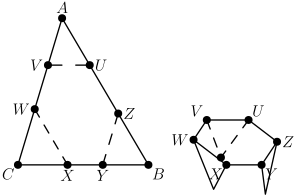
In and Points and are on with on points and are on with on and points and are on with on In addition, the points are positioned so that and Right angle folds are then made along and The resulting figure is placed on a level floor to make a table with triangular legs. Let be the maximum possible height of a table constructed from whose top is parallel to the floor. Then can be written in the form where and are relatively prime positive integers and is a positive integer that is not divisible by the square of any prime. Find
Pista pequeña:
Una solapa doblada hacia abajo desde un vértice cuelga hasta una profundidad igual a la distancia de ese vértice a su línea de pliegue, así que las tres líneas de pliegue deben estar a distancia de sus vértices
A flap folded down from a vertex hangs to a depth equal to the distance from that vertex to its fold line, so all three fold lines must be at distance from their vertices
Pista grande:
Dos pliegues que cortan el mismo lado no deben solaparse: para cada lado, el producto de por la suma de las longitudes de los otros dos lados es como máximo el doble del área del triángulo; la mayor de esas sumas es la restricción determinante
Two folds cutting the same side must not overlap: for each side, multiplying by the sum of the other two side lengths gives at most twice the triangle’s area; the largest such sum is the binding constraint
Solución:
Escribe y sea el área de Por la fórmula de Herón con semiperímetro Cuando la esquina en un vértice se dobla hacia abajo en ángulo recto, la solapa cuelga hasta una profundidad igual a la distancia de ese vértice a la línea de pliegue, así que para una superficie de mesa nivelada de altura cada línea de pliegue debe estar a distancia de su vértice.
La solapa en es semejante a con razón (dividiendo entre la distancia de a ), así que ocupa del lado de igual modo la solapa en ocupa del mismo lado. Los dos pliegues caben sin cruzarse exactamente cuando es decir, Los otros dos lados dan y
La restricción determinante proviene de la suma mayor, así que la altura máxima es y
Write and let be the area of By Heron’s formula with semiperimeter When the corner at a vertex is folded down at a right angle, the flap hangs to a depth equal to the distance from that vertex to the fold line, so for a level tabletop of height each fold line must lie at distance from its vertex.
The flap at is similar to with ratio (dividing by the distance from to ), so it uses up of side likewise the flap at uses of the same side. The two folds fit without crossing exactly when that is, The other two sides give and
The binding constraint comes from the largest sum, so the maximum height is and
9.
Supón que está en el intervalo y Halla
Suppose is in the interval and Find
Pista pequeña:
Reescribe la ecuación en forma exponencial y eleva al cuadrado ambos lados para obtener
Rewrite the equation in exponential form and square both sides to get
Pista grande:
Reemplaza por y busca una raíz racional de la ecuación cúbica resultante en
Replace by and look for a rational root of the resulting cubic in
Solución:
En forma exponencial la ecuación dice Elevando al cuadrado se obtiene así que
Escribiendo y usando obtenemos que se factoriza como El factor cuadrático tiene discriminante negativo, así que
Entonces
In exponential form the equation says Squaring gives so
Writing and using we get which factors as The quadratic factor has negative discriminant, so
Then
10.
La probabilidad de que un conjunto de tres vértices distintos elegidos al azar entre los vértices de un -ágono regular determinen un triángulo obtuso es Halla la suma de todos los valores posibles de
The probability that a set of three distinct vertices chosen at random from among the vertices of a regular -gon determine an obtuse triangle is Find the sum of all possible values of
Pista pequeña:
Un triángulo inscrito en un círculo es obtuso exactamente cuando sus tres vértices están estrictamente dentro de algún semicírculo
A triangle inscribed in a circle is obtuse exactly when its three vertices lie strictly inside some semicircle
Pista grande:
Cuenta los triángulos obtusos según su primer vértice en sentido horario, y trata por separado par e impar (solo par tiene triángulos rectángulos)
Count obtuse triangles by their clockwise-first vertex, and handle even and odd separately (only even has right triangles)
Solución:
Por el teorema del ángulo inscrito, un triángulo inscrito es obtuso exactamente cuando sus tres vértices están estrictamente dentro de algún semicírculo. Cuenta los triángulos obtusos según su vértice “primero”, el vértice desde el cual se llega a los otros dos yendo en sentido horario dentro de media circunferencia. Si el semicírculo abierto en sentido horario desde un vértice contiene vértices, lo que da triángulos obtusos; si contiene vértices, lo que da
Para la probabilidad es así que lo que da y
Para la probabilidad es así que lo que da y La suma de todos los valores posibles es
By the inscribed angle theorem, an inscribed triangle is obtuse exactly when its three vertices lie strictly within some semicircle. Count obtuse triangles by their “first” vertex, the vertex from which the other two are reached going clockwise within half the circle. If the open semicircle clockwise of a vertex contains vertices, giving obtuse triangles; if it contains vertices, giving
For the probability is so giving and
For the probability is so giving and The sum of all possible values is
11.
Sea el conjunto de todos los residuos posibles cuando un número de la forma con entero no negativo, se divide entre Sea la suma de los elementos de Halla el residuo cuando se divide entre
Let be the set of all possible remainders when a number of the form a nonnegative integer, is divided by Let be the sum of the elements in Find the remainder when is divided by
Pista pequeña:
A partir de , todo residuo es múltiplo de y las potencias de se repiten módulo con período
From on, every remainder is a multiple of and the powers of repeat mod with period
Pista grande:
Demuestra que de modo que los residuos separados por en el ciclo suman exactamente
Show so remainders apart in the cycle sum to exactly
Solución:
Los residuos y aparecen, y para todo es divisible por Módulo las potencias de para se repiten con período así que consta de y los residuos distintos de
El hecho clave es en efecto donde es divisible por y el segundo factor es porque Por lo tanto, para la suma es divisible por y por así que es divisible por
Emparejar cada residuo del ciclo con el que está pasos después da entonces pares de residuos distintos, cada par sumando exactamente así que esos residuos contribuyen un múltiplo de a Por lo tanto,
The remainders and occur, and for every is divisible by Modulo the powers of for repeat with period so consists of and the distinct remainders of
The key fact is indeed where is divisible by and the second factor is because Hence for the sum is divisible by and by so by
Pairing each remainder in the cycle with the one steps later therefore gives pairs of distinct remainders, each pair summing to exactly so those remainders contribute a multiple of to Thus
12.
Seis hombres y cierto número de mujeres se colocan en fila en orden aleatorio. Sea la probabilidad de que al menos cuatro hombres estén juntos en la fila, dado que cada hombre está junto a al menos otro hombre. Halla el menor número de mujeres en la fila tal que no exceda el por ciento.
Six men and some number of women stand in a line in random order. Let be the probability that a group of at least four men stand together in the line, given that every man stands next to at least one other man. Find the least number of women in the line such that does not exceed percent.
Pista pequeña:
Que cada hombre esté junto a otro hombre significa que los hombres se dividen en bloques de tamaños o coloca los bloques en los huecos entre las mujeres
Every man next to a man means the men split into blocks of sizes or place the blocks into gaps between the women
Pista grande:
La probabilidad condicional se simplifica a exige que sea a lo sumo
The conditional probability simplifies to require it to be at most
Solución:
Sea el número de mujeres; solo importa el patrón de las posiciones de hombres y mujeres. Si cada hombre está junto a otro hombre, los hombres forman bloques maximales cuyos tamaños, en orden, son o Un patrón con bloques equivale a elegir de los huecos determinados por las mujeres, así que hay patrones para para cada uno de los tres órdenes de dos bloques, y para un solo bloque.
Al menos cuatro hombres están juntos en los órdenes y así que
La condición se convierte en Como y el menor número de mujeres es
Let be the number of women; only the pattern of men’s and women’s positions matters. If every man stands next to another man, the men form maximal blocks whose sizes, in order, are or A pattern with blocks amounts to choosing of the gaps determined by the women, so there are patterns for for each of the three two-block orders, and for a single block.
At least four men stand together in the orders and so
The condition becomes Since and the least number of women is
13.
Un cubo de lado está suspendido sobre un plano. El vértice más cercano al plano se etiqueta Los tres vértices adyacentes al vértice están a alturas y sobre el plano. La distancia del vértice al plano se puede expresar como donde y son enteros positivos. Halla
A cube with side length is suspended above a plane. The vertex closest to the plane is labeled The three vertices adjacent to vertex are at heights and above the plane. The distance from vertex to the plane can be expressed as where and are positive integers. Find
Pista pequeña:
Si está a altura las tres aristas en ganan alturas y
If is at height the three edges at gain heights and
Pista grande:
Esas ganancias son veces las componentes, en las direcciones de las tres aristas perpendiculares, de la normal unitaria al plano orientada hacia arriba, así que la suma de sus cuadrados es
Those gains are times the components of the upward unit normal along the three perpendicular edges, so their squares sum to
Solución:
Sea la altura de y sean vectores unitarios a lo largo de las tres aristas mutuamente perpendiculares en Si es la normal unitaria al plano orientada hacia arriba, la altura del vértice a lo largo de la arista es así que y Como forman una base ortonormal,
Por lo tanto, lo que se simplifica a así que
Como es el vértice más cercano al plano, lo que obliga a y
Let be the height of and let be unit vectors along the three mutually perpendicular edges at If is the upward unit normal of the plane, the height of the vertex along edge is so and Because form an orthonormal basis,
Therefore which simplifies to so
Since is the closest vertex to the plane, forcing and
14.
Sea un octágono regular. Sean y los puntos medios de los lados y respectivamente. Para se construye el rayo desde hacia el interior del octágono de modo que y Los pares de rayos y y y y y se cortan en y respectivamente. Si entonces se puede escribir en la forma donde y son enteros positivos. Halla
Let be a regular octagon. Let and be the midpoints of sides and respectively. For ray is constructed from towards the interior of the octagon such that and Pairs of rays and and and and and meet at and respectively. If then can be written in the form where and are positive integers. Find
Pista pequeña:
Por la simetría de rotación de tanto como están en el rayo así que
By the rotational symmetry, both and lie on ray so
Pista grande:
El triángulo rectángulo da conocido , halla y usa
Right triangle gives with known, find and use
Solución:
Escala de modo que Una rotación de alrededor del centro lleva toda la configuración a sí misma, así que es un cuadrado y las distancias y no dependen de Tanto como están en el rayo (a distancias y de ), así que Además, hace que el triángulo sea rectángulo en así que
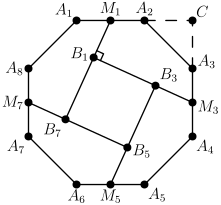
Las rectas y se cortan en un punto en ángulo recto, y el triángulo es un triángulo rectángulo isósceles con catetos así que y Entonces
Como el triángulo es un triángulo rectángulo isósceles y está sobre el segmento tenemos mientras que por el triángulo rectángulo. La fórmula de adición de la tangente da así que Por lo tanto, y
Scale so that A rotation about the center carries the whole configuration to itself, so is a square and the distances and do not depend on Both and lie on ray (at distances and from ), so Also, makes triangle right-angled at so
Lines and meet at a point at a right angle, and triangle is an isosceles right triangle with legs so and Then
Since triangle is an isosceles right triangle and lies on segment we have while from the right triangle. The tangent addition formula gives so Therefore and
15.
Para algún entero el polinomio tiene tres raíces enteras y Halla
For some integer the polynomial has the three integer roots and Find
Pista pequeña:
Vieta da y elimina para obtener
Vieta gives and eliminate to get
Pista grande:
Multiplica por Si es la menor raíz no negativa, entonces prueba qué hace de un cuadrado perfecto.
Multiply by If is the smaller nonnegative root, then test which makes a perfect square.
Solución:
Por las fórmulas de Vieta, y Negar las tres raíces reemplaza por así que podemos suponer que dos raíces, digamos son no negativas. Sustituir en la segunda ecuación da es decir,
Multiplicando por y completando el cuadrado, Como tenemos así que Al revisar estos valores, es un cuadrado perfecto solo para donde
Entonces da y (En efecto ) Por lo tanto,
By Vieta’s formulas, and Negating all three roots replaces by so we may assume two roots, say are nonnegative. Substituting into the second equation gives that is,
Multiplying by and completing the square, Since we have so Checking these values, is a perfect square only for where
Then gives and (Indeed ) Therefore