2005 AIME II Problema 8

A continuación está la solución preparada profesionalmente para el Problema 8 del 2005 AIME II, de LIVE by Po-Shen Loh. También puedes intentar el examen cronometrado completo, ver todas las soluciones del 2005 AIME II, o revisar la clave de respuestas.

Todos los problemas se usan con el permiso legal oficial de la Mathematical Association of America (MAA).

Conceptos:circunferencias tangentescuerdaTeorema de Pitágoras

Nivel de dificultad: 2710

8.

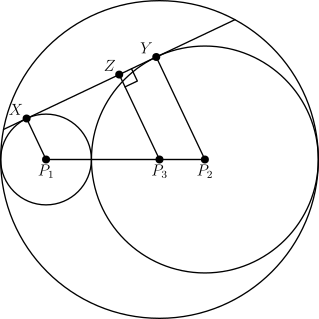
Los círculos C1\mathcal{C}_1 y C2\mathcal{C}_2 son tangentes exteriormente, y ambos son tangentes interiormente al círculo C3\mathcal{C}_3. Los radios de C1\mathcal{C}_1 y C2\mathcal{C}_2 son 44 y 1010, respectivamente, y los centros de los tres círculos son todos colineales. Una cuerda de C3\mathcal{C}_3 es también una tangente exterior común de C1\mathcal{C}_1 y C2\mathcal{C}_2. Dado que la longitud de la cuerda es mnp\frac{m\sqrt{n}}{p}, donde mm, nn, y pp son enteros positivos, mm y pp son primos entre sí, y nn no es divisible por el cuadrado de ningún primo, halla m+n+pm + n + p.

Circles C1\mathcal{C}_1 and C2\mathcal{C}_2 are externally tangent, and they are both internally tangent to circle C3.\mathcal{C}_3. The radii of C1\mathcal{C}_1 and C2\mathcal{C}_2 are 44 and 10,10, respectively, and the centers of the three circles are all collinear. A chord of C3\mathcal{C}_3 is also a common external tangent of C1\mathcal{C}_1 and C2.\mathcal{C}_2. Given that the length of the chord is mnp,\frac{m\sqrt{n}}{p}, where m,m, n,n, and pp are positive integers, mm and pp are relatively prime, and nn is not divisible by the square of any prime, find m+n+p.m + n + p.

Solución:

Sean P1P_1, P2P_2, P3P_3 los centros de los círculos y RR el radio de C3\mathcal{C}_3. La tangencia exterior da P1P2=4+10=14P_1P_2 = 4 + 10 = 14, y la tangencia interior da P3P1=R4P_3P_1 = R - 4 y P3P2=R10P_3P_2 = R - 10. Como los centros son colineales, (R4)+(R10)=14(R - 4) + (R - 10) = 14, así que R=14R = 14 y P3P_3 está sobre P1P2\overline{P_1P_2} con P3P1=10P_3P_1 = 10 y P3P2=4P_3P_2 = 4.

Traza las perpendiculares P1XP_1X, P2YP_2Y, P3ZP_3Z a la cuerda, de modo que P1X=4P_1X = 4, P2Y=10P_2Y = 10, y ZZ es el punto medio de la cuerda. La distancia desde un punto que se mueve a lo largo de la recta P1P2P_1P_2 hasta la recta tangente cambia linealmente, y P3P_3 está a 1014\frac{10}{14} del camino de P1P_1 a P2P_2, así que P3Z=4+1014(104)=587.P_3Z = 4 + \frac{10}{14}(10 - 4) = \frac{58}{7}.

La semicuerda es 142(587)2\sqrt{14^2 - \left(\frac{58}{7}\right)^2} =960433647= \frac{\sqrt{9604 - 3364}}{7} =43907= \frac{4\sqrt{390}}{7}, así que la cuerda tiene longitud 83907\frac{8\sqrt{390}}{7}. Como 390=23513390 = 2 \cdot 3 \cdot 5 \cdot 13 es libre de cuadrados y gcd(8,7)=1\gcd(8, 7) = 1, la respuesta es m+n+p=8+390+7=405m + n + p = 8 + 390 + 7 = 405.

Let P1,P_1, P2,P_2, P3P_3 be the centers of the circles and RR the radius of C3.\mathcal{C}_3. External tangency gives P1P2=4+10=14,P_1P_2 = 4 + 10 = 14, and internal tangency gives P3P1=R4P_3P_1 = R - 4 and P3P2=R10.P_3P_2 = R - 10. Since the centers are collinear, (R4)+(R10)=14,(R - 4) + (R - 10) = 14, so R=14R = 14 and P3P_3 lies on P1P2\overline{P_1P_2} with P3P1=10P_3P_1 = 10 and P3P2=4.P_3P_2 = 4.

Drop perpendiculars P1X,P_1X, P2Y,P_2Y, P3ZP_3Z to the chord, so P1X=4,P_1X = 4, P2Y=10,P_2Y = 10, and ZZ is the midpoint of the chord. The distance from a point moving along line P1P2P_1P_2 to the tangent line changes linearly, and P3P_3 is 1014\frac{10}{14} of the way from P1P_1 to P2,P_2, so P3Z=4+1014(104)=587.P_3Z = 4 + \frac{10}{14}(10 - 4) = \frac{58}{7}.

The half-chord is 142(587)2\sqrt{14^2 - \left(\frac{58}{7}\right)^2} =960433647= \frac{\sqrt{9604 - 3364}}{7} =43907,= \frac{4\sqrt{390}}{7}, so the chord has length 83907.\frac{8\sqrt{390}}{7}. Since 390=23513390 = 2 \cdot 3 \cdot 5 \cdot 13 is squarefree and gcd(8,7)=1,\gcd(8, 7) = 1, the answer is m+n+p=8+390+7=405.m + n + p = 8 + 390 + 7 = 405.

← Problema 7#7Examen completoProblema 9#9 →

El Problema 8 en otros años