
Problemas del 2005 AIME II
¡Desplázate hacia abajo y presiona Iniciar para intentar el examen! O ve al PDF imprimible, la clave de respuestas, o las soluciones profesionales preparadas por LIVE by Po-Shen Loh.
Todos los problemas se usan con el permiso legal oficial de la Mathematical Association of America (MAA).
O salta directamente a un solo problema con su solución: 1 · 2 · 3 · 4 · 5 · 6 · 7 · 8 · 9 · 10 · 11 · 12 · 13 · 14 · 15
¿Quieres aprender de forma profesional con clases interactivas en video?
Con tiempo
3:00:00
1.
Un juego usa una baraja de cartas distintas, donde es un entero y La cantidad de conjuntos posibles de cartas que se pueden sacar de la baraja es veces la cantidad de conjuntos posibles de cartas que se pueden sacar. Halla
A game uses a deck of different cards, where is an integer and The number of possible sets of cards that can be drawn from the deck is times the number of possible sets of cards that can be drawn. Find
Respuesta: 13
Pista pequeña:
Escribe la razón en factoriales; casi todo se cancela.
Write the ratio in factorials; almost everything cancels
Pista grande:
Resuelve escribiendo
Solve by writing
Solución:
La condición dice que Dividiendo los coeficientes binomiales, así que
Como el producto es creciente en la única solución es es decir,
The condition says Dividing the binomial coefficients, so
Since the product is increasing in the only solution is that is,
2.
Un hotel empaquetó un desayuno para cada uno de tres huéspedes. Cada desayuno debía consistir en tres tipos de panecillos, uno de nuez, uno de queso y uno de fruta. La encargada envolvió cada uno de los nueve panecillos y, una vez envueltos, los panecillos eran indistinguibles entre sí. Luego colocó al azar tres panecillos en una bolsa para cada uno de los huéspedes. Dado que la probabilidad de que cada huésped reciba un panecillo de cada tipo es donde y son enteros positivos primos entre sí, halla
A hotel packed a breakfast for each of three guests. Each breakfast should have consisted of three types of rolls, one each of nut, cheese, and fruit rolls. The preparer wrapped each of the nine rolls, and, once they were wrapped, the rolls were indistinguishable from one another. She then randomly put three rolls in a bag for each of the guests. Given that the probability that each guest got one roll of each type is where and are relatively prime positive integers, find
Respuesta: 79
Pista pequeña:
Halla la probabilidad de que la bolsa del primer huésped contenga uno de cada tipo extrayendo los tres panecillos uno a uno.
Find the chance the first guest’s bag has one roll of each type by drawing its three rolls one at a time
Pista grande:
Suponiendo que la primera bolsa es correcta, la segunda se llena con los seis panecillos restantes, dos de cada tipo; el contenido de la tercera queda entonces determinado.
Given the first bag is good, the second bag draws from six rolls, two of each type; the third bag is then forced
Solución:
Llena la bolsa del primer huésped de a un panecillo por vez. El primer panecillo puede ser cualquiera; el segundo debe evitar los panecillos restantes del tipo del primero, con probabilidad de éxito y el tercero debe ser uno de los panecillos del tipo faltante entre los restantes. Así que la primera bolsa tiene uno de cada tipo con probabilidad
En esas condiciones, quedan seis panecillos, dos de cada tipo, y el mismo argumento da para la segunda bolsa. La tercera bolsa contiene entonces automáticamente uno de cada tipo. La probabilidad es así que
Fill the first guest’s bag one roll at a time. The first roll can be anything; the second must avoid the remaining rolls of the first roll’s type, succeeding with probability and the third must be one of the rolls of the missing type among the remaining So the first bag has one roll of each type with probability
Given that, six rolls remain, two of each type, and the same argument gives for the second bag. The third bag is then automatically one of each type. The probability is so
3.
Una serie geométrica infinita tiene suma Una nueva serie, obtenida al elevar al cuadrado cada término de la serie original, tiene suma igual a veces la suma de la serie original. La razón común de la serie original es donde y son enteros positivos primos entre sí. Halla
An infinite geometric series has sum A new series, obtained by squaring each term of the original series, has sum times the sum of the original series. The common ratio of the original series is where and are relatively prime positive integers. Find
Respuesta: 802
Pista pequeña:
La serie de los cuadrados también es geométrica, con primer término y razón
The squared series is also geometric, with first term and ratio
Pista grande:
Factoriza para obtener y luego compara con
Factor to get then compare with
Solución:
Sean y el primer término y la razón de la serie original, respectivamente, de modo que La serie de los cuadrados es geométrica con primer término y razón así que lo cual da
Dividiendo las dos ecuaciones, así que lo que da y Como y la fracción está en su forma más simple, y
Let the original series have first term and ratio so The squared series is geometric with first term and ratio so which gives
Dividing the two equations, so giving and Since and the fraction is in lowest terms, and
4.
Halla la cantidad de enteros positivos que son divisores de al menos uno de
Find the number of positive integers that are divisors of at least one of
Respuesta: 435
Pista pequeña:
Cuenta los divisores de cada número a partir de su factorización en primos y luego corrige el conteo repetido.
Count the divisors of each number from its prime factorization, then fix the overcounting
Pista grande:
Los divisores comunes de dos de los números son exactamente los divisores de su máximo común divisor, por ejemplo
The common divisors of two of the numbers are exactly the divisors of their gcd, e.g.
Solución:
A partir de las factorizaciones y las cantidades de divisores son y
Los divisores comunes a dos de los números son exactamente los divisores de su máximo común divisor: tiene divisores, tiene y tiene Solo divide a los tres números.
Por inclusión-exclusión, la cantidad es
From the factorizations and the divisor counts are and
The divisors common to two of the numbers are exactly the divisors of their gcd: has divisors, has and has Only divides all three numbers.
By inclusion-exclusion, the count is
5.
Determina la cantidad de pares ordenados de enteros tales que y
Determine the number of ordered pairs of integers such that and
Respuesta: 54
Pista pequeña:
Pon como la ecuación se vuelve
Set since the equation becomes
Pista grande:
Los dos casos son y cuenta cuántos mantienen en cada caso.
The two cases are and count how many keep in each
Solución:
Sea Como la ecuación se vuelve es decir, así que o Eso significa que o
Para necesitamos (ya que y ), lo que da pares. Para necesitamos (ya que y ), lo que da pares.
En total hay pares ordenados.
Let Since the equation becomes i.e. so or That means or
For we need (since and ), giving pairs. For we need (since and ), giving pairs.
In total there are ordered pairs.
6.
Las cartas de un montón de cartas están numeradas consecutivamente de a de arriba hacia abajo. Se quitan las cartas de arriba, se mantienen en orden y forman el montón Las cartas restantes forman el montón Ahora las cartas se reapilan en un solo montón tomando cartas alternadamente de las partes superiores del montón y del montón respectivamente. En este proceso, la carta número es la carta del fondo del nuevo montón, la carta número queda encima de esta, y así sucesivamente, hasta que se agotan los montones y Si, tras el proceso de reapilado, al menos una carta de cada montón ocupa la misma posición que ocupaba en el montón original, se dice que el montón es mágico. Por ejemplo, ocho cartas forman un montón mágico porque las cartas número y número conservan sus posiciones originales. Halla la cantidad de cartas del montón mágico en el que la carta número conserva su posición original.
The cards in a stack of cards are numbered consecutively from through from top to bottom. The top cards are removed, kept in order, and form pile The remaining cards form pile The cards are now restacked into a single stack by taking cards alternately from the tops of pile and pile respectively. In this process, card number is the bottom card of the new stack, card number is on top of this card, and so on, until piles and are exhausted. If, after the restacking process, at least one card from each pile occupies the same position that it occupied in the original stack, the stack is called magical. For example, eight cards form a magical stack because cards number and number retain their original positions. Find the number of cards in the magical stack in which card number retains its original position.
Respuesta: 392
Pista pequeña:
Tras reapilar, las cartas del montón ocupan las posiciones impares desde arriba en orden inverso, y las del montón ocupan las posiciones pares.
After restacking, pile ’s cards fill the odd positions from the top in reverse order, and pile ’s fill the even positions
Pista grande:
La carta debe provenir del montón y una carta del montón en la posición va a parar a la posición
Card must come from pile and a pile- card at position lands at position
Solución:
El nuevo montón, leído de abajo hacia arriba, es Así que las cartas del montón ocupan las posiciones pares desde arriba en orden inverso, y las cartas del montón ocupan las posiciones impares en orden inverso: una carta en la posición original (montón ) se mueve a la posición mientras que una carta en la posición (montón ) se mueve a la posición
Como es impar, la carta puede conservar su posición solo si proviene del montón así que lo que da En efecto y el montón es mágico porque la carta del montón también queda fija: El montón tiene cartas.
The new stack, read from the bottom up, is So pile ’s cards occupy the even positions from the top in reverse order, and pile ’s cards occupy the odd positions in reverse order: a card at original position (pile ) moves to position while a card at position (pile ) moves to position
Since is odd, card can keep its position only if it comes from pile so which gives Indeed and the stack is magical because card from pile also stays fixed: The stack has cards.
7.
Sea Halla
Let Find
Respuesta: 125
Pista pequeña:
Pon y multiplica el numerador y el denominador por
Let and multiply the numerator and denominator by
Pista grande:
La aplicación repetida de la diferencia de cuadrados simplifica el denominador a
Repeated difference of squares collapses the denominator to
Solución:
Sea Al multiplicar el numerador y el denominador por las aplicaciones sucesivas de la diferencia de cuadrados producen cancelación telescópica en el denominador:
Por lo tanto y
Let Multiplying the numerator and denominator by telescopes the denominator by repeated difference of squares:
Hence and
8.
Los círculos y son tangentes exteriormente y ambos son tangentes interiormente al círculo Los radios de y son y respectivamente, y los centros de los tres círculos son colineales. Una cuerda de es también una tangente exterior común de y Dado que la longitud de la cuerda es donde y son enteros positivos, y son primos entre sí y no es divisible por el cuadrado de ningún primo, halla
Circles and are externally tangent, and they are both internally tangent to circle The radii of and are and respectively, and the centers of the three circles are all collinear. A chord of is also a common external tangent of and Given that the length of the chord is where and are positive integers, and are relatively prime, and is not divisible by the square of any prime, find
Respuesta: 405
Pista pequeña:
La tangencia obliga a que tenga radio con su centro sobre el segmento que une los otros dos centros, a del centro de
Tangency forces to have radius with its center on the segment joining the other two centers, from ’s center
Pista grande:
Las distancias desde los centros colineales a la recta tangente varían linealmente: la del medio es Luego usa el triángulo rectángulo formado por la mitad de la cuerda.
Distances from the collinear centers to the tangent line vary linearly: the middle one is Then use the half-chord right triangle.
Solución:
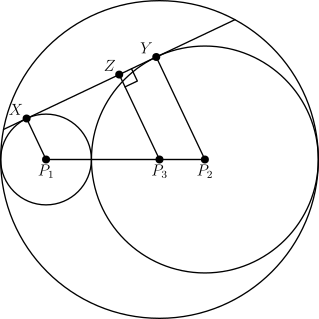
Sean y los centros de los círculos, y sea el radio de La tangencia exterior da y la tangencia interior da y Como los centros son colineales, así que y está sobre con y
Traza las perpendiculares y a la cuerda, de modo que y es el punto medio de la cuerda. La distancia hasta la recta tangente varía linealmente al desplazarse por y está a del trayecto desde hasta así que
La semicuerda es así que la cuerda tiene longitud Como es libre de cuadrados y la respuesta es
Let be the centers of the circles and the radius of External tangency gives and internal tangency gives and Since the centers are collinear, so and lies on with and
Drop perpendiculars to the chord, so and is the midpoint of the chord. The distance from a point moving along line to the tangent line changes linearly, and is of the way from to so
The half-chord is so the chord has length Since is squarefree and the answer is
9.
¿Para cuántos enteros positivos menores o iguales que se cumple para todo real ?
For how many positive integers less than or equal to is true for all real
Respuesta: 250
Pista pequeña:
Escribe y
Write and
Pista grande:
Por el teorema de De Moivre, la ecuación se reduce a así que debe ser más que un múltiplo de
By de Moivre the equation reduces to so must be more than a multiple of
Solución:
Como y el teorema de De Moivre (aplicado al ángulo ) da
Así que la ecuación se cumple para todo real exactamente cuando es decir, cuando Los valores dan exactamente enteros positivos hasta
Since and de Moivre’s theorem (applied to angle ) gives
So the equation holds for all real exactly when that is, when The values give exactly positive integers up to
10.
Dado que es un octaedro regular, que es el cubo cuyos vértices son los centros de las caras de y que la razón del volumen de al de es donde y son enteros positivos primos entre sí, halla
Given that is a regular octahedron, that is the cube whose vertices are the centers of the faces of and that the ratio of the volume of to that of is where and are relatively prime positive integers, find
Respuesta: 11
Pista pequeña:
Coloca los vértices del octaedro en y míralo como dos pirámides de base cuadrada.
Place the octahedron’s vertices at and view it as two square pyramids
Pista grande:
El centroide de cada cara es el promedio de sus tres vértices, así que los vértices del cubo son
Each face centroid is the average of its three vertices, so the cube’s vertices are
Solución:
Coloca los vértices del octaedro en Está formado por dos pirámides de base cuadrada unidas por el cuadrado con vértices y cuya área es Cada pirámide tiene altura así que
Cada centroide de cara es el promedio de los tres vértices de esa cara, por ejemplo así que el cubo tiene vértices Su arista es y su volumen es
La razón es así que
Place the octahedron’s vertices at It is two square pyramids glued along the square with vertices and which has area and each pyramid has height so
Each face centroid is the average of that face’s three vertices, e.g. so the cube has vertices Its edge is and its volume is
The ratio is so
11.
Sea un entero positivo y sea una sucesión de números reales tal que y para Halla
Let be a positive integer, and let be a sequence of real numbers such that and for Find
Respuesta: 889
Pista pequeña:
Multiplica la recurrencia por para ver que los productos disminuyen en a cada paso.
Multiply the recurrence by to see that the products drop by at each step
Pista grande:
y exactamente cuando el producto llega a
and exactly when the product reaches
Solución:
Multiplicar la recurrencia por da así que los productos forman una sucesión aritmética con diferencia común Como obtenemos
Así que para de modo que ningún término antes de puede anularse (y la recurrencia nunca divide por cero), mientras que con Por lo tanto y
Multiplying the recurrence by gives so the products form an arithmetic sequence with common difference Since we get
Thus for so no term before can vanish (and the recurrence never divides by zero), while with Hence and
12.
El cuadrado tiene centro y están sobre con y entre y y Dado que donde y son enteros positivos y no es divisible por el cuadrado de ningún primo, halla
Square has center and are on with and between and and Given that where and are positive integers and is not divisible by the square of any prime, find
Respuesta: 307
Pista pequeña:
Sea el punto medio de entonces y el rayo descompone el ángulo de como
Let be the midpoint of then and ray splits the angle into
Pista grande:
A partir de y obtén luego resuelve una ecuación cuadrática.
From and get then solve a quadratic
Solución:
Sea el punto medio de de modo que y Con y a ambos lados del rayo tenemos y De obtenemos
La fórmula de la tangente de la suma da así que Por lo tanto y son las raíces de a saber
Como y la condición significa así que Entonces y
Let be the midpoint of so and With and on either side of ray we have and From we get
The tangent addition formula gives so Hence and are the roots of namely
Since and the condition means so Then and
13.
Sea un polinomio con coeficientes enteros que satisface y Dado que la ecuación tiene dos soluciones enteras distintas y halla el producto
Let be a polynomial with integer coefficients that satisfies and Given that the equation has two distinct integer solutions and find the product
Respuesta: 418
Pista pequeña:
Considera que vale tanto en como en
Consider which equals at both and
Pista grande:
Si entonces divide a esos dos factores son enteros que difieren en
If then divides those two factors are integers differing by
Solución:
Sea de modo que Como tiene coeficientes enteros y se anula en y para algún polinomio con coeficientes enteros.
Si para un entero entonces así que divide a Los factores y son enteros que difieren en cuyo producto divide a así que son o lo que da y Ambos valores se obtienen, por ejemplo, con
Por lo tanto
Let so Since has integer coefficients and vanishes at and for some polynomial with integer coefficients.
If for an integer then so divides The factors and are integers differing by whose product divides so they are or giving and Both occur, for example, for
Hence
14.
En el triángulo y El punto está sobre con El punto está sobre tal que Dado que donde y son enteros positivos primos entre sí, halla
In triangle and Point is on with Point is on such that Given that where and are relatively prime positive integers, find
Respuesta: 463
Pista pequeña:
Compara y escribiendo cada razón como un cociente de áreas calculadas con para triángulos con vértice
Compare and by writing each as a ratio of triangle areas at vertex
Pista grande:
Los ángulos iguales se emparejan: al multiplicar las dos razones se obtiene
The equal angles pair up: multiplying the two ratios gives
Solución:
Una ceviana divide el lado opuesto en la razón y de forma análoga
Como también tenemos (cada uno es ese ángulo común más ), así que multiplicar las dos razones cancela todos los senos: Con y esto da
Por lo tanto Como es primo y no divide a la fracción está en su forma más simple, y
A cevian splits the opposite side in the ratio and similarly
Since we also have (each is that common angle plus ), so multiplying the two ratios cancels all the sines: With and this gives
Hence Since is prime and does not divide the fraction is in lowest terms, and
15.
Sean y los círculos y respectivamente. Sea el menor valor positivo de para el cual la recta contiene el centro de un círculo que es tangente interiormente a y tangente exteriormente a Dado que donde y son enteros positivos primos entre sí, halla
Let and denote the circles and respectively. Let be the smallest positive value of for which the line contains the center of a circle that is internally tangent to and externally tangent to Given that where and are relatively prime positive integers, find
Respuesta: 169
Pista pequeña:
Completa el cuadrado: los círculos tienen centros y con radios y Suma las dos condiciones de distancia de tangencia.
Complete the square: the circles have centers and with radii and Add the two tangency distance conditions.
Pista grande:
Los centros describen una elipse con focos sustituye y exige que el discriminante sea no negativo.
The centers trace an ellipse with foci substitute and require the discriminant to be nonnegative
Solución:
Completar el cuadrado da y con centros y y radios y Si un círculo con centro y radio es tangente interiormente a y tangente exteriormente a entonces y así que
Por lo tanto está sobre la elipse con focos y y eje mayor el semieje mayor es la distancia del centro al foco es así que el cuadrado del semieje menor es lo que da es decir, Sustituir da
La recta contiene un centro así exactamente cuando esta ecuación cuadrática tiene una raíz real, es decir, lo que se simplifica a así que El menor valor positivo de que cumple esto tiene y
Completing the square gives and with centers and and radii and If a circle with center and radius is internally tangent to and externally tangent to then and so
Thus lies on the ellipse with foci and and major axis the semimajor axis is the center-to-focus distance is so the semiminor axis squared is giving i.e. Substituting yields
The line contains such a center exactly when this quadratic has a real root, i.e. which simplifies to so The smallest positive such has and