
Problemas del 2016 AIME I
¡Desplázate hacia abajo y presiona Iniciar para intentar el examen! O ve al PDF imprimible, la clave de respuestas, o las soluciones profesionales preparadas por LIVE by Po-Shen Loh.
Todos los problemas se usan con el permiso legal oficial de la Mathematical Association of America (MAA).
O salta directamente a un solo problema con su solución: 1 · 2 · 3 · 4 · 5 · 6 · 7 · 8 · 9 · 10 · 11 · 12 · 13 · 14 · 15
¿Quieres aprender de forma profesional con clases interactivas en video?
Con tiempo
3:00:00
1.
Para sea la suma de la serie geométrica Sea entre y que satisface Halla
For let denote the sum of the geometric series Let between and satisfy Find
Respuesta: 336
Pista pequeña:
Cada serie es geométrica:
Each series is geometric:
Pista grande:
Tanto como dependen solo de así que nunca necesitas hallar
Both and depend only on so you never need to find
Solución:
La serie geométrica suma Por lo tanto así que
Sumando las dos sumas sobre un común denominador,
The geometric series sums to Therefore so
Adding the two sums over a common denominator,
2.
Dos dados parecen ser dados estándar con sus caras numeradas del al pero cada dado está sesgado de modo que la probabilidad de sacar el número es directamente proporcional a La probabilidad de sacar un con este par de dados es donde y son enteros positivos primos entre sí. Halla
Two dice appear to be standard dice with their faces numbered from to but each die is weighted so that the probability of rolling the number is directly proportional to The probability of rolling a with this pair of dice is where and are relatively prime positive integers. Find
Respuesta: 71
Pista pequeña:
En cada dado la probabilidad de sacar es ya que
On each die the probability of rolling is since
Pista grande:
La probabilidad de un total de es
The probability of a total of is
Solución:
Como cada dado saca con probabilidad Un total de surge de los pares para así que su probabilidad es
Por lo tanto
Since each die rolls with probability A total of arises from the pairs for so its probability is
Thus
3.
Un icosaedro regular es un sólido de caras donde cada cara es un triángulo equilátero y cinco triángulos se encuentran en cada vértice. El icosaedro regular que se muestra abajo tiene un vértice en la parte superior, un vértice en la parte inferior, un pentágono superior de cinco vértices todos adyacentes al vértice superior y todos en el mismo plano horizontal, y un pentágono inferior de cinco vértices todos adyacentes al vértice inferior y todos en otro plano horizontal. Halla el número de trayectorias desde el vértice superior hasta el vértice inferior tales que cada parte de una trayectoria va hacia abajo u horizontalmente a lo largo de una arista del icosaedro, y ningún vértice se repite.
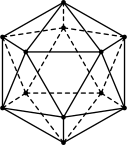
A regular icosahedron is a -faced solid where each face is an equilateral triangle and five triangles meet at every vertex. The regular icosahedron shown below has one vertex at the top, one vertex at the bottom, an upper pentagon of five vertices all adjacent to the top vertex and all in the same horizontal plane, and a lower pentagon of five vertices all adjacent to the bottom vertex and all in another horizontal plane. Find the number of paths from the top vertex to the bottom vertex such that each part of a path goes downward or horizontally along an edge of the icosahedron, and no vertex is repeated.
Respuesta: 810
Pista pequeña:
Cada trayectoria va: vértice superior, alrededor del pentágono superior, abajo, alrededor del pentágono inferior, abajo. Cuenta cada etapa por separado.
Every path goes: top vertex, around the upper pentagon, down, around the lower pentagon, down. Count each stage separately.
Pista grande:
Alrededor de un pentágono hay recorridos ( a pasos, en sentido horario o antihorario), y cada vértice superior tiene aristas hacia abajo al pentágono inferior
Around a pentagon there are routes ( to steps, clockwise or counterclockwise), and each upper vertex has downward edges to the lower pentagon
Solución:
Cada vértice del pentágono superior es adyacente al vértice superior, a dos vecinos del pentágono superior y a dos vértices del pentágono inferior; cada vértice del pentágono inferior es adyacente a dos vértices superiores, a dos vecinos del pentágono inferior y al vértice inferior. Así, una trayectoria hacia abajo u horizontal sin vértice repetido debe descender al pentágono superior, rodear parte de él en una dirección, bajar al pentágono inferior, rodear parte de él en una dirección y terminar en el vértice inferior.
Hay opciones para el primer paso hacia abajo. En el pentágono superior la trayectoria puede dar o pasos horizontales, en cualquiera de dos direcciones (una inversión repetiría un vértice), lo que da opciones. Luego hay aristas hacia abajo al pentágono inferior, de nuevo opciones horizontales allí, y último paso hacia abajo.
El total es
Each vertex of the upper pentagon is adjacent to the top vertex, two upper-pentagon neighbors, and two vertices of the lower pentagon; each vertex of the lower pentagon is adjacent to two upper vertices, two lower-pentagon neighbors, and the bottom vertex. So a downward-or-horizontal path with no repeated vertex must descend to the upper pentagon, circle part of it in one direction, drop to the lower pentagon, circle part of it in one direction, and end at the bottom.
There are choices for the first step down. On the upper pentagon the path can take or horizontal steps, in either of two directions (a reversal would repeat a vertex), for options. Then there are edges down to the lower pentagon, again horizontal options there, and final step down.
The total is
4.
Un prisma recto de altura tiene bases que son hexágonos regulares con lados de longitud Un vértice del prisma y sus tres vértices adyacentes son los vértices de una pirámide triangular. El ángulo diedro (el ángulo entre los dos planos) formado por la cara de la pirámide que está en una base del prisma y la cara de la pirámide que no contiene a mide Halla
A right prism with height has bases that are regular hexagons with sides of length A vertex of the prism and its three adjacent vertices are the vertices of a triangular pyramid. The dihedral angle (the angle between the two planes) formed by the face of the pyramid that lies in a base of the prism and the face of the pyramid that does not contain measures Find
Respuesta: 108
Pista pequeña:
La pirámide usa sus dos vecinos en la base y y el vértice directamente encima de el ángulo diedro se ubica a lo largo de
The pyramid uses its two base neighbors and and the vertex directly above the dihedral angle sits along
Pista grande:
Si es el punto medio de el ángulo diedro es usa para hallar
If is the midpoint of the dihedral angle is use to find
Solución:
Los tres vértices adyacentes a son sus dos vecinos y en la misma base hexagonal y el vértice directamente encima de con perpendicular a la base. La cara en la base es y la cara que evita es se encuentran a lo largo de
Sea el punto medio de Como y (el ángulo interior de un hexágono regular), y Como es perpendicular a la base, también, así que el ángulo diedro es
En el triángulo rectángulo así que
The three vertices adjacent to are its two neighbors and in the same hexagonal base and the vertex directly above with perpendicular to the base. The face in the base is and the face avoiding is they meet along
Let be the midpoint of Since and (the interior angle of a regular hexagon), and Because is perpendicular to the base, as well, so the dihedral angle is
In right triangle so
5.
Anh leyó un libro. El primer día leyó páginas en minutos, donde y son enteros positivos. El segundo día Anh leyó páginas en minutos. Cada día siguiente Anh leyó una página más que el día anterior, y le tomó un minuto más que el día anterior hasta que leyó por completo el libro de páginas. Le tomó un total de minutos leer el libro. Halla
Anh read a book. On the first day she read pages in minutes, where and are positive integers. On the second day Anh read pages in minutes. Each day thereafter Anh read one more page than she read on the previous day, and it took her one more minute than on the previous day until she completely read the page book. It took her a total of minutes to read the book. Find
Respuesta: 53
Pista pequeña:
Si terminó en días, las series aritméticas dan y
If she finished in days, arithmetic series give and
Pista grande:
Restar da y también divide a
Subtracting gives and also divides
Solución:
Supongamos que Anh terminó el día Sumando las progresiones aritméticas de páginas y de minutos, y así que y
Restando, así que Por lo tanto divide tanto a como a así que divide a Como la historia abarca más de un día,
Entonces da y da Por lo tanto
Say Anh finished on day Summing the arithmetic progressions of pages and of minutes, and so and
Subtracting, so Thus divides both and so divides Since the story spans more than one day,
Then gives and gives Hence
6.
En sea el centro de la circunferencia inscrita, y considérese la bisectriz de que corta a en La recta que pasa por y corta a la circunferencia circunscrita de en los dos puntos y Si y entonces donde y son enteros positivos primos entre sí. Halla
In let be the center of the inscribed circle, and let the bisector of intersect at The line through and intersects the circumscribed circle of at the two points and If and then where and are relatively prime positive integers. Find
Respuesta: 13
Pista pequeña:
Muestra mediante persecución de ángulos, así que
Show by angle chasing, so
Pista grande:
Los triángulos y comparten el ángulo y tienen así que
Triangles and share angle and have so
Solución:
El incentro está sobre la bisectriz entre y En el triángulo el ángulo exterior en da Por otro lado, (ambos subtienden el arco ) y (la bisectriz), así que Por lo tanto el triángulo es isósceles con
Los triángulos y tienen un ángulo común en y así que son semejantes. Por lo tanto lo que da
Finalmente así que
The incenter lies on the bisector between and In triangle the exterior angle at gives On the other hand, (both subtend arc ) and (the bisector), so Hence triangle is isosceles with
Triangles and have a common angle at and so they are similar. Therefore giving
Finally so
7.
Para enteros y considera el número complejo Halla el número de pares ordenados de enteros tales que este número complejo sea un número real.
For integers and consider the complex number Find the number of ordered pairs of integers such that this complex number is a real number.
Respuesta: 103
Pista pequeña:
Si el número es real exactamente cuando atiende al rango de y al denominador
If the number is real exactly when watch the range of and the denominator
Pista grande:
Si ambos términos son imaginarios y deben cancelarse: Factoriza como
If both terms are imaginary and must cancel: Factor as
Solución:
Si el primer término es real, así que el número es real exactamente cuando es decir Entonces obliga a y el denominador descarta Eso da pares.
Si entonces así que el número dado es que es real exactamente cuando Nota que es imposible aquí ya que no tiene solución entera. Para la ecuación se convierte en es decir y para se convierte en
Como tiene divisores positivos, tiene soluciones enteras ordenadas, y se cumple exactamente cuando el factor positivo es el mayor en valor absoluto: soluciones. Simétricamente, el otro caso da más. En todas ellas El total es
If the first term is real, so the number is real exactly when that is Then forces and the denominator rules out That gives pairs.
If then so the whole number is which is real exactly when Note is impossible here since has no integer solution. For the equation becomes that is and for it becomes
Since has positive divisors, has ordered integer solutions, and holds exactly when the positive factor is the larger in absolute value: solutions. Symmetrically the other case gives more. In all of these The total is
8.
Para una permutación de los dígitos sea la suma de los tres números de dígitos y Sea el valor mínimo de sujeto a la condición de que el dígito de las unidades de sea Sea el número de permutaciones con Halla
For a permutation of the digits let denote the sum of the three -digit numbers and Let be the minimum value of subject to the condition that the units digit of is Let denote the number of permutations with Find
Respuesta: 162
Pista pequeña:
Escribe por valor posicional: los tres dígitos de las unidades deben sumar o
Write by place value: the three units digits must sum to or
Pista grande:
El mínimo obliga a que los dígitos de las centenas sean y a que la suma de la columna de unidades sea cuenta cuáles ternas de suman
The minimum forces hundreds digits and a units-column sum of count which triples from sum to
Solución:
Por valor posicional, y los nueve dígitos suman El dígito de las unidades de es exactamente cuando o Escribiendo si la columna de unidades suma entonces mientras que si suma entonces Así que alcanzado exactamente cuando y los dígitos de las unidades suman
Los dígitos restantes deben dividirse de modo que la terna de unidades sume las posibilidades son y Cada una de las divisiones permite disposiciones de las tres columnas, así que
Por lo tanto
By place value, and all nine digits sum to The units digit of is exactly when or Writing if the units column sums to then while if it sums to then So achieved exactly when and the units digits sum to
The remaining digits must split so the units triple sums to the possibilities are and Each of the splits allows arrangements of the three columns, so
Therefore
9.
El triángulo tiene y Este triángulo está inscrito en el rectángulo con en y en Halla el área máxima posible de
Triangle has and This triangle is inscribed in rectangle with on and on Find the maximum possible area of
Respuesta: 744
Pista pequeña:
Con y el área es y
With and the area is and
Pista grande:
Producto a suma: maximizado cuando
Product-to-sum: maximized when
Solución:
Sea y de modo que A partir de los triángulos rectángulos y los lados del rectángulo son y así que su área es usando la identidad de producto a suma y
Esto se maximiza cuando lo cual es compatible con la restricción, dando un área de
Let and so From the right triangles and the sides of the rectangle are and so its area is using the product-to-sum identity and
This is maximized when which the constraint allows, giving area
10.
Una sucesión estrictamente creciente de enteros positivos tiene la propiedad de que para todo entero positivo la subsucesión es geométrica y la subsucesión es aritmética. Supongamos que Halla
A strictly increasing sequence of positive integers has the property that for every positive integer the subsequence is geometric and the subsequence is arithmetic. Suppose that Find
Respuesta: 504
Pista pequeña:
Escribe en su forma más simple; entonces y para algún entero positivo
Write in lowest terms; then and for some positive integer
Pista grande:
La inducción da así que nota que
Induction gives so note
Solución:
Escribe la razón común de como en su forma más simple, con ya que la sucesión crece. Como es un entero y obtenemos que divide a sea Entonces y la condición aritmética da Continuando, la inducción muestra para todo que
En particular Sea entonces divide a así que Pero y el único valor en el rango para el cual divide a es lo que da De necesitamos que sea múltiplo de con así que y que son coprimos.
Por lo tanto (De hecho la sucesión comienza y alcanza )
Write the common ratio of as in lowest terms, with since the sequence increases. Because is an integer and we get that divides set Then and the arithmetic condition gives Continuing, induction shows for every that
In particular Let then divides so But and the only value in range for which divides is giving From we need to be a multiple of with so and which are coprime.
Therefore (Indeed the sequence begins and reaches )
11.
Sea un polinomio no nulo tal que para todo real y Entonces donde y son enteros positivos primos entre sí. Halla
Let be a nonzero polynomial such that for every real and Then where and are relatively prime positive integers. Find
Respuesta: 109
Pista pequeña:
Sustituye y para hallar tres raíces de
Substitute and to find three roots of
Pista grande:
Escribir obliga a así que es una constante; hállala a partir de
Writing forces so is a constant; find it from
Solución:
Poniendo en la identidad da así que Poniendo da así que y poniendo da así que Por lo tanto para algún polinomio
Sustituyendo de nuevo, así que para todo real lo cual obliga a que sea una constante La normalización queda así que
Entonces y
Setting in the identity gives so Setting gives so and setting gives so Hence for some polynomial
Substituting back, so for all real which forces to be a constant The normalization reads so
Then and
12.
Halla el menor entero positivo tal que sea un producto de al menos cuatro primos no necesariamente distintos.
Find the least positive integer such that is a product of at least four not necessarily distinct primes.
Respuesta: 132
Pista pequeña:
Verifica módulo y nunca es divisible por ninguno de ellos
Check modulo and it is never divisible by any of them
Pista grande:
Así que cada factor primo es al menos Prueba los candidatos y usando o
So every prime factor is at least Test the candidates and using or
Solución:
Sea Como es siempre par, es impar. Verificar todos los residuos muestra que tampoco es nunca módulo o así que cada factor primo de es al menos Un producto de cuatro primos así es al menos y los dos candidatos más pequeños son y
Para el discriminante de es que está estrictamente entre y así que no hay solución entera. Para como debe ser divisible por o bien o Probar da es decir que satisface:
Como es creciente para todo más pequeño tiene y el único valor de cuatro primos por debajo de eso, es inalcanzable. Por lo tanto el menor es donde
Let Since is always even, is odd. Checking all residues shows is never modulo or either, so every prime factor of is at least A product of four such primes is at least and the two smallest candidates are and
For the discriminant of is which lies strictly between and so there is no integer solution. For since must be divisible by either or Trying gives that is which satisfies:
Since is increasing for every smaller has and the only four-prime value below that, is unattainable. Hence the least is where
13.
La rana Freddy salta por el plano coordenado buscando un río, que está en la recta horizontal Una cerca está ubicada en la recta horizontal En cada salto Freddy elige aleatoriamente una dirección paralela a uno de los ejes coordenados y se mueve una unidad en esa dirección. Cuando está en un punto donde elige con igual probabilidad una de las tres direcciones que lo hacen saltar paralelamente a la cerca o alejarse de ella, pero nunca elige la dirección que lo haría cruzar la cerca hacia donde Freddy comienza su búsqueda en el punto y se detendrá al llegar a un punto del río. Halla el número esperado de saltos que le tomará a Freddy llegar al río.
Freddy the frog is jumping around the coordinate plane searching for a river, which lies on the horizontal line A fence is located at the horizontal line On each jump Freddy randomly chooses a direction parallel to one of the coordinate axes and moves one unit in that direction. When he is at a point where with equal likelihoods he chooses one of three directions where he either jumps parallel to the fence or jumps away from the fence, but he never chooses the direction that would have him cross over the fence to where Freddy starts his search at the point and will stop once he reaches a point on the river. Find the expected number of jumps it will take Freddy to reach the river.
Respuesta: 273
Pista pequeña:
Solo importa la altura Si es el número esperado de saltos desde la altura entonces para
Only the height matters. If is the expected number of jumps from height then for
Pista grande:
En la cerca Suma la recurrencia sobre para telescopar, luego trabaja hacia abajo desde
At the fence Sum the recurrence over to telescope, then work down from
Solución:
Los saltos horizontales no cambian nada relevante, así que sea el número esperado de saltos para llegar al río desde la altura Entonces para cada salto va hacia arriba, hacia abajo o de lado con probabilidades así que lo cual se simplifica a En la cerca los tres movimientos igualmente probables dan es decir
Sumar sobre telescopa a Sustituir y da
Ahora ejecuta la recurrencia hacia abajo como desde y obtenemos y Freddy comienza en la altura así que la respuesta es
Horizontal jumps change nothing that matters, so let be the expected number of jumps to reach the river from height Then for each jump goes up, down, or sideways with probabilities so which simplifies to At the fence the three equally likely moves give that is
Summing over telescopes to Substituting and yields
Now run the recurrence downward as from and we get and Freddy starts at height so the answer is
14.
Centrados en cada punto reticular del plano coordenado hay una circunferencia de radio y un cuadrado con lados de longitud cuyos lados son paralelos a los ejes coordenados. El segmento de recta desde hasta corta de los cuadrados y de las circunferencias. Halla
Centered at each lattice point in the coordinate plane are a circle radius and a square with sides of length whose sides are parallel to the coordinate axes. The line segment from to intersects of the squares and of the circles. Find
Respuesta: 574
Pista pequeña:
Como el segmento es copias del segmento desde hasta
Since the segment is copies of the segment from to
Pista grande:
La recta corta el cuadrado centrado en exactamente cuando cuando solo roza una esquina del cuadrado y no toca la circunferencia
The line meets the square at exactly when when it only grazes a corner of the square and misses the circle
Solución:
Como el segmento pasa por los puntos reticulares para y consta de copias trasladadas del segmento desde hasta La recta es Corta el cuadrado centrado en exactamente cuando su altura pasa a menos de de para algún a menos de de es decir cuando o equivalentemente
Para las soluciones son y con y y con En las dos primeras la recta pasa por el centro, así que también corta la circunferencia. En las otras dos, la igualdad significa que la recta pasa exactamente por una esquina del cuadrado (para la esquina ), mientras que su distancia al centro es así que no toca la circunferencia. Por lo tanto cada copia del segmento corta cuadrados y circunferencias.
Los puntos reticulares interiores son compartidos cada uno por dos copias consecutivas, así que y lo que da
Since the segment passes through the lattice points for and consists of translated copies of the segment from to The line is It meets the square centered at exactly when its height passes within of for some within of that is when or equivalently
For the solutions are and with and and with In the first two the line passes through the center, so it meets the circle as well. In the other two, equality means the line passes exactly through a corner of the square (for the corner ), while its distance to the center is so it misses the circle. Thus each copy of the segment meets squares and circles.
The interior lattice points are each shared by two consecutive copies, so and giving
15.
Las circunferencias y se cortan en los puntos y La recta es tangente a y en y respectivamente, con la recta más cerca del punto que de La circunferencia pasa por y cortando a de nuevo en y cortando a de nuevo en Los tres puntos son colineales, y Halla
Circles and intersect at points and Line is tangent to and at and respectively, with line closer to point than to Circle passes through and intersecting again at and intersecting again at The three points are collinear, and Find
Respuesta: 270
Pista pequeña:
Las rectas y son ejes radicales de pares de las circunferencias, así que se encuentran en un punto
Lines and are radical axes of pairs of the circles, so they meet at a point
Pista grande:
Si entonces muestra que es un paralelogramo y
If then show is a parallelogram and
Solución:
La recta es el eje radical de y la recta el de y y la recta el de y así que las tres rectas se encuentran en el centro radical (No pueden ser paralelas: eso obligaría a una configuración simétrica con ) Sea La potencia de respecto a cada circunferencia da así que es el punto medio de con entre y
Como es cíclico, y como es cíclico, al ser colineales estos suman así que es cíclico. El ángulo tangente-cuerda en da así que y simétricamente Por lo tanto es un paralelogramo, y como es el punto medio de la diagonal también es el punto medio de por lo tanto Además y (por el ángulo tangente-cuerda en ) así que los triángulos y son semejantes, dando
Juntando todo, lo cual es igual a
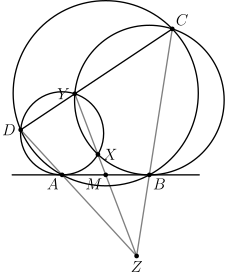
Line is the radical axis of and line that of and and line that of and so the three lines meet at the radical center (They cannot be parallel: that would force a symmetric configuration with ) Let The power of with respect to each circle gives so is the midpoint of with between and
Since is cyclic, and since is cyclic, as are collinear these add to so is cyclic. The tangent-chord angle at gives so and symmetrically Hence is a parallelogram, and since is the midpoint of diagonal it is also the midpoint of therefore Moreover and (by the tangent-chord angle at ) so triangles and are similar, giving
Putting it together, which equals