2016 AIME I Problema 3

A continuación está la solución preparada profesionalmente para el Problema 3 del 2016 AIME I, de LIVE by Po-Shen Loh. También puedes intentar el examen cronometrado completo, ver todas las soluciones del 2016 AIME I, o revisar la clave de respuestas.

Todos los problemas se usan con el permiso legal oficial de la Mathematical Association of America (MAA).

Conceptos:teoría de grafosprincipio de multiplicación

Nivel de dificultad: 2230

3.

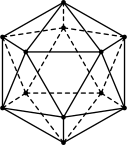
Un icosaedro regular es un sólido de 2020 caras donde cada cara es un triángulo equilátero y cinco triángulos se encuentran en cada vértice. El icosaedro regular que se muestra abajo tiene un vértice en la parte superior, un vértice en la parte inferior, un pentágono superior de cinco vértices todos adyacentes al vértice superior y todos en el mismo plano horizontal, y un pentágono inferior de cinco vértices todos adyacentes al vértice inferior y todos en otro plano horizontal. Halla el número de trayectorias desde el vértice superior hasta el vértice inferior tales que cada parte de una trayectoria va hacia abajo u horizontalmente a lo largo de una arista del icosaedro, y ningún vértice se repite.

A regular icosahedron is a 2020-faced solid where each face is an equilateral triangle and five triangles meet at every vertex. The regular icosahedron shown below has one vertex at the top, one vertex at the bottom, an upper pentagon of five vertices all adjacent to the top vertex and all in the same horizontal plane, and a lower pentagon of five vertices all adjacent to the bottom vertex and all in another horizontal plane. Find the number of paths from the top vertex to the bottom vertex such that each part of a path goes downward or horizontally along an edge of the icosahedron, and no vertex is repeated.

Solución:

Cada vértice del pentágono superior es adyacente al vértice superior, a dos vecinos del pentágono superior y a dos vértices del pentágono inferior; cada vértice del pentágono inferior es adyacente a dos vértices superiores, a dos vecinos del pentágono inferior y al vértice inferior. Así, una trayectoria hacia abajo u horizontal sin vértice repetido debe descender al pentágono superior, rodear parte de él en una dirección, bajar al pentágono inferior, rodear parte de él en una dirección y terminar en el vértice inferior.

Hay 55 opciones para el primer paso hacia abajo. En el pentágono superior la trayectoria puede dar 0,1,2,3,0, 1, 2, 3, o 44 pasos horizontales, en cualquiera de dos direcciones (una inversión repetiría un vértice), lo que da 1+24=91 + 2 \cdot 4 = 9 opciones. Luego hay 22 aristas hacia abajo al pentágono inferior, de nuevo 99 opciones horizontales allí, y 11 último paso hacia abajo.

El total es 5929=810.5 \cdot 9 \cdot 2 \cdot 9 = 810.

Each vertex of the upper pentagon is adjacent to the top vertex, two upper-pentagon neighbors, and two vertices of the lower pentagon; each vertex of the lower pentagon is adjacent to two upper vertices, two lower-pentagon neighbors, and the bottom vertex. So a downward-or-horizontal path with no repeated vertex must descend to the upper pentagon, circle part of it in one direction, drop to the lower pentagon, circle part of it in one direction, and end at the bottom.

There are 55 choices for the first step down. On the upper pentagon the path can take 0,1,2,3,0, 1, 2, 3, or 44 horizontal steps, in either of two directions (a reversal would repeat a vertex), for 1+24=91 + 2 \cdot 4 = 9 options. Then there are 22 edges down to the lower pentagon, again 99 horizontal options there, and 11 final step down.

The total is 5929=810.5 \cdot 9 \cdot 2 \cdot 9 = 810.

← Problema 2#2Examen completoProblema 4#4 →

El Problema 3 en otros años