2010 AIME II Problema 14

A continuación está la solución preparada profesionalmente para el Problema 14 del 2010 AIME II, de LIVE by Po-Shen Loh. También puedes intentar el examen cronometrado completo, ver todas las soluciones del 2010 AIME II, o revisar la clave de respuestas.

Todos los problemas se usan con el permiso legal oficial de la Mathematical Association of America (MAA).

Conceptos:potencia de un puntocircunferencia circunscrita, circuncentro y circunradioángulo inscrito

Nivel de dificultad: 3270

14.

En el triángulo rectángulo ABCABC con el ángulo recto en C,C, BAC<45\angle BAC \lt 45^\circ y AB=4.AB = 4. El punto PP en AB\overline{AB} tiene las propiedades de que APC=2ACP\angle APC = 2\angle ACP y CP=1.CP = 1. La razón APBP\frac{AP}{BP} se puede representar en la forma p+qr,p + q\sqrt{r}, donde p,p, q,q, y rr son enteros positivos y rr no es divisible por el cuadrado de ningún primo. Halla p+q+r.p + q + r.

In right triangle ABCABC with the right angle at C,C, BAC<45\angle BAC \lt 45^\circ and AB=4.AB = 4. Point PP on AB\overline{AB} has the properties that APC=2ACP\angle APC = 2\angle ACP and CP=1.CP = 1. The ratio APBP\frac{AP}{BP} can be represented in the form p+qr,p + q\sqrt{r}, where p,p, q,q, and rr are positive integers and rr is not divisible by the square of any prime. Find p+q+r.p + q + r.

Solución:

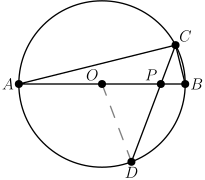
Como el ángulo recto está en C,C, el segmento ABAB es un diámetro de la circunferencia circunscrita; sea OO su centro, así que el radio es 2.2. Sea α=ACP\alpha = \angle ACP y prolonga CP\overline{CP} hasta cortar de nuevo la circunferencia en D.D. El ángulo central sobre el arco ADAD es AOD=2ACD=2α,\angle AOD = 2\angle ACD = 2\alpha, mientras que los ángulos opuestos por el vértice dan DPB=APC=2α.\angle DPB = \angle APC = 2\alpha. Así, OD\overline{OD} y PD\overline{PD} forman ángulos iguales con la recta AB,AB, y el triángulo ODPODP es isósceles con DP=DO=2.DP = DO = 2.

Por la potencia del punto P,P, APPB=CPPD=12=2,AP+PB=4, \begin{aligned} AP \cdot PB = CP \cdot PD = 1 \cdot 2 &= 2, \\ AP + PB &= 4, \end{aligned} así que APAP y PBPB son las raíces de t24t+2,t^2 - 4t + 2, a saber 2±2.2 \pm \sqrt{2}. Como BAC<45,\angle BAC \lt 45^\circ, tenemos BC<ACBC \lt AC con AC2+BC2=16,AC^2 + BC^2 = 16, así que AC>22,AC \gt 2\sqrt{2}, y la desigualdad triangular da APACCPAP \ge AC - CP >221\gt 2\sqrt{2} - 1 >22.\gt 2 - \sqrt{2}. Por tanto AP=2+2.AP = 2 + \sqrt{2}.

Por tanto APBP=2+222=(2+2)22=3+22, \begin{aligned} \frac{AP}{BP} &= \frac{2 + \sqrt{2}}{2 - \sqrt{2}} \\ &= \frac{(2 + \sqrt{2})^2}{2} = 3 + 2\sqrt{2}, \end{aligned} así que p+q+r=3+2+2=7.p + q + r = 3 + 2 + 2 = 7.

Because the right angle is at C,C, segment ABAB is a diameter of the circumcircle; let OO be its center, so the radius is 2.2. Let α=ACP\alpha = \angle ACP and extend CP\overline{CP} to meet the circle again at D.D. The central angle over arc ADAD is AOD=2ACD=2α,\angle AOD = 2\angle ACD = 2\alpha, while vertical angles give DPB=APC=2α.\angle DPB = \angle APC = 2\alpha. So OD\overline{OD} and PD\overline{PD} make equal angles with line AB,AB, and triangle ODPODP is isosceles with DP=DO=2.DP = DO = 2.

By the power of the point P,P, APPB=CPPD=12=2,AP+PB=4, \begin{aligned} AP \cdot PB = CP \cdot PD = 1 \cdot 2 &= 2, \\ AP + PB &= 4, \end{aligned} so APAP and PBPB are the roots of t24t+2,t^2 - 4t + 2, namely 2±2.2 \pm \sqrt{2}. Since BAC<45,\angle BAC \lt 45^\circ, we have BC<ACBC \lt AC with AC2+BC2=16,AC^2 + BC^2 = 16, so AC>22,AC \gt 2\sqrt{2}, and the triangle inequality gives APACCPAP \ge AC - CP >221\gt 2\sqrt{2} - 1 >22.\gt 2 - \sqrt{2}. Hence AP=2+2.AP = 2 + \sqrt{2}.

Therefore APBP=2+222=(2+2)22=3+22, \begin{aligned} \frac{AP}{BP} &= \frac{2 + \sqrt{2}}{2 - \sqrt{2}} \\ &= \frac{(2 + \sqrt{2})^2}{2} = 3 + 2\sqrt{2}, \end{aligned} and p+q+r=3+2+2=7.p + q + r = 3 + 2 + 2 = 7.

← Problema 13#13Examen completoProblema 15#15 →

El Problema 14 en otros años