
Soluciones del 2008 AIME I
Desplázate hacia abajo para ver las soluciones preparadas profesionalmente de LIVE by Po-Shen Loh, imprime las soluciones en PDF, consulta la clave de respuestas, o haz el examen cronometrado completo.
Todos los problemas se usan con el permiso legal oficial de la Mathematical Association of America (MAA).
1.
De los estudiantes que asisten a una fiesta escolar, el son chicas y al le gusta bailar. Después de que a estos estudiantes se les unen chicos más, a todos los cuales les gusta bailar, la fiesta ahora tiene un de chicas. ¿A cuántos estudiantes de los que ahora están en la fiesta les gusta bailar?
Of the students attending a school party, of the students are girls, and of the students like to dance. After these students are joined by more boy students, all of whom like to dance, the party is now girls. How many students now at the party like to dance?
Pista pequeña:
Sea el número original de estudiantes; el número de chicas no cambia cuando llegan los chicos
Let be the original number of students; the number of girls does not change when the boys arrive
Pista grande:
Resuelve luego cuenta el de los estudiantes originales más todos los chicos nuevos
Solve then count of the original students plus all new boys
Solución:
Sea el número de estudiantes que había originalmente en la fiesta, de modo que son chicas y a les gusta bailar. Cuando llegan los chicos, el número de chicas no cambia pero el total pasa a ser así que Entonces lo que da
El número de estudiantes a los que ahora les gusta bailar es
Let be the number of students originally at the party, so are girls and like to dance. When the boys arrive, the number of girls is unchanged but the total becomes so Then giving
The number of students who now like to dance is
2.
El cuadrado tiene lados de longitud unidades. El triángulo isósceles tiene base y el área común al triángulo y al cuadrado es de unidades cuadradas. Halla la longitud de la altura sobre en el
Square has sides of length units. Isosceles triangle has base and the area common to triangle and square is square units. Find the length of the altitude to in
Pista pequeña:
Si la altura fuera a lo sumo el solapamiento sería todo el triángulo, forzando , lo cual es imposible, así que el vértice superior sobresale por encima del cuadrado
If the altitude were at most the overlap would be the whole triangle, forcing — impossible, so the apex pokes out above the square
Pista grande:
El solapamiento es el triángulo menos un triángulo semejante por encima del cuadrado, con altura y base
The overlap is triangle minus a similar triangle above the square with height and base
Solución:
Aquí es un lado del cuadrado. Sea la altura del triángulo Si el triángulo quedaría enteramente dentro del cuadrado, y su área forzaría una contradicción. Así que y el vértice queda fuera del cuadrado; el lado opuesto recorta un triángulo más pequeño semejante a con altura y base
La región común es el triángulo menos ese pequeño triángulo: Multiplicando por se obtiene así que y
Here is a side of the square. Let be the altitude of triangle If the triangle would lie entirely inside the square, and its area would force a contradiction. So and the apex lies outside the square; the opposite side cuts off a smaller triangle similar to with height and base
The common region is triangle minus that small triangle: Multiplying by gives so and
3.
Ed y Sue montan en bicicleta a velocidades iguales y constantes. De igual manera, trotan a velocidades iguales y constantes, y nadan a velocidades iguales y constantes. Ed recorre kilómetros tras montar en bicicleta durante horas, trotar durante horas y nadar durante horas, mientras que Sue recorre kilómetros tras trotar durante horas, nadar durante horas y montar en bicicleta durante horas. Sus velocidades de ciclismo, trote y natación son todas números enteros de kilómetros por hora. Halla la suma de los cuadrados de las velocidades de ciclismo, trote y natación de Ed.
Ed and Sue bike at equal and constant rates. Similarly, they jog at equal and constant rates, and they swim at equal and constant rates. Ed covers kilometers after biking for hours, jogging for hours, and swimming for hours, while Sue covers kilometers after jogging for hours, swimming for hours, and biking for hours. Their biking, jogging, and swimming rates are all whole numbers of kilometers per hour. Find the sum of the squares of Ed’s biking, jogging, and swimming rates.
Pista pequeña:
Los dos recorridos dan y en números enteros
The two trips give and in whole numbers
Pista grande:
Elimina para obtener de sus tres soluciones positivas, solo una hace que sea un número entero
Eliminate to get of its three positive solutions, only one makes a whole number
Solución:
Sean y las velocidades de ciclismo, trote y natación. Los dos recorridos dan y Duplicar la primera ecuación y restar la segunda produce cuyas soluciones enteras positivas son y
Los valores correspondientes de son y así que solo da una velocidad entera, La suma de los cuadrados es
Let and be the biking, jogging, and swimming rates. The two trips give and Doubling the first equation and subtracting the second yields whose positive integer solutions are and
The corresponding values of are and so only gives a whole-number rate, The sum of the squares is
4.
Existen enteros positivos únicos e que satisfacen la ecuación Halla
There exist unique positive integers and that satisfy the equation Find
Pista pequeña:
Compara con
Compare with
Pista grande:
Escribe y factoriza: y ambos factores de la diferencia de cuadrados deben ser pares
Write and factor: and both factors of the difference of squares must be even
Solución:
Completando el cuadrado, así que lo que se factoriza como Los dos factores tienen la misma paridad, y su producto es par, así que ambos son pares: y
Sumando se obtiene y entonces en efecto Por lo tanto
Completing the square, so which factors as The two factors have the same parity, and their product is even, so both are even: and
Adding gives and then indeed Therefore
5.
Un cono circular recto tiene radio de base y altura El cono está apoyado sobre su costado en una mesa plana. Cuando el cono rueda sobre la superficie de la mesa sin deslizarse, el punto donde la base del cono toca la mesa traza un arco circular centrado en el punto donde el vértice toca la mesa. El cono regresa por primera vez a su posición original sobre la mesa después de dar rotaciones completas. El valor de puede escribirse en la forma donde y son enteros positivos y no es divisible por el cuadrado de ningún primo. Halla
A right circular cone has base radius and height The cone lies on its side on a flat table. As the cone rolls on the surface of the table without slipping, the point where the cone’s base meets the table traces a circular arc centered at the point where the vertex touches the table. The cone first returns to its original position on the table after making complete rotations. The value of can be written in the form where and are positive integers and is not divisible by the square of any prime. Find
Pista pequeña:
El vértice permanece fijo, así que el punto de contacto traza un círculo cuyo radio es la generatriz
The vertex stays fixed, so the point of contact traces a circle whose radius is the slant height
Pista grande:
Diecisiete rotaciones significan eleva al cuadrado y simplifica
Seventeen rotations means square and simplify
Solución:
El punto de contacto de la base se mantiene a distancia (la generatriz) del vértice fijo, así que traza un círculo de radio Al rodar sin deslizarse, el cono da una rotación por cada longitud de arco igual a una circunferencia de la base, así que regresar después de exactamente rotaciones significa es decir
Elevar al cuadrado da así que y
The contact point of the base stays at distance (the slant height) from the fixed vertex, so it traces a circle of radius Rolling without slipping, the cone makes one rotation for each base circumference of arc, so returning after exactly rotations means i.e.
Squaring gives so and
6.
Un arreglo triangular de números tiene una primera fila formada por los enteros impares en orden creciente. Cada fila debajo de la primera tiene una entrada menos que la fila que está encima, y la fila inferior tiene una sola entrada. Cada entrada de cualquier fila después de la fila superior es igual a la suma de las dos entradas diagonalmente encima de ella en la fila inmediatamente superior. ¿Cuántas entradas del arreglo son múltiplos de ?
A triangular array of numbers has a first row consisting of the odd integers in increasing order. Each row below the first has one fewer entry than the row above it, and the bottom row has a single entry. Each entry in any row after the top row equals the sum of the two entries diagonally above it in the row immediately above it. How many entries in the array are multiples of
Pista pequeña:
Demuestra que la -ésima entrada de la fila es así que solo el factor impar importa para la divisibilidad por
Show the th entry of row is so only the odd factor matters for divisibility by
Pista grande:
A lo largo de la fila el factor toma todos los valores de la paridad de desde hasta así que el único múltiplo de que puede alcanzar es el propio
Across row the factor takes every value of ’s parity from to so the only multiple of it can hit is itself
Solución:
Por inducción, la -ésima entrada de la fila es la fila da y sumar dos entradas adyacentes de la fila da la fórmula para la fila La fila tiene entradas, así que
Como es impar, una entrada es múltiplo de exactamente cuando es divisible por A medida que recorre la fila la cantidad toma los valores todos con la misma paridad que y todos menores que Así que el único múltiplo posible de es el propio , lo que requiere que sea impar y es decir,
Cada fila impar contiene exactamente una entrada de este tipo, para un total de
By induction, the th entry of row is row gives and summing two adjacent entries of row gives the formula for row Row has entries, so
Since is odd, an entry is a multiple of exactly when is divisible by As runs through row the quantity takes the values all with the same parity as and all less than So the only possible multiple of is itself, which requires odd and that is,
Each odd row contains exactly one such entry, for a total of
7.
Sea el conjunto de todos los enteros tales que Por ejemplo, es el conjunto ¿Cuántos de los conjuntos no contienen un cuadrado perfecto?
Let be the set of all integers such that For example, is the set How many of the sets do not contain a perfect square?
Pista pequeña:
Los cuadrados consecutivos difieren en que es menor que para así que cada conjunto hasta el que contiene tiene un cuadrado
Consecutive squares differ by which is less than for so every set up through the one containing has a square
Pista grande:
Después de los saltos superan así que cada conjunto restante contiene a lo sumo un cuadrado; cuenta los cuadrados hasta y resta
Past the gaps exceed so each remaining set holds at most one square; count the squares up to and subtract
Solución:
Los cuadrados consecutivos y difieren en para así que los cuadrados desde hasta nunca se saltan un bloque de cien: cada conjunto contiene un cuadrado perfecto. Para el salto supera así que cada uno de los conjuntos contiene a lo sumo un cuadrado.
El número más grande involucrado es y Así que los cuadrados que caen en son , es decir, cuadrados que ocupan conjuntos distintos de esos
Por lo tanto conjuntos no contienen ningún cuadrado perfecto.
Consecutive squares and differ by for so the squares from to never skip a hundred-block: every set contains a perfect square. For the gap exceeds so each of the sets contains at most one square.
The largest number involved is and So the squares landing in are — that is, squares occupying distinct sets out of those
Therefore sets contain no perfect square.
8.
Halla el entero positivo tal que
Find the positive integer such that
Pista pequeña:
Combina dos términos a la vez usando (válido aquí porque todos los productos son pequeños)
Combine two terms at a time using (valid here since all products are small)
Pista grande:
Los tres primeros arcotangentes suman el último término debe completarlo hasta
The first three arctangents sum to the last term must top it up to
Solución:
Para positivos con la fórmula de adición de la tangente da Aplicándola dos veces:
La ecuación se convierte en así que Despejando denominadores, lo que da
For positive with the tangent addition formula gives Applying it twice:
The equation becomes so Clearing denominators, giving
9.
Diez cajas idénticas tienen cada una dimensiones pies pies pies. La primera caja se coloca plana sobre el suelo. Cada una de las nueve cajas restantes se coloca, por turno, plana encima de la caja anterior, y la orientación de cada caja se elige al azar. Sea la probabilidad de que la pila de cajas mida exactamente pies de altura, donde y son enteros positivos primos entre sí. Halla
Ten identical crates each have dimensions ft ft ft. The first crate is placed flat on the floor. Each of the remaining nine crates is placed, in turn, flat on top of the previous crate, and the orientation of each crate is chosen at random. Let be the probability that the stack of crates is exactly ft tall, where and are relatively prime positive integers. Find
Pista pequeña:
Si cajas aportan alturas entonces y
If crates contribute heights then and
Pista grande:
Restar da con tres soluciones; cuenta las ordenaciones de cada una con coeficientes multinomiales de entre pilas igualmente probables
Subtracting gives with three solutions; count the orderings of each with multinomial coefficients out of equally likely stacks
Solución:
Cada caja aporta de forma independiente una altura o cada una con probabilidad así que hay pilas igualmente probables. Si cajas tienen alturas entonces y restar tres veces la primera ecuación da así que
Estas pueden ordenarse de y maneras, para un total de pilas. La probabilidad es que está en su forma más simple ya que Por lo tanto
Each crate independently contributes height or each with probability so there are equally likely stacks. If crates have heights then and subtracting three times the first equation gives so
These can be ordered in and ways, for stacks in all. The probability is which is in lowest terms since Thus
10.
Sea un trapecio isósceles con cuyo ángulo en la base más larga es Las diagonales tienen longitud y el punto está a distancias y de los vértices y respectivamente. Sea el pie de la altura desde hacia La distancia puede expresarse en la forma donde y son enteros positivos y no es divisible por el cuadrado de ningún primo. Halla
Let be an isosceles trapezoid with whose angle at the longer base is The diagonals have length and point is at distances and from vertices and respectively. Let be the foot of the altitude from to The distance can be expressed in the form where and are positive integers and is not divisible by the square of any prime. Find
Pista pequeña:
La desigualdad triangular da así que
The triangle inequality gives so
Pista grande:
La ley de los senos en el triángulo da así que la igualdad se cumple en todas partes: y está sobre el rayo más allá de
The Law of Sines in triangle gives so equality holds everywhere: and lies on ray beyond
Solución:
Por la desigualdad triangular, así que Por otro lado, en el triángulo el ángulo en es y así que la ley de los senos da
Ambas cotas fuerzan así que y la igualdad en la desigualdad triangular significa que está sobre la recta con entre y Del triángulo rectángulo, y como el pie satisface
Los puntos y están sobre la recta del mismo lado de así que y
By the triangle inequality, so On the other hand, in triangle the angle at is and so the Law of Sines gives
Both bounds force so and equality in the triangle inequality means lies on line with between and From the right triangle, and since the foot satisfies
Points and are on line on the same side of so and
11.
Considera las sucesiones que constan enteramente de y y que tienen la propiedad de que toda racha de consecutivas tiene longitud par, y toda racha de consecutivas tiene longitud impar. Ejemplos de tales sucesiones son y mientras que no es una sucesión de este tipo. ¿Cuántas sucesiones de este tipo tienen longitud ?
Consider sequences that consist entirely of ’s and ’s and that have the property that every run of consecutive ’s has even length, and every run of consecutive ’s has odd length. Examples of such sequences are and while is not such a sequence. How many such sequences have length
Pista pequeña:
Clasifica según la primera letra: una sucesión válida que empieza con debe comenzar con seguido de cualquier sucesión válida (posiblemente vacía)
Classify by the first letter: a valid sequence starting with must begin with followed by any valid (possibly empty) sequence
Pista grande:
Con contando las sucesiones válidas de longitud que empiezan con o y Itera hasta
With counting valid length- sequences starting with or and Iterate up to
Solución:
Sean y el número de sucesiones válidas de longitud que empiezan con y con Una sucesión que empieza con comienza con seguido de cualquier sucesión válida de longitud (posiblemente vacía), así que donde la sucesión vacía cuenta una vez. Una sucesión que empieza con comienza o bien con una sola seguida de una sucesión que empieza con o bien con seguido de una sucesión que empieza con así que
Partiendo de y los pares para son
El número de sucesiones válidas de longitud es
Let and count valid sequences of length beginning with and with A sequence beginning with starts with followed by any valid sequence of length (possibly empty), so where the empty sequence counts once. A sequence beginning with starts either with a single followed by a sequence beginning with or with followed by a sequence beginning with so
Starting from and the pairs for are
The number of valid sequences of length is
12.
En un tramo largo y recto de una autopista de un solo sentido y un solo carril, todos los coches viajan a la misma velocidad y todos obedecen la regla de seguridad: la distancia desde la parte trasera del coche de delante hasta la parte delantera del coche de detrás es exactamente la longitud de un coche por cada kilómetros por hora de velocidad o fracción de ella. (Así, la parte delantera de un coche que viaja a kilómetros por hora estará cuatro longitudes de coche por detrás de la parte trasera del coche que va delante de él.)
Un sensor fotoeléctrico al costado de la carretera cuenta el número de coches que pasan en una hora. Suponiendo que cada coche mide metros de largo y que los coches pueden viajar a cualquier velocidad, sea el máximo número entero de coches que pueden pasar por el sensor fotoeléctrico en una hora. Halla el cociente cuando se divide entre
On a long straight stretch of one-way single-lane highway, cars all travel at the same speed and all obey the safety rule: the distance from the back of the car ahead to the front of the car behind is exactly one car length for each kilometers per hour of speed or fraction thereof. (Thus the front of a car traveling kilometers per hour will be four car lengths behind the back of the car in front of it.)
A photoelectric eye by the side of the road counts the number of cars that pass in one hour. Assuming that each car is meters long and that the cars can travel at any speed, let be the maximum whole number of cars that can pass the photoelectric eye in one hour. Find the quotient when is divided by
Pista pequeña:
A km/h la separación de delantera a delantera es metros, y metros de tráfico pasan por el sensor por hora
At km/h the front-to-front spacing is meters, and meters of traffic pass the eye per hour
Pista grande:
Para el número de huecos crece hacia un límite que nunca alcanza, pero con un coche exactamente en el sensor cuando comienza la hora, el número de coches enteros que pasan sí alcanza ese límite
For the gap count rises toward a limit it never attains, but with a car exactly at the eye as the hour starts, the number of whole cars passing does reach that limit
Solución:
Supongamos que los coches viajan a kilómetros por hora. El hueco es de longitudes de coche, así que las partes delanteras de coches sucesivos están separadas metros, y en una hora una columna de metros de tráfico pasa por el sensor, es decir, huecos por hora.
Para un valor fijo el conteo es máximo en donde es igual a Esto siempre es menor que pero se aproxima a a medida que crece. Aunque el número de huecos nunca alcanza el conteo de coches sí puede: elige tan grande que pasen más de huecos, y comienza la hora con un coche exactamente en el sensor. Ese coche, más un coche por cada uno de los huecos completos que siguen, da coches.
Así que y el cociente cuando se divide entre es
Suppose the cars travel at kilometers per hour. The gap is car lengths, so successive fronts are meters apart, and in one hour a column of meters of traffic passes the eye — that is, gaps per hour.
For a fixed value the count is largest at where it equals This is always less than but approaches as grows. Although the gap count never reaches the car count can: choose so large that more than gaps pass, and start the hour with a car exactly at the eye. That car, plus one car for each of the complete gaps that follow, makes cars.
So and the quotient when is divided by is
13.
Sea Supongamos que
Existe un punto para el cual para todos esos polinomios, donde y son enteros positivos, y son primos entre sí, y Halla
Let Suppose that
There is a point for which for all such polynomials, where and are positive integers, and are relatively prime, and Find
Pista pequeña:
Aplica las condiciones en orden: las primeras cinco fuerzan
Apply the conditions in order: the first five force
Pista grande:
Al final un punto que funciona para toda elección de y debe ser un cero común de y que se factorizan de forma agradable
Eventually a point that works for every choice of and must be a common zero of and which factor nicely
Solución:
De obtenemos Sumando y restando se obtiene y de manera similar dan y Luego y se reducen a y así que y Ahora y da es decir
Por lo tanto y un punto que es un cero para toda elección de debe anular ambos corchetes. El primer corchete se factoriza como así que para un nuevo punto (con ) necesitamos El segundo corchete es sustituyendo convierte en cuyas raíces son y
La raíz reproduce el punto dado así que el nuevo punto tiene y Por lo tanto y
From we get Adding and subtracting gives and similarly give and Then and reduce to and so and Now and gives i.e.
Therefore and a point that is a zero for every choice of must kill both brackets. The first bracket factors as so for a new point (with ) we need The second bracket is substituting turns into whose roots are and
The root reproduces the given point so the new point has and Thus and
14.
Sea un diámetro del círculo Prolonga a través de hasta El punto está sobre de modo que la recta es tangente a El punto es el pie de la perpendicular desde a la recta Supón que y sea la longitud máxima posible del segmento Halla
Let be a diameter of circle Extend through to Point lies on so that line is tangent to Point is the foot of the perpendicular from to line Suppose and let denote the maximum possible length of segment Find
Pista pequeña:
Coloca el centro en el origen; si la recta tangente es
Put the center at the origin; if the tangent line is
Pista grande:
El pie es y se simplifica a una cuadrática en , maximízala
The foot is and simplifies to a quadratic in — maximize it
Solución:
Coloca el centro en el origen con radio así que y Si el punto de tangencia es la recta tangente es corta al eje en que queda más allá de exactamente cuando Escribiendo la distancia con signo desde a la recta es así que el pie de la perpendicular es
Entonces y usando Esta cuadrática en se maximiza en que está dentro de (allí ), dando
Por lo tanto
Place the center at the origin with radius so and If the point of tangency is the tangent line is it meets the -axis at which lies beyond exactly when Writing the signed distance from to the line is so the foot of the perpendicular is
Then and using This quadratic in is maximized at which is inside (there ), giving
Therefore
15.
Una hoja de papel cuadrada tiene lados de longitud De cada esquina se corta una cuña de la siguiente manera: en cada esquina, los dos cortes de la cuña comienzan cada uno a distancia de la esquina, y se encuentran sobre la diagonal formando un ángulo de (ver la figura de abajo). Luego el papel se pliega hacia arriba a lo largo de las líneas que unen los vértices de cortes adyacentes. Cuando los dos bordes de un corte se encuentran, se pegan con cinta. El resultado es una bandeja de papel cuyos lados no forman ángulos rectos con la base. La altura de la bandeja, es decir, la distancia perpendicular entre el plano de la base y el plano formado por los bordes superiores, puede escribirse en la forma donde y son enteros positivos, y no es divisible por la -ésima potencia de ningún primo. Halla
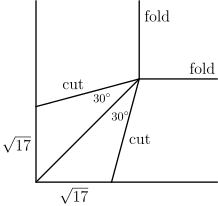
A square piece of paper has sides of length From each corner a wedge is cut in the following manner: at each corner, the two cuts for the wedge each start at distance from the corner, and they meet on the diagonal at an angle of (see the figure below). The paper is then folded up along the lines joining the vertices of adjacent cuts. When the two edges of a cut meet, they are taped together. The result is a paper tray whose sides are not at right angles to the base. The height of the tray, that is, the perpendicular distance between the plane of the base and the plane formed by the upper edges, can be written in the form where and are positive integers, and is not divisible by the th power of any prime. Find
Pista pequeña:
Coloca la esquina en con inicio del corte los cortes se encuentran en sobre la diagonal con y
Set the corner at with cut start the cuts meet at on the diagonal with and
Pista grande:
El plegado gira alrededor de la línea de pliegue que pasa por hasta un punto por encima de la altura es con sobre la línea de pliegue por encima de
Folding swings about the fold line through to a point above the height is with on the fold line above
Solución:
Coloca la esquina en el origen con los dos lados a lo largo de los ejes positivos, y escribe El corte sobre el borde inferior comienza en y los dos cortes se encuentran en sobre la diagonal formando cada uno un ángulo de con la diagonal. En el triángulo y así que la ley de los senos da Las líneas de pliegue son las líneas horizontal y vertical que pasan por Sea el punto de la línea de pliegue horizontal directamente encima de y el punto donde la línea vertical que pasa por corta la diagonal. Como el segmento forma un ángulo de con el borde inferior, así que
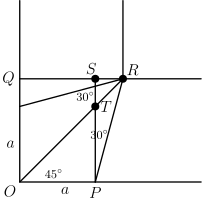
Cuando la tira inferior se pliega hacia arriba a lo largo de la línea horizontal que pasa por el punto se mantiene a distancia de moviéndose en el plano vertical que pasa por perpendicular a esa línea de pliegue. Por simetría, los dos bordes de corte pegados se encuentran por encima de la diagonal, así que aterriza en un punto directamente encima de y es la altura de la bandeja. Por el teorema de Pitágoras,
Así que la altura es y
Put the corner at the origin with the two sides along the positive axes, and write The cut on the bottom edge starts at and the two cuts meet at on the diagonal each making a angle with the diagonal. In triangle and so the Law of Sines gives The fold lines are the horizontal and vertical lines through Let be the point of the horizontal fold line directly above and the point where the vertical line through meets the diagonal. Since segment makes a angle with the bottom edge, so
When the bottom strip folds up along the horizontal line through point stays at distance from moving in the vertical plane through perpendicular to that fold line. By symmetry the two taped cut edges meet above the diagonal, so lands at a point directly above and is the height of the tray. By the Pythagorean theorem,
So the height is and