
Soluciones del 2002 AIME I
Desplázate hacia abajo para ver las soluciones preparadas profesionalmente de LIVE by Po-Shen Loh, imprime las soluciones en PDF, consulta la clave de respuestas, o haz el examen cronometrado completo.
Todos los problemas se usan con el permiso legal oficial de la Mathematical Association of America (MAA).
1.
Muchos estados usan una secuencia de tres letras seguida de una secuencia de tres dígitos como su formato estándar de matrícula. Dado que cada disposición de tres letras y tres dígitos es igualmente probable, la probabilidad de que tal matrícula contenga al menos un palíndromo (una disposición de tres letras o una disposición de tres dígitos que se lee igual de izquierda a derecha que de derecha a izquierda) es donde y son enteros positivos primos entre sí. Halle
Many states use a sequence of three letters followed by a sequence of three digits as their standard license-plate pattern. Given that each three-letter three-digit arrangement is equally likely, the probability that such a license plate will contain at least one palindrome (a three-letter arrangement or a three-digit arrangement that reads the same left-to-right as it does right-to-left) is where and are relatively prime positive integers. Find
Pista pequeña:
Una disposición de tres letras es un palíndromo exactamente cuando la tercera letra es igual a la primera, así que esa probabilidad es .
A three-letter arrangement is a palindrome exactly when the third letter equals the first, so that probability is
Pista grande:
Combine los eventos de letras y dígitos por inclusión-exclusión: .
Combine the letter and digit events by inclusion-exclusion:
Solución:
Una disposición de tres letras es un palíndromo exactamente cuando la tercera letra coincide con la primera, así que la probabilidad de un palíndromo de letras es De igual modo, la probabilidad de un palíndromo de dígitos es y los dos eventos son independientes.
Por inclusión-exclusión, la probabilidad de al menos un palíndromo es Por lo tanto,
A three-letter arrangement is a palindrome exactly when the third letter matches the first, so the probability of a letter palindrome is Similarly, the probability of a digit palindrome is and the two events are independent.
By inclusion-exclusion, the probability of at least one palindrome is Thus
2.
El diagrama muestra veinte círculos congruentes dispuestos en tres filas y encerrados en un rectángulo. Los círculos son tangentes entre sí y a los lados del rectángulo como se muestra en el diagrama. La razón entre la dimensión más larga del rectángulo y la dimensión más corta puede escribirse como donde y son enteros positivos. Halle
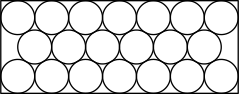
The diagram shows twenty congruent circles arranged in three rows and enclosed in a rectangle. The circles are tangent to one another and to the sides of the rectangle as shown in the diagram. The ratio of the longer dimension of the rectangle to the shorter dimension can be written as where and are positive integers. Find
Pista pequeña:
Con radio del círculo el lado más largo es Para el lado más corto, conecte los centros de tres círculos mutuamente tangentes.
With circle radius the longer side is For the shorter side, connect the centers of three mutually tangent circles.
Pista grande:
Filas adyacentes de centros están separadas así que el lado más corto es racionalice
Adjacent rows of centers are apart, so the shorter side is rationalize
Solución:
Sea el radio común. El lado más largo contiene una fila de siete círculos, así que es igual a Los centros de tres círculos mutuamente tangentes en filas adyacentes forman un triángulo equilátero de lado cuya altura es de modo que los dos espacios entre filas de centros aportan y el lado más corto es
La razón es así que y
Let be the common radius. The longer side holds a row of seven circles, so it equals The centers of three mutually tangent circles in adjacent rows form an equilateral triangle with side whose height is so the two gaps between rows of centers contribute and the shorter side is
The ratio is so and
3.
Jane tiene años. Dick es mayor que Jane. Dentro de años, donde es un entero positivo, las edades de Dick y de Jane serán ambas números de dos dígitos y tendrán la propiedad de que la edad de Jane se obtiene intercambiando los dígitos de la edad de Dick. Sea la edad actual de Dick. ¿Cuántos pares ordenados de enteros positivos son posibles?
Jane is years old. Dick is older than Jane. In years, where is a positive integer, Dick’s age and Jane’s age will both be two-digit numbers and will have the property that Jane’s age is obtained by interchanging the digits of Dick’s age. Let be Dick’s present age. How many ordered pairs of positive integers are possible?
Pista pequeña:
Concéntrese en las edades futuras: la de Jane es un número de dos dígitos cuya inversión de dígitos, la edad de Dick, es mayor
Focus on the future ages: Jane’s is a two-digit number whose digit reversal, Dick’s age, is larger
Pista grande:
Cuente las edades futuras posibles de Jane: números de dos dígitos cuya decena sea menor que la unidad. Cada una determina
Count the possible values of Jane’s future age: two-digit numbers old enough for Jane whose tens digit is smaller than the units digit. Each determines
Solución:
Dentro de años la edad de Jane es y la edad de Dick es su inversión de dígitos. Si la edad futura de Jane es la de Dick es que es mayor exactamente cuando Recíprocamente, todo valor de dos dígitos de con dígito de las decenas menor que el de las unidades da exactamente un par válido: y así que Dick es en efecto mayor que Jane ahora.
Así que contamos números de dos dígitos que son al menos y tienen dígito de las decenas menor que el de las unidades: que empiezan con (a saber, hasta ), luego empezando con hasta El total es
In years Jane’s age is and Dick’s age is its digit reversal. If Jane’s future age is Dick’s is which is larger exactly when Conversely, every two-digit value of with tens digit less than units digit yields exactly one valid pair: and so Dick is indeed older than Jane now.
So we count two-digit numbers that are at least and have tens digit less than units digit: starting with (namely through ), then starting with through The total is
4.
Considere la sucesión definida por para Dado que para enteros positivos y con halle
Consider the sequence defined by for Given that for positive integers and with find
Pista pequeña:
así que la suma telescopa a
so the sum telescopes to
Pista grande:
Elimine denominadores y factorice: luego use que es primo
Clear denominators and factor: then use that is prime
Solución:
Como la suma telescopa:
Multiplicando todo por se obtiene que se reordena como Como es primo y la única factorización con entero positivo es y así que y
Por lo tanto
Since the sum telescopes:
Multiplying through by gives which rearranges to Since is prime and the only factorization with a positive integer is and so and
Therefore
5.
Sean los vértices de un dodecágono regular. ¿Cuántos cuadrados distintos en el plano del dodecágono tienen al menos dos vértices en el conjunto ?
Let be the vertices of a regular dodecagon. How many distinct squares in the plane of the dodecagon have at least two vertices in the set
Pista pequeña:
Cada par de vértices determina tres cuadrados: dos que tienen el par como lado y uno que lo tiene como diagonal
Each pair of vertices determines three squares: two having the pair as a side and one having it as a diagonal
Pista grande:
Solo se cuentan de más los cuadrados con los cuatro vértices entre los y cada uno de tales cuadrados surge de de sus pares de vértices
Only squares with all four vertices among the are overcounted, and each such square arises from of its vertex pairs
Solución:
Cada uno de los pares de vértices determina exactamente tres cuadrados: dos que tienen el par como lado (uno a cada lado del segmento) y uno que lo tiene como diagonal. Eso cuenta cuadrados.
Un cuadrado se cuenta de más solo si tiene más de dos vértices entre los Si tres vértices de un cuadrado están en la circunferencia circunscrita, la propia circunferencia circunscrita del cuadrado comparte tres puntos con ella y por tanto coincide con ella, y los vértices de un cuadrado inscrito están separados , es decir, tres pasos del dodecágono, así que el cuarto vértice también es un Los cuadrados totalmente inscritos son exactamente y y cada uno se genera con los pares de sus vértices, así que cada uno se cuenta veces en lugar de una.
El número de cuadrados distintos es
Each of the pairs of vertices determines exactly three squares: two having the pair as a side (one on each side of the segment) and one having it as a diagonal. That counts squares.
A square is overcounted only if it has more than two vertices among the If three vertices of a square lie on the circumcircle, the square’s own circumcircle shares three points with it and hence coincides with it, and an inscribed square’s vertices are spaced apart — three steps of the dodecagon — so the fourth vertex is also an The fully inscribed squares are exactly and and each is generated by all of its vertex pairs, so each is counted times instead of once.
The number of distinct squares is
6.
Las soluciones del sistema de ecuaciones son y Halle
The solutions to the system of equations are and Find
Pista pequeña:
Ponga y usando y
Set and using and
Pista grande:
Solo necesita y ya que obténgalos de por Vieta
You only need and since get them from by Vieta
Solución:
Sea y de modo que y El sistema se convierte en y Sustituyendo en la segunda ecuación y eliminando denominadores se obtiene es decir,
Las dos soluciones del sistema corresponden a las dos raíces de esta cuadrática, así que por las fórmulas de Vieta y entonces Por tanto, así que
Let and so and The system becomes and Substituting into the second equation and clearing denominators gives that is,
The two solutions of the system correspond to the two roots of this quadratic, so by Vieta’s formulas and then Hence so
7.
La expansión binomial es válida para exponentes que no son enteros. Es decir, para todos los números reales y con ¿Cuáles son los primeros tres dígitos a la derecha del punto decimal en la representación decimal de ?
The Binomial Expansion is valid for exponents that are not integers. That is, for all real numbers and with What are the first three digits to the right of the decimal point in the decimal representation of
Pista pequeña:
Desarrolle con el primer término es un entero y desde el tercer término en adelante son insignificantemente pequeños
Expand with the first term is an integer and the third term onward is negligibly small
Pista grande:
Los dígitos pedidos forman la parte fraccionaria de use el decimal periódico de período de
The requested digits form the fractional part of use the period- repeating decimal of
Solución:
Aplique el desarrollo con y El primer término es un entero, y el tercer término y los posteriores son mucho más pequeños que demasiado pequeños para afectar los primeros dígitos decimales. Así que esos dígitos provienen de la parte fraccionaria de
Esa parte fraccionaria es Como y obtenemos así que la parte fraccionaria es
Los primeros tres dígitos a la derecha del punto decimal son
Apply the expansion with and The first term is an integer, and the third and later terms are far smaller than too small to affect the leading decimal digits. So those digits come from the fractional part of
That fractional part is Since and we get so the fractional part is
The first three digits to the right of the decimal point are
8.
Halle el menor entero para el cual las condiciones
es una sucesión no decreciente de enteros positivos
para todo
se cumplen para más de una sucesión.
Find the smallest integer for which the conditions
is a nondecreasing sequence of positive integers
for all
are satisfied by more than one sequence.
Pista pequeña:
Itere la recurrencia para expresar el objetivo en los dos primeros términos:
Iterate the recurrence to express the target in the first two terms:
Pista grande:
Si con entonces es un múltiplo de forzando a que y sean al menos
If with then is a multiple of forcing and to be at least
Solución:
Iterando la recurrencia se obtiene y la sucesión es no decreciente exactamente cuando (todos los términos posteriores se acomodan por sí solos). Así que necesitamos el menor para el cual tiene dos soluciones con
Supongamos con Entonces así que es un múltiplo positivo de Por tanto y como también lo que da
Recíprocamente funciona: y dan las sucesiones y La respuesta es
Iterating the recurrence gives and the sequence is nondecreasing exactly when (all later terms then take care of themselves). So we need the smallest for which has two solutions with
Suppose with Then so is a positive multiple of Hence and since also giving
Conversely works: and give the sequences and The answer is
9.
Harold, Tanya y Ulysses pintan una cerca de estacas muy larga.
• Harold empieza con la primera estaca y pinta cada -ésima estaca;
• Tanya empieza con la segunda estaca y pinta cada -ésima estaca; y
• Ulysses empieza con la tercera estaca y pinta cada -ésima estaca.
Llame al entero positivo pintable cuando la terna de enteros positivos hace que cada estaca sea pintada exactamente una vez. Halle la suma de todos los enteros pintables.
Harold, Tanya, and Ulysses paint a very long picket fence.
• Harold starts with the first picket and paints every th picket;
• Tanya starts with the second picket and paints every th picket; and
• Ulysses starts with the third picket and paints every th picket.
Call the positive integer paintable when the triple of positive integers results in every picket being painted exactly once. Find the sum of all the paintable integers.
Pista pequeña:
Las tres progresiones aritméticas deben particionar los enteros positivos; verificar quién pinta la estaca muestra que debe ser o
The three arithmetic progressions must partition the positive integers; checking who paints picket shows must be or
Pista grande:
Para cada valor de la estaca más pequeña aún no cubierta fuerza y luego dando exactamente una terna válida en cada caso
For each value of the smallest picket not yet covered forces and then giving exactly one valid triple each
Solución:
Las tres progresiones deben particionar los enteros positivos. Si Harold pinta todas las estacas y se superpone con los otros dos pintores. Si Harold pinta la estaca que Ulysses también pinta, así que Si considere la estaca la siguiente estaca de Harold es y Ulysses no puede pintarla (eso requeriría con lo cual pintaría todas las estacas desde la en adelante), así que debe hacerlo Tanya, forzando Entonces la estaca queda sin pintar a menos que pero en ese caso Tanya y Ulysses juntos cubren cada estaca desde la en adelante, y la estaca de Harold se pinta dos veces. Así que o
Si Harold pinta Ulysses no puede pintar la estaca (entonces y repintaría ), así que lo hace Tanya: cubriendo Lo que queda es exactamente así que dando Si Harold pinta la estaca fuerza de nuevo y las estacas restantes fuerzan dando
La suma de los enteros pintables es
The three progressions must partition the positive integers. If Harold paints every picket and overlaps the other two painters. If Harold paints picket which Ulysses also paints, so If consider picket Harold’s next picket is and Ulysses cannot paint it (that would need repainting everything from on), so Tanya must, forcing Then picket is unpainted unless but then Tanya and Ulysses together cover every picket from on, and Harold’s picket is painted twice. So or
If Harold paints Ulysses cannot paint picket (then and he would repaint ), so Tanya does: covering What remains is exactly so giving If Harold paints picket again forces and the leftover pickets force giving
The sum of the paintable integers is
10.
En el diagrama de abajo, el ángulo es un ángulo recto. El punto está en y biseca el ángulo Los puntos y están en y respectivamente, de modo que y Dado que y halle el entero más cercano al área del cuadrilátero
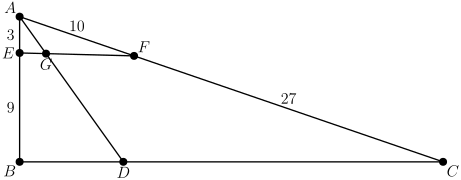
In the diagram below, angle is a right angle. Point is on and bisects angle Points and are on and respectively, so that and Given that and find the integer closest to the area of quadrilateral
Pista pequeña:
y así que y Escriba
and so and Write
Pista grande:
Aplique el teorema de la bisectriz dos veces: en el triángulo y en el triángulo
Apply the angle bisector ratio twice: in triangle and in triangle
Solución:
Aquí y el ángulo es recto, así que y El cuadrilátero es el triángulo con el triángulo quitado, donde es la intersección de y
Por el teorema de la bisectriz en el triángulo así que En el triángulo el rayo biseca el mismo ángulo, así que y Además,
Por lo tanto, y el entero más cercano es
Here and angle is right, so and The quadrilateral is triangle with triangle removed, where is the intersection of and
By the angle bisector theorem in triangle so In triangle ray bisects the same angle, so and Also
Therefore and the closest integer is
11.
Sean y dos caras de un cubo con Un haz de luz emana del vértice y se refleja en la cara en el punto que está a unidades de y a unidades de El haz sigue reflejándose en las caras del cubo. La longitud del camino de la luz desde que sale del punto hasta que alcanza por primera vez un vértice del cubo está dada por donde y son enteros y no es divisible por el cuadrado de ningún primo. Halle
Let and be two faces of a cube with A beam of light emanates from vertex and reflects off face at point which is units from and units from The beam continues to be reflected off the faces of the cube. The length of the light path from the time it leaves point until it next reaches a vertex of the cube is given by where and are integers and is not divisible by the square of any prime. Find
Pista pequeña:
Refleje el cubo a través de una cara en cada rebote; las reflexiones enderezan el camino de la luz en el único rayo desde que pasa por
Reflect the cube across a face at each bounce; the reflections straighten the light path into the single ray from through
Pista grande:
Los puntos del rayo son las tres coordenadas son divisibles por por primera vez cuando
The ray’s points are all three coordinates are first divisible by when
Solución:
Coloque con el cubo y en la cara Reflejar el cubo a través de la cara relevante en cada rebote endereza el camino reflejado en el rayo recto desde que pasa por cada cruce de un plano o corresponde a un rebote, y el haz alcanza un vértice del cubo exactamente cuando las tres coordenadas son simultáneamente múltiplos de
El rayo consiste en los puntos Como y son coprimos con las coordenadas y son divisibles por por primera vez cuando en el punto La longitud del camino es igual a la distancia en línea recta
Como es libre de cuadrados,
Place with the cube and on the face Reflecting the cube across the relevant face at each bounce straightens the reflected path into the straight ray from through each crossing of a plane or corresponds to a bounce, and the beam reaches a vertex of the cube exactly when all three coordinates are simultaneously multiples of
The ray consists of the points Since and are relatively prime to the coordinates and are first divisible by when at the point The path length equals the straight-line distance
Since is squarefree,
12.
Sea para todos los números complejos y sea para todos los enteros positivos Dado que y donde y son números reales, halle
Let for all complex numbers and let for all positive integers Given that and where and are real numbers, find
Pista pequeña:
Componga la aplicación consigo misma: se simplifica a
Compose the map with itself: simplifies to
Pista grande:
así que la sucesión tiene período como basta calcular
so the sequence has period since just compute
Solución:
Componiendo la aplicación consigo misma, y aplicando una vez más se obtiene así que la sucesión es periódica con período
Como tenemos Por lo tanto
Composing the map with itself, and applying once more gives so the sequence is periodic with period
Since we have Thus
13.
En el triángulo las medianas y tienen longitudes y respectivamente, y Prolongue hasta cortar la circunferencia circunscrita de en El área del triángulo es donde y son enteros positivos y no es divisible por el cuadrado de ningún primo. Halle
In triangle the medians and have lengths and respectively, and Extend to intersect the circumcircle of at The area of triangle is where and are positive integers and is not divisible by the square of any prime. Find
Pista pequeña:
es el punto medio de así que la potencia de respecto de la circunferencia da
is the midpoint of so the power of the point gives
Pista grande:
El baricentro divide cada mediana en la razón de dos a uno, así que tiene lados y compare y mediante sus bases colineales en
The centroid divides each median two-to-one, so triangle has side lengths and compare triangles and using their collinear bases on
Solución:
Como es el punto medio de Sea el baricentro, que divide cada mediana en la razón de dos a uno: y Por la potencia de respecto a la circunferencia circunscrita, así que
El triángulo es isósceles con y base así que la altura desde hacia es lo que da Como y están ambos sobre la recta los triángulos y comparten el vértice y tienen bases colineales, así que
Finalmente, como es el punto medio de y
Since is the midpoint of Let be the centroid, which divides each median in a two-to-one ratio: and By the power of the point with respect to the circumcircle, so
Triangle is isosceles with and base so the altitude from to is giving Since and both lie on line triangles and share the apex and have collinear bases, so
Finally, since is the midpoint of and
14.
Un conjunto de enteros positivos distintos tiene la siguiente propiedad: para cada entero en la media aritmética del conjunto de valores obtenidos al eliminar de es un entero. Dado que pertenece a y que es el mayor elemento de ¿cuál es el mayor número de elementos que puede tener?
A set of distinct positive integers has the following property: for every integer in the arithmetic mean of the set of values obtained by deleting from is an integer. Given that belongs to and that is the largest element of what is the greatest number of elements that can have?
Pista pequeña:
Si es la suma y el tamaño, cada es un entero, así que todos los elementos son congruentes módulo
If is the sum and the size, every is an integer, so all elements are congruent mod
Pista grande:
Con y en el conjunto, divide a y elementos distintos de ese tipo fuerzan
With and in the set, divides and distinct such elements force
Solución:
Sea un conjunto de elementos cuya suma es La condición dice que es un entero para cada lo que significa que todo elemento es congruente con módulo En particular todos los elementos son congruentes entre sí, y como todo elemento es más que un múltiplo de
Entonces así que divide a Además los elementos distintos van desde hasta en pasos que son múltiplos de así que lo que fuerza El mayor divisor de que es a lo sumo es así que
Treinta es alcanzable: tome los números junto con Todos son y la suma de los es así que toda media tras eliminar un elemento es un entero. La respuesta es
Let have elements with sum The condition says is an integer for every which means every element is congruent to modulo In particular all elements are congruent to each other, and since every element is more than a multiple of
Then so divides Moreover the distinct elements run from up to in steps that are multiples of so forcing The largest divisor of that is at most is so
Thirty is attainable: take the numbers together with All are and the sum of all is so every deleted mean is an integer. The answer is
15.
El poliedro tiene seis caras. La cara es un cuadrado con la cara es un trapecio con paralelo a y y la cara cumple Las otras tres caras son y La distancia de a la cara es Dado que donde y son enteros positivos y no es divisible por el cuadrado de ningún primo, halle
Polyhedron has six faces. Face is a square with face is a trapezoid with parallel to and and face has The other three faces are and The distance from to face is Given that where and are positive integers and is not divisible by the square of any prime, find
Pista pequeña:
Establezca coordenadas con el cuadrado en el plano ; las longitudes dadas ubican
Set up coordinates with square in the -plane; the given lengths place
Pista grande:
La cara es plana, así que está en el plano que pasa por la simetría del trapecio isósceles da y determina
Face is planar, so lies on the plane through trapezoid symmetry gives and determines
Solución:
Coloque y usando la distancia dada de a la cara De obtenemos y luego da así que y
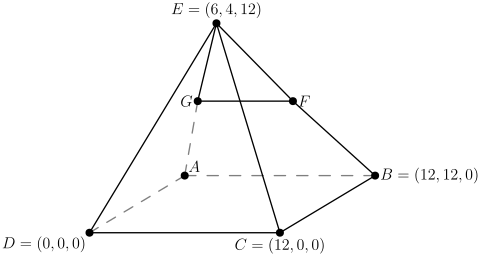
En el trapecio es paralelo a con y así que y son simétricos respecto al plano y La cara es plana, y el plano que pasa por contiene toda la dirección del eje (tanto como tienen ), así que es el plano que en efecto contiene a Por tanto Ahora da así que
Entonces y la forma dada corresponde a Así,
Place and using the given distance from to face From we get and then gives so and
In trapezoid is parallel to with and so and are symmetric about the plane and Face is planar, and the plane through contains the entire -axis direction (both and have ), so it is the plane which indeed contains Hence Now gives so
Then and the stated form corresponds to Thus