2025 AMC 10B Problema 12

A continuación está la solución preparada profesionalmente para el Problema 12 del 2025 AMC 10B, de LIVE by Po-Shen Loh. También puedes intentar el examen cronometrado completo, ver todas las soluciones del 2025 AMC 10B, o revisar la clave de respuestas.

Todos los problemas se usan con el permiso legal oficial de la Mathematical Association of America (MAA).

Conceptos:circunferencias tangentesrazón de áreaspolígono regular

Nivel de dificultad: 1710

12.

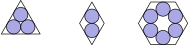
La figura de abajo muestra un triángulo equilátero, un rombo con un ángulo de 6060^\circ, y un hexágono regular, cada uno de ellos conteniendo algunos discos congruentes mutuamente tangentes. Sean T,T, R,R, y H,H, respectivamente, la razón en cada caso entre el área total de los discos y el área del polígono que los encierra.

¿Cuál de las siguientes afirmaciones es verdadera?

The figure below shows an equilateral triangle, a rhombus with a 6060^\circ angle, and a regular hexagon, each of them containing some mutually tangent congruent disks. Let T,T, R,R, and H,H, respectively, denote the ratio in each case of the total area of the disks to the area of the enclosing polygon.

Which of the following is true?

T=R=HT = R = H

H<R=TH \lt R = T

H=R<TH = R \lt T

H<R<TH \lt R \lt T

H<T<RH \lt T \lt R

Solución:

Toma el triángulo con lado s.s. Tres discos de radio rr dan s=2r(1+3),s = 2r(1 + \sqrt3), así que T=3πr2(3/4)s2T = \dfrac{3\pi r^2}{(\sqrt3/4)s^2} =(233)π20.73.= \dfrac{(2\sqrt3 - 3)\pi}{2} \approx 0.73. Para el rombo con lado a,a, los dos discos se ubican sobre la diagonal larga a3=6r,a\sqrt3 = 6r, así que r=a23r = \tfrac{a}{2\sqrt3} y R=2πr2(a23/2)=π390.60.R = \dfrac{2\pi r^2}{(a^2\sqrt3/2)} = \dfrac{\pi\sqrt3}{9} \approx 0.60. Para el hexágono con lado a,a, cada uno de los seis discos toca un lado en su punto medio, dando de nuevo r=a23r = \tfrac{a}{2\sqrt3} y H=6πr2(33/2)a2H = \dfrac{6\pi r^2}{(3\sqrt3/2)a^2} =π390.60.= \dfrac{\pi\sqrt3}{9} \approx 0.60. Así que H=R<T.H = R \lt T. Por lo tanto, la respuesta es C.

Take the triangle with side s.s. Three disks of radius rr give s=2r(1+3),s = 2r(1 + \sqrt3), so T=3πr2(3/4)s2T = \dfrac{3\pi r^2}{(\sqrt3/4)s^2} =(233)π20.73.= \dfrac{(2\sqrt3 - 3)\pi}{2} \approx 0.73. For the rhombus with side a,a, the two disks sit on the long diagonal a3=6r,a\sqrt3 = 6r, so r=a23r = \tfrac{a}{2\sqrt3} and R=2πr2(a23/2)=π390.60.R = \dfrac{2\pi r^2}{(a^2\sqrt3/2)} = \dfrac{\pi\sqrt3}{9} \approx 0.60. For the hexagon with side a,a, each of the six disks touches a side at its midpoint, again giving r=a23r = \tfrac{a}{2\sqrt3} and H=6πr2(33/2)a2H = \dfrac{6\pi r^2}{(3\sqrt3/2)a^2} =π390.60.= \dfrac{\pi\sqrt3}{9} \approx 0.60. So H=R<T.H = R \lt T. Therefore, the answer is C.

← Problema 11#11Examen completoProblema 13#13 →

El Problema 12 en otros años