
Problemas del 2025 AMC 10B
¡Desplázate hacia abajo y presiona Iniciar para intentar el examen! O ve al PDF imprimible, la clave de respuestas, o las soluciones profesionales preparadas por LIVE by Po-Shen Loh.
Todos los problemas se usan con el permiso legal oficial de la Mathematical Association of America (MAA).
O salta directamente a un solo problema con su solución: 1 · 2 · 3 · 4 · 5 · 6 · 7 · 8 · 9 · 10 · 11 · 12 · 13 · 14 · 15 · 16 · 17 · 18 · 19 · 20 · 21 · 22 · 23 · 24 · 25
¿Quieres aprender de forma profesional con clases interactivas en video?
Con tiempo
1:15:00
1.
Las instrucciones en una bolsa de gramos de granos de café dicen que preparar correctamente una taza grande de café de filtro requiere gramos de granos de café. ¿Cuál es el mayor número de tazas grandes de café correctamente preparadas que se pueden hacer con los granos de café de esa bolsa?
The instructions on a -gram bag of coffee beans say that proper brewing of a large mug of pour-over coffee requires grams of coffee beans. What is the greatest number of properly brewed large mugs of coffee that can be made from the coffee beans in that bag?
Respuesta: B
Pista pequeña:
Cada taza usa gramos, así que divide la masa total entre .
Each mug uses grams, so divide the total mass by
Pista grande:
Una taza parcial no cuenta, así que redondea hacia abajo hasta un número entero.
A partial mug does not count, so round down to a whole number
Solución:
Cada taza necesita gramos, así que dividimos: Media taza no es una taza, así que redondeamos hacia abajo. Eso deja Por lo tanto, B es la respuesta correcta.
Each mug needs grams, so we divide: A half mug isn’t a mug, so round down. That leaves Thus, B is the correct answer.
2.
Jerry escribió el dígito de las unidades de cada uno de los primeros cuadrados positivos: ¿Cuál es la suma de todos los números que escribió Jerry?
Jerry wrote down the ones digit of each of the first positive squares: What is the sum of all the numbers Jerry wrote down?
Respuesta: D
Pista pequeña:
El dígito de las unidades de depende solo del dígito de las unidades de así que la lista se repite cada términos.
The ones digit of depends only on the ones digit of so the list repeats every terms
Pista grande:
Un bloque completo suma hay bloques completos y términos sobrantes.
One full block sums to there are full blocks and leftover terms
Solución:
El dígito de las unidades de depende solo del dígito de las unidades de así que la lista se repite cada términos: Un bloque suma Ahora así que obtenemos bloques completos más los primeros cinco términos: Por lo tanto, la respuesta es D.
The ones digit of depends only on the ones digit of so the list repeats every terms: One block sums to Now so we get full blocks plus the first five terms: Therefore, the answer is D.
3.
Un triángulo similar al de Pascal tiene como fila superior y seguido de como segunda fila. En cada fila siguiente el primer número es el último número es y, como en el triángulo de Pascal estándar, cada otro número de la fila es la suma de los dos números directamente encima de él. Las primeras cuatro filas se muestran a continuación.
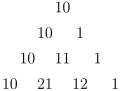
¿Cuál es la suma de los dígitos de la suma de los números de la ª fila?
A Pascal-like triangle has as the top row and followed by as the second row. In each subsequent row the first number is the last number is and, as in the standard Pascal’s Triangle, each other number in the row is the sum of the two numbers directly above it. The first four rows are shown below.
What is the sum of the digits of the sum of the numbers in the th row?
Respuesta: D
Pista pequeña:
Rastrea solo las sumas de las filas. Cada entrada interior es contada por las dos entradas debajo de ella.
Track only the row sums. Each interior entry is counted by both of the two entries below it
Pista grande:
Demuestra que para con luego calcula .
Show for with then compute
Solución:
Sea la suma de la fila Cada entrada de la fila alimenta las dos entradas justo debajo de ella, y los números fijos del borde y compensan exactamente los términos perdidos en los extremos. Así que para Con esto da así que Sus dígitos suman Por lo tanto, D es la respuesta correcta.
Let be the sum of row Each entry in row feeds the two entries just below it, and the fixed border numbers and exactly make up for the terms lost at the edges. So for With this gives so Its digits sum to Thus, D is the correct answer.
4.
El valor del número de dos dígitos en base siete es igual al valor del número de dos dígitos en base nueve. ¿Cuánto vale ?
The value of the two-digit number in base seven equals the value of the two-digit number in base nine. What is
Respuesta: A
Pista pequeña:
Por el valor posicional, en base siete es y en base nueve es .
By place value, in base seven is and in base nine is
Pista grande:
La ecuación se reduce a encuentra dígitos con siendo un dígito válido en base siete.
The equation reduces to find digits with a valid base-seven digit
Solución:
Por valor posicional, en base siete es y en base nueve es Los igualamos: así que es decir, Por tanto, y Como son numerales de dos cifras, como es un dígito de base siete, Así, y por lo que Por lo tanto, la respuesta es A.
By place value, in base seven is and in base nine is Set them equal: so that is Thus and Because these are two-digit numerals, because is a base-seven digit, Hence and so Therefore, the answer is A.
5.
En y Sea el centro del círculo que contiene los puntos y ¿Cuál es la medida en grados de ?
In and Let be the center of the circle containing points and What is the degree measure of
Respuesta: C
Pista pequeña:
es el circuncentro, así que Relaciona el ángulo central con el ángulo inscrito .
is the circumcenter, so Relate the central angle to the inscribed angle
Pista grande:
Como es obtuso, luego usa el triángulo isósceles .
Because is obtuse, then use the isosceles triangle
Solución:
Como es el circuncentro, El ángulo inscrito subtiende el arco y como es obtuso, el ángulo central es El triángulo es isósceles, así que (Las longitudes y nunca intervienen.) Por lo tanto, C es la respuesta correcta.
Since is the circumcenter, The inscribed angle subtends arc and because is obtuse, the central angle is Triangle is isosceles, so (The lengths and never enter.) Thus, C is the correct answer.
6.
La recta divide la región cuadrada definida por y en una región superior y una región inferior. La recta divide la región inferior en dos regiones de igual área. Entonces se puede escribir como donde y son enteros positivos. ¿Cuánto vale ?
The line divides the square region defined by and into an upper region and a lower region. The line divides the lower region into two regions of equal area. Then can be written as where and are positive integers. What is
Respuesta: C
Pista pequeña:
La región inferior a la izquierda de es un trapecio con lados verticales y y ancho .
The lower region left of is a trapezoid with vertical sides and and width
Pista grande:
El área inferior total es así que iguala a la mitad de ella, y resuelve la cuadrática.
The total lower area is so set equal to half of it, and solve the quadratic
Solución:
La región inferior tiene área La franja con es un trapecio de área Queremos que sea la mitad del total, es decir así que y Entonces y Por lo tanto, la respuesta es C.
The lower region has area The slice with is a trapezoid of area We want that to be half the total, namely so and Then and Therefore, the answer is C.
7.
Frances está metros directamente al sur de una puerta cerrada con llave en una cerca que corre de este a oeste. Justo detrás de la cerca hay una caja de chocolates, ubicada metros al este de la puerta cerrada. Una puerta sin llave está metros al este de la caja, y otra puerta sin llave está metros al oeste de la puerta cerrada. Frances puede llegar a la caja caminando hacia una puerta sin llave, cruzándola, y caminando hacia la caja. Resulta que la distancia total que Frances recorrería sería la misma por cualquiera de las dos puertas sin llave. ¿Cuál es el valor de ?
Frances stands meters directly south of a locked gate in a fence that runs east-west. Immediately behind the fence is a box of chocolates, located meters east of the locked gate. An unlocked gate lies meters east of the box, and another unlocked gate lies meters west of the locked gate. Frances can reach the box by walking toward an unlocked gate, passing through it, and walking toward the box. It happens that the total distance Frances would travel would be the same via either unlocked gate. What is the value of
Respuesta: C
Pista pequeña:
Pon la puerta cerrada en el origen y a Frances en cada ruta es una caminata recta hasta una puerta más una caminata a lo largo de la cerca hasta la caja.
Put the locked gate at the origin and Frances at each route is a straight walk to a gate plus a walk along the fence to the box
Pista grande:
La ruta oeste suma iguálala a y eleva al cuadrado.
The west route totals set it equal to and square
Solución:
Pon la cerca sobre el eje , la puerta cerrada en el origen, y a Frances en Entonces la caja está en la puerta este en y la puerta oeste en La ruta este es la ruta oeste es Igualándolas: Eleva al cuadrado y simplifica para obtener así que Por lo tanto, C es la respuesta correcta.
Put the fence on the -axis, the locked gate at the origin, and Frances at Then the box is at the east gate at and the west gate at The east route is the west route is Set them equal: Square and simplify to get so Thus, C is the correct answer.
8.
Emmy le dice a Max: «Hoy pedí sudaderas del club de matemáticas.» Max pregunta: «¿Cuánto costó cada camiseta?» Emmy responde: «Te daré una pista. El costo total fue donde y son dígitos y » Tras una pausa, Max dice: «Ese fue un buen precio.» ¿Cuánto vale ?
Emmy says to Max, “I ordered math club sweatshirts today.” Max asks, “How much did each shirt cost?” Emmy responds, “I’ll give you a hint. The total cost was where and are digits and ” After a pause, Max says, “That was a good price.” What is
Respuesta: C
Pista pequeña:
Escribe el total en centavos: es centavos, y debe ser divisible entre .
Write the total in cents: is cents, and it must be divisible by
Pista grande:
Reduce la condición módulo a prueba dígitos para encontrar los únicos .
Reduce the condition modulo to test digits to find the unique
Solución:
En centavos el total es Se reparte por igual entre camisetas, así que es divisible entre Ahora y así que necesitamos lo que se reduce a La única solución en dígitos con es ya que Eso es o por camiseta, así que Por lo tanto, la respuesta es C.
In cents the total is Split evenly among shirts, so it’s divisible by Now and so we need which reduces to The only digit solution with is since That’s or a shirt, so Therefore, the answer is C.
9.
¿Cuántas ternas ordenadas de enteros satisfacen el siguiente sistema de desigualdades?
How many ordered triples of integers satisfy the following system of inequalities?
Respuesta: C
Pista pequeña:
Las últimas tres desigualdades son simétricas en sea .
The last three inequalities are symmetric in let
Pista grande:
Entonces con igual paridad y cuenta esas ternas.
Then with equal parity and count such triples
Solución:
Sea Las últimas tres desigualdades dicen la primera dice y Como y así sucesivamente, deben tener todos la misma paridad. Ahora cuenta las ternas con cada parte igual paridad, y suma en Las pares son las permutaciones de de y de dando La única impar es Eso es en total, y cada una da una única Por lo tanto, C es la respuesta correcta.
Let The last three inequalities say the first says and Since and so on, must all share the same parity. Now count triples with each part equal parity, and sum in The even ones are the permutations of of and of giving The only odd one is That’s in all, and each yields a unique Thus, C is the correct answer.
10.
Sea y sea ¿Cuál es la suma de todos los valores enteros de para los cuales también es un entero?
Let and let What is the sum of all integer values of for which is also an integer?
Respuesta: A
Pista pequeña:
Ambas cúbicas tienen como raíz; factoriza cada una y cancela los factores comunes.
Both cubics have as a root; factor each and cancel common factors
Pista grande:
El cociente se simplifica a es un entero solo cuando divide a .
The ratio simplifies to it is an integer only when divides
Solución:
Factoriza ambas cúbicas: y Lejos de donde se anula o el cociente es los factores comunes se cancelan y Eso es un entero solo cuando así que o Pero anula así que solo sobrevive, y la suma es Por lo tanto, la respuesta es A.
Factor both cubics: and Away from where vanishes or the ratio is the common factors cancel and That’s an integer only when so or But kills so only survives, and the sum is Therefore, the answer is A.
11.
El lunes, estudiantes fueron al centro de tutoría al mismo tiempo, y cada uno fue asignado al azar a uno de los tutores de turno. El martes, los mismos estudiantes se presentaron, los mismos tutores estaban de turno, y los estudiantes fueron nuevamente asignados al azar a los tutores. ¿Cuál es la probabilidad de que exactamente estudiantes se reunieran con el mismo tutor tanto el lunes como el martes?
On Monday, students went to the tutoring center at the same time, and each one was randomly assigned to one of the tutors on duty. On Tuesday, the same students showed up, the same tutors were on duty, and the students were again randomly assigned to the tutors. What is the probability that exactly students met with the same tutor both Monday and Tuesday?
Respuesta: B
Pista pequeña:
La asignación de cada día es una permutación; comparar los dos días es como una sola permutación aleatoria, y «el mismo tutor» significa un punto fijo.
Each day’s assignment is a permutation; comparing the two days is like a single random permutation, and “same tutor” means a fixed point
Pista grande:
Elige los estudiantes coincidentes de maneras y desordena los otros (hay desórdenes); divide entre .
Choose the matched students in ways and derange the other (there are derangements); divide by
Solución:
La asignación de cada día es una permutación de los estudiantes entre los tutores. Comparando los dos días, el número que mantiene el mismo tutor es el número de puntos fijos de que es en sí misma una permutación uniformemente aleatoria de elementos. Queremos exactamente puntos fijos, así que elegimos esos de maneras y desordenamos los otros donde La probabilidad es Por lo tanto, B es la respuesta correcta.
Each day’s assignment is a permutation of the students among the tutors. Comparing the two days, the number who keep the same tutor is the number of fixed points of itself a uniformly random permutation of elements. We want exactly fixed points, so choose those in ways and derange the other where The probability is Thus, B is the correct answer.
12.
La figura de abajo muestra un triángulo equilátero, un rombo con un ángulo de , y un hexágono regular, cada uno de ellos conteniendo algunos discos congruentes mutuamente tangentes. Sean y respectivamente, la razón en cada caso entre el área total de los discos y el área del polígono que los encierra.
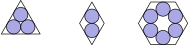
¿Cuál de las siguientes afirmaciones es verdadera?
The figure below shows an equilateral triangle, a rhombus with a angle, and a regular hexagon, each of them containing some mutually tangent congruent disks. Let and respectively, denote the ratio in each case of the total area of the disks to the area of the enclosing polygon.
Which of the following is true?
Respuesta: C
Pista pequeña:
Para un disco tangente a dos lados que se encuentran en un ángulo su centro está a una distancia del vértice.
For a disk tangent to two sides meeting at angle its center is at distance from the vertex
Pista grande:
Usa las condiciones de tangencia para escribir cada radio de disco en términos del tamaño del polígono, luego calcula (área del disco) / (área del polígono) en cada caso.
Use the tangency conditions to write each disk radius in terms of the polygon’s size, then compute (disk area) / (polygon area) in each case
Solución:
Toma el triángulo con lado Tres discos de radio dan así que Para el rombo con lado los dos discos se ubican sobre la diagonal larga así que y Para el hexágono con lado cada uno de los seis discos toca un lado en su punto medio, dando de nuevo y Así que Por lo tanto, la respuesta es C.
Take the triangle with side Three disks of radius give so For the rhombus with side the two disks sit on the long diagonal so and For the hexagon with side each of the six disks touches a side at its midpoint, again giving and So Therefore, the answer is C.
13.
La altura sobre la hipotenusa de un triángulo rectángulo -- es dividida en dos segmentos de longitudes por la mediana al lado más corto del triángulo. ¿Cuál es la razón ?
The altitude to the hypotenuse of a -- right triangle is divided into two segments of lengths by the median to the shortest side of the triangle. What is the ratio
Respuesta: A
Pista pequeña:
Coloca el ángulo recto en el origen con los catetos a lo largo de los ejes (cateto corto cateto largo ); encuentra el pie de la altura y la recta mediana.
Set the right angle at the origin with legs along the axes (short leg long leg ); find the foot of the altitude and the median line
Pista grande:
Interseca la altura con la mediana al lado corto, luego toma la razón del segmento cercano a la altura completa.
Intersect the altitude with the median to the short side, then take the ratio of the near segment to the whole altitude
Solución:
Coloca el ángulo recto en el cateto corto con y el cateto largo con La altura desde a la hipotenusa tiene pie y va a lo largo de La mediana desde al punto medio de corta esa altura en Esto divide (longitud ) en y así que y Por lo tanto, A es la respuesta correcta.
Place the right angle at the short leg with and the long leg with The altitude from to hypotenuse has foot and runs along The median from to the midpoint of meets that altitude at This cuts (length ) into and so and Thus, A is the correct answer.
14.
Nueve atletas, sin que dos de ellos tengan la misma estatura, se presentan a las pruebas para el equipo de baloncesto. Uno a la vez, sacan una pulsera al azar, sin reemplazo, de una bolsa que contiene pulseras azules, pulseras rojas, y pulseras verdes. Se dividen en un grupo azul, un grupo rojo, y un grupo verde. El miembro más alto de cada grupo es nombrado capitán del grupo. ¿Cuál es la probabilidad de que los capitanes de grupo sean los tres atletas más altos?
Nine athletes, no two of whom are the same height, try out for the basketball team. One at a time, they draw a wristband at random, without replacement, from a bag containing blue bands, red bands, and green bands. They are divided into a blue group, a red group, and a green group. The tallest member of each group is named the group captain. What is the probability that the group captains are the three tallest athletes?
Respuesta: C
Pista pequeña:
Los capitanes son los tres más altos exactamente cuando los tres más altos terminan en tres grupos diferentes.
The captains are the three tallest exactly when the three tallest end up in three different groups
Pista grande:
Asigna a los tres más altos a los lugares uno a la vez: las probabilidades de que cada nuevo caiga en un grupo distinto son y luego .
Assign the top three to slots one at a time: the probabilities that each new one lands in a fresh group are then
Solución:
Los capitanes son los tres más altos exactamente cuando esos tres caen en tres grupos diferentes, ya que entonces cada uno es el más alto de su propio grupo. Colócalos en los lugares uno a la vez ( por grupo). El segundo más alto no cae en el grupo del primero con probabilidad y el tercero evita ambos con probabilidad Así que la probabilidad es Por lo tanto, la respuesta es C.
The captains are the three tallest exactly when those three land in three different groups, since each is then the tallest of its own group. Drop them into the slots one at a time ( per group). The second tallest misses the first’s group with probability and the third misses both with probability So the probability is Therefore, the answer is C.
15.
La suma
se puede expresar como donde y son enteros positivos primos entre sí. ¿Cuánto vale ?
The sum
can be expressed as where and are relatively prime positive integers. What is
Respuesta: D
Pista pequeña:
Factoriza el denominador como y usa fracciones parciales.
Factor the denominator as and use partial fractions
Pista grande:
Las piezas se telescopian; solo dejan un residuo.
The pieces telescope; only leave a remainder
Solución:
Factoriza luego separa en fracciones parciales: Sumando sobre todos los el coeficiente de se cancela para así que solo sobreviven los primeros términos: Así que Por lo tanto, D es la respuesta correcta.
Factor then split into partial fractions: Summing over all the coefficient of cancels for so only the first few terms survive: So Thus, D is the correct answer.
16.
Un círculo ha sido dividido en sectores de tamaños diferentes. Luego de los sectores se pintan de rojo, de verde, y de azul de modo que no haya dos sectores vecinos pintados del mismo color. A continuación se muestra una de estas coloraciones.
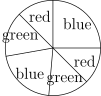
¿Cuántas coloraciones diferentes son posibles?
A circle has been divided into sectors of different sizes. Then of the sectors are painted red, painted green, and painted blue so that no two neighboring sectors are painted the same color. One such coloring is shown below.
How many different colorings are possible?
Respuesta: D
Pista pequeña:
Los sectores desiguales forman un ciclo fijo de posiciones; necesitas coloraciones propias que usen cada color exactamente dos veces.
The unequal sectors form a fixed cycle of positions; you need proper colorings using each color exactly twice
Pista grande:
Un -ciclo tiene coloraciones propias con colores; elimina las que no usan cada color exactamente dos veces.
A -cycle has proper -colorings; remove those that do not use each color exactly twice
Solución:
Los seis sectores desiguales forman un ciclo fijo de posiciones distinguibles, así que buscamos coloraciones propias de un ciclo de vértices con colores, usando cada color exactamente dos veces. Hay coloraciones propias con colores. De ellas, usan solo dos colores: elegimos el color ausente de maneras y alternamos los otros dos de maneras. Otras tienen conteos : elegimos el color usado tres veces de maneras, uno de los conjuntos alternados de posiciones, el color usado dos veces de maneras y sus posiciones entre las otras de maneras. Las restantes usan cada color exactamente dos veces. Por lo tanto, la respuesta es D.
The six unequal sectors form a fixed cycle of distinguishable positions, so we want proper -colorings of a -cycle that use each color exactly twice. There are proper -colorings altogether. Of these, use only two colors: choose the missing color in ways, then alternate the other two colors in ways. Another have color counts : choose the color used three times in ways, choose one of the alternating sets of positions for it, choose the color used twice in ways, and choose its positions among the other in ways. The remaining use each color exactly twice. Therefore, the answer is D.
17.
Considera una sucesión decreciente de enteros positivos que satisface las siguientes condiciones. El promedio de los primeros términos de la sucesión es Para todo el promedio de los primeros términos de la sucesión es menos que el promedio de los primeros términos de la sucesión.
¿Cuál es el mayor valor posible de ?
Consider a decreasing sequence of positive integers that satisfies the following conditions. The average of the first terms in the sequence is For all the average of the first terms in the sequence is less than the average of the first terms in the sequence.
What is the greatest possible value of
Respuesta: B
Pista pequeña:
Sea el promedio de los primeros términos; las condiciones dan para .
Let be the average of the first terms; the conditions give for
Pista grande:
Entonces para exige que siga siendo un entero positivo.
Then for require it to stay a positive integer
Solución:
Sea el promedio de los primeros términos. Entonces y para así que La suma parcial es y para los términos son es decir Estos se mantienen positivos mientras es decir con Esta cota es alcanzable: toma que es decreciente, suma y queda por encima de Así, el mayor valor posible es por lo que B es la respuesta correcta.
Let be the average of the first terms. Then and for so The partial sum is and for the terms are namely These stay positive as long as that is with This bound is attainable: take which is decreasing, sums to and lies above Thus the greatest possible value is so B is the correct answer.
18.
¿Cuál es el dígito de las unidades de la suma ? (Recuerda que denota el mayor entero menor o igual que )
What is the ones digit of the sum (Recall that denotes the greatest integer less than or equal to )
Respuesta: D
Pista pequeña:
para los valores .
for the values
Pista grande:
Como suma para hasta y añade el término final .
Since sum for to and add the final term
Solución:
Para cada en los enteros Como los términos con contribuyen y añade Esa suma es así que el total es Su dígito de las unidades es Por lo tanto, la respuesta es D.
For each on the integers Since the terms with contribute and tacks on That sum is so the total is Its ones digit is Therefore, the answer is D.
19.
Un recipiente tiene una base cuadrada de , una abertura cuadrada superior de , y cuatro lados trapezoidales congruentes, como se muestra. Comenzando cuando el recipiente está vacío, una manguera que vierte agua a ritmo constante tarda minutos en llenar el recipiente hasta la línea media de los trapecios.
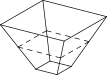
¿Cuántos minutos más tardará en llenar el resto del recipiente?
A container has a square bottom, a open square top, and four congruent trapezoidal sides, as shown. Starting when the container is empty, a hose that runs water at a constant rate takes minutes to fill the container up to the midline of the trapezoids.
How many more minutes will it take to fill the remainder of the container?
Respuesta: D
Pista pequeña:
El recipiente es una parte de una pirámide; el volumen desde el ápice hasta la longitud de lado escala como .
The container is a piece of a pyramid; the volume from the apex up to side length scales as
Pista grande:
Los volúmenes se dividen como (hasta la línea media, lado ) y (resto); escala los minutos.
Volumes split as (up to the midline, side ) and (remainder); scale the minutes
Solución:
El recipiente es un tronco de pirámide cuadrado: un corte horizontal a la fracción de altura tiene lado Extiende los lados hasta su ápice, y el volumen hasta donde la longitud de lado es escala como Así que todo el recipiente son partes, la parte hasta la línea media (lado ) son partes, y el resto son partes. Esas partes tardan minutos, así que cada parte son minutos. Las partes restantes tardan minutos. Por lo tanto, D es la respuesta correcta.
The container is a square frustum: a horizontal slice at height fraction has side Extend the sides up to their apex, and the volume out to where the side length is scales as So the whole container is parts, the piece up to the midline (side ) is parts, and the rest is parts. Those parts take minutes, so each part is minutes. The remaining parts take minutes. Thus, D is the correct answer.
20.
Cuatro semicírculos congruentes están inscritos en un cuadrado de lado de modo que sus diámetros están sobre los lados del cuadrado, un extremo de cada diámetro está en un vértice del cuadrado, y los semicírculos adyacentes son tangentes entre sí. Un círculo pequeño centrado en el centro del cuadrado es tangente a cada uno de los cuatro semicírculos, como se muestra abajo.
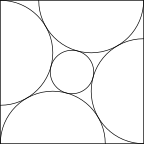
El diámetro del círculo pequeño se puede escribir como donde y son enteros. ¿Cuánto vale ?
Four congruent semicircles are inscribed in a square of side length so that their diameters are on the sides of the square, one endpoint of each diameter is at a vertex of the square, and adjacent semicircles are tangent to each other. A small circle centered at the center of the square is tangent to each of the four semicircles, as shown below.
The diameter of the small circle can be written as where and are integers. What is
Respuesta: A
Pista pequeña:
Primero encuentra el radio del semicírculo a partir de la tangencia de dos semicírculos adyacentes cuyos diámetros empiezan en vértices vecinos.
First find the semicircle radius from the tangency of two adjacent semicircles whose diameters start at neighboring vertices
Pista grande:
El radio pequeño es igual a (distancia del centro del cuadrado al centro de un semicírculo) menos luego factoriza en dos binomios.
The small radius equals (distance from the square’s center to a semicircle’s center) minus then factor into two binomials
Solución:
Sea cada semicírculo de radio con centros como y Los semicírculos adyacentes son tangentes, así que estos centros están a de distancia: Esto da así que El círculo pequeño de radio se ubica en y es tangente a un semicírculo cuando su distancia a ese centro es igual a Esa distancia es así que y el diámetro es Así que Por lo tanto, la respuesta es A.
Let each semicircle have radius with centers like and Adjacent semicircles are tangent, so these centers are apart: This gives so The small circle of radius sits at and it’s tangent to a semicircle when its distance to that center equals That distance is so and the diameter is So Therefore, the answer is A.
21.
Cada uno de los cuadrados de una cuadrícula se colorea de rojo, azul o amarillo de tal manera que cada cuadrado rojo comparte un lado con al menos un cuadrado azul, cada cuadrado azul comparte un lado con al menos un cuadrado amarillo, y cada cuadrado amarillo comparte un lado con al menos un cuadrado rojo. Las coloraciones que se pueden obtener una de otra mediante rotaciones y/o reflexiones se consideran iguales. ¿Cuántas coloraciones diferentes son posibles?
Each of the squares in a grid is to be colored red, blue, or yellow in such a way that each red square shares an edge with at least one blue square, each blue square shares an edge with at least one yellow square, and each yellow square shares an edge with at least one red square. Colorings that can be obtained from one another by rotations and/or reflections are to be considered the same. How many different colorings are possible?
Respuesta: C
Pista pequeña:
Las reglas forman un ciclo dirigido: el rojo necesita un vecino azul, el azul necesita uno amarillo, el amarillo necesita uno rojo.
The rules form a directed cycle: red needs a blue neighbor, blue needs a yellow, yellow needs a red
Pista grande:
Cuenta todas las coloraciones válidas de la cuadrícula etiquetada fija, luego agrúpalas por las rotaciones y reflexiones del cuadrado.
Count all valid colorings of the fixed labeled grid, then group them by the rotations and reflections of the square
Solución:
Primero contemos las coloraciones de una cuadrícula con posiciones distinguibles. Fijemos el cuadrado central en rojo y enumeremos cíclicamente los colores de los cuatro cuadrados centrales de los bordes. Salvo rotación o reflexión, los únicos patrones posibles son y El primero tiene posiciones y posibles cadenas cíclicas de esquinas, y el segundo tiene posiciones y posibles cadenas, y Así, hay coloraciones con centro rojo. El centro tiene colores posibles, por lo que hay coloraciones etiquetadas.
Ahora aplicamos el lema de Burnside. La identidad fija las coloraciones. Ninguna rotación no trivial fija una coloración válida. Cada una de las dos reflexiones horizontal y vertical fija coloraciones, mientras que las reflexiones diagonales no fijan ninguna. Por tanto, el número de coloraciones salvo rotaciones y reflexiones es Así, C es la respuesta correcta.
First count colorings of a grid whose positions are distinguished. Fix the center square as red and list the four edge-middle colors cyclically. Up to a rotation or reflection, the only possible edge patterns are and The first has placements and possible cyclic corner strings, and the second has placements and possible corner strings, and Thus there are colorings with a red center. The center has possible colors, so there are labeled colorings.
Now apply Burnside’s lemma. The identity fixes all colorings. No nonidentity rotation fixes a valid coloring. Each of the two reflections across a horizontal or vertical axis fixes colorings, while each diagonal reflection fixes none. Therefore, the number of colorings up to rotations and reflections is Thus, C is the correct answer.
22.
Se elige al azar un entero positivo de siete dígitos. ¿Cuál es la probabilidad de que el número sea divisible entre dado que la suma de sus dígitos es ?
A seven-digit positive integer is chosen at random. What is the probability that the number is divisible by given that the sum of its digits is
Respuesta: A
Pista pequeña:
Una suma de dígitos de está por debajo del máximo así que los dígitos son todos excepto por un déficit total de .
A digit sum of is below the maximum so the digits are all except a total shortfall of
Pista grande:
Para la divisibilidad entre usa la suma alternada de dígitos; exprésala mediante los déficits en los dígitos de posición impar frente a los de posición par.
For divisibility by use the alternating digit sum; express it through the shortfalls on the odd- versus even-position digits
Solución:
Una suma de dígitos de significa que los siete dígitos son excepto por un déficit total de lo que da números. Para la divisibilidad entre necesitamos donde suma los dígitos de posición impar y los pares. Escribe los déficits como Entonces un múltiplo de solo cuando Así que todo el déficit recae en las posiciones pares, dando maneras. La probabilidad es Por lo tanto, la respuesta es A.
A digit sum of means all seven digits are except for a total deficit of which gives numbers. For divisibility by we need where sums the odd-position digits and the even ones. Write the deficits as Then a multiple of only when So all of the deficit falls on the even positions, giving ways. The probability is Therefore, the answer is A.
23.
Una cuadrícula rectangular de cuadrados tiene filas y columnas. Cada cuadrado tiene espacio para dos números. Horace y Vera llenan cada uno la cuadrícula poniendo los números del al en los cuadrados. Horace llena la cuadrícula horizontalmente: pone hasta en orden de izquierda a derecha en la fila pone hasta en la fila en orden de izquierda a derecha, y continúa de manera similar hasta la fila Vera llena la cuadrícula verticalmente: pone hasta en orden de arriba a abajo en la columna luego hasta en la columna en orden de arriba a abajo, y continúa de manera similar hasta la columna ¿Cuántos cuadrados reciben dos copias del mismo número?
A rectangular grid of squares has rows and columns. Each square has room for two numbers. Horace and Vera each fill in the grid by putting the numbers from through into the squares. Horace fills the grid horizontally: he puts through in order from left to right into row puts through into row in order from left to right, and continues similarly through row Vera fills the grid vertically: she puts through in order from top to bottom into column then through into column in order from top to bottom, and continues similarly through column How many squares get two copies of the same number?
Respuesta: C
Pista pequeña:
En la fila columna Horace escribe y Vera escribe iguálalos.
At row column Horace writes and Vera writes set them equal
Pista grande:
La ecuación se reduce a encuentra las columnas que hacen que sea un entero en el rango.
The equation reduces to find the columns that make an integer in range
Solución:
En la fila columna Horace escribe y Vera escribe Iguálalos y simplifica para obtener así que un entero exactamente cuando Para eso son valores, y recorre todos dentro del rango. Así que cuadrados coinciden. Por lo tanto, C es la respuesta correcta.
At row column Horace writes and Vera writes Set them equal and simplify to get so an integer exactly when For that’s values, and runs all within range. So squares match. Thus, C is the correct answer.
24.
Una rana salta a lo largo de la recta numérica según las siguientes reglas. Empieza en Si está en entonces se mueve a con probabilidad y desaparece con probabilidad Para o si está en entonces se mueve a con probabilidad se mueve a con probabilidad y desaparece con probabilidad
¿Cuál es la probabilidad de que la rana llegue a ?
A frog hops along the number line according to the following rules. It starts at If it is at then it moves to with probability and it disappears with probability For or if it is at then it moves to with probability it moves to with probability and it disappears with probability
What is the probability that the frog reaches
Respuesta: E
Pista pequeña:
Sea la probabilidad de llegar alguna vez a partiendo de con plantea una ecuación por estado.
Let be the probability of ever reaching starting from with set up one equation per state
Pista grande:
Usa y para luego resuelve el sistema.
Use and for then solve the system
Solución:
Sea la probabilidad de llegar a desde la posición con Las reglas dan y Trabaja hacia arriba: y Estos se desenrollan a y finalmente Por lo tanto, la respuesta es E.
Let be the probability of reaching from position with The rules give and Work upward: and These unwind to and finally Therefore, the answer is E.
25.
El cuadrado tiene lados de longitud Los puntos y están sobre y respectivamente, con y Una trayectoria comienza a lo largo del segmento de recta de a y continúa reflejándose contra los lados de (con ángulos de entrada y de salida congruentes), como se muestra en la figura. Si la trayectoria golpea un vértice del cuadrado, entonces termina ahí; de lo contrario continúa para siempre.
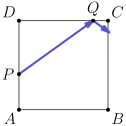
¿En qué vértice termina la trayectoria?
Square has sides of length Points and lie on and respectively, with and A path begins along the line segment from to and continues by reflecting against the sides of (with congruent incoming and outgoing angles), as shown in the figure. If the path hits a vertex of the square, then it terminates there; otherwise it continues forever.
At which vertex does the path terminate?
La trayectoria continúa para siempre.
The path continues forever.
Respuesta: B
Pista pequeña:
Reflejar trayectorias de billar es más fácil «desplegando»: sigue una recta a través de una cuadrícula de copias reflejadas del cuadrado.
Reflecting billiard paths is easiest by “unfolding”: follow a straight line through a grid of reflected copies of the square
Pista grande:
Encuentra el primer vértice de cuadrícula que la recta alcanza; las paridades de y determinan qué vértice real es.
Find the first grid corner the line hits; the parities of and determine which actual vertex it is
Solución:
Coloquemos de modo que y La dirección inicial es Despleguemos el billar en una cuadrícula de copias reflejadas y sigamos la recta desde En un vértice de la cuadrícula la coordenada horizontal da La coordenada vertical exige entonces así que La primera posibilidad positiva es que da y el vértice desplegado Cruzar celdas horizontalmente (un número impar) lo coloca en el lado y cruzar celdas verticalmente (un número par) lo coloca en Ese es el vértice Así, B es la respuesta correcta.
Place so and The initial direction is Unfold the billiard into a grid of reflected copies and follow the straight line from At a grid corner the horizontal coordinate gives The vertical coordinate then requires so The first positive possibility is giving and the unfolded corner Crossing cells across (odd) puts it on the side and cells up (even) puts it on That’s vertex Thus, B is the correct answer.