2025 AIME I Problema 2

A continuación está la solución preparada profesionalmente para el Problema 2 del 2025 AIME I, de LIVE by Po-Shen Loh. También puedes intentar el examen cronometrado completo, ver todas las soluciones del 2025 AIME I, o revisar la clave de respuestas.

Todos los problemas se usan con el permiso legal oficial de la Mathematical Association of America (MAA).

Conceptos:razón de áreasfórmula del cordónvector

Nivel de dificultad: 2340

2.

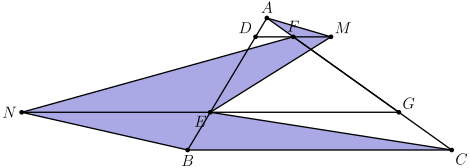
En ABC\triangle ABC los puntos A,A, D,D, E,E, y BB están en ese orden sobre el lado AB\overline{AB} con AD=4,AD = 4, DE=16,DE = 16, y EB=8.EB = 8. Los puntos A,A, F,F, G,G, y CC están en ese orden sobre el lado AC\overline{AC} con AF=13,AF = 13, FG=52,FG = 52, y GC=26.GC = 26. Sea MM la reflexión de DD respecto a F,F, y sea NN la reflexión de GG respecto a E.E. El cuadrilátero DEGFDEGF tiene área 288.288. Halle el área del heptágono AFNBCEM.AFNBCEM.

On ABC\triangle ABC points A,A, D,D, E,E, and BB lie in that order on side AB\overline{AB} with AD=4,AD = 4, DE=16,DE = 16, and EB=8.EB = 8. Points A,A, F,F, G,G, and CC lie in that order on side AC\overline{AC} with AF=13,AF = 13, FG=52,FG = 52, and GC=26.GC = 26. Let MM be the reflection of DD through F,F, and let NN be the reflection of GG through E.E. Quadrilateral DEGFDEGF has area 288.288. Find the area of heptagon AFNBCEM.AFNBCEM.

Solución:

Aquí AB=4+16+8=28AB = 4 + 16 + 8 = 28 y AC=13+52+26=91,AC = 13 + 52 + 26 = 91, así que DD y FF están a 17\frac{1}{7} del camino desde AA sobre sus lados, mientras que EE y GG están a 57\frac{5}{7} del camino. Los triángulos que comparten el ángulo AA tienen áreas proporcionales a los productos de los lados adyacentes, así que [ADF]=149[ABC][ADF] = \frac{1}{49}[ABC] y [AEG]=2549[ABC].[AEG] = \frac{25}{49}[ABC]. Por lo tanto [DEGF]=[AEG][ADF]=2449[ABC]=288, \begin{aligned} [DEGF] &= [AEG] - [ADF] \\ &= \frac{24}{49}[ABC] = 288, \end{aligned} lo que da [ABC]=588.[ABC] = 588.

Ahora sea b=AB\mathbf{b} = \overrightarrow{AB} y c=AC,\mathbf{c} = \overrightarrow{AC}, de modo que D=17b,D = \frac{1}{7}\mathbf{b}, E=57b,E = \frac{5}{7}\mathbf{b}, F=17c,F = \frac{1}{7}\mathbf{c}, G=57c,G = \frac{5}{7}\mathbf{c}, y las reflexiones son M=2FD=17(2cb)M = 2F - D = \frac{1}{7}(2\mathbf{c} - \mathbf{b}) y N=2EG=17(10b5c).N = 2E - G = \frac{1}{7}(10\mathbf{b} - 5\mathbf{c}). La fórmula del cordón de zapato para AFNBCEMAFNBCEM suma los productos cruzados de vértices consecutivos: los dos términos en AA se anulan, y F×N=1049b×c,N×B=57b×c,B×C=b×c,C×E=57b×c,E×M=1049b×c. \begin{aligned} F \times N &= -\tfrac{10}{49}\,\mathbf{b} \times \mathbf{c}, \\ N \times B &= \tfrac{5}{7}\,\mathbf{b} \times \mathbf{c}, \\ B \times C &= \mathbf{b} \times \mathbf{c}, \\ C \times E &= -\tfrac{5}{7}\,\mathbf{b} \times \mathbf{c}, \\ E \times M &= \tfrac{10}{49}\,\mathbf{b} \times \mathbf{c}. \end{aligned}

Todo se cancela excepto el único término b×c,\mathbf{b} \times \mathbf{c}, así que el área del heptágono es 12b×c=[ABC]=588.\frac{1}{2}\left|\mathbf{b} \times \mathbf{c}\right| = [ABC] = 588.

Here AB=4+16+8=28AB = 4 + 16 + 8 = 28 and AC=13+52+26=91,AC = 13 + 52 + 26 = 91, so DD and FF lie 17\frac{1}{7} of the way from AA along their sides while EE and GG lie 57\frac{5}{7} of the way. Triangles sharing angle AA have areas proportional to the products of the adjacent sides, so [ADF]=149[ABC][ADF] = \frac{1}{49}[ABC] and [AEG]=2549[ABC].[AEG] = \frac{25}{49}[ABC]. Therefore [DEGF]=[AEG][ADF]=2449[ABC]=288, \begin{aligned} [DEGF] &= [AEG] - [ADF] \\ &= \frac{24}{49}[ABC] = 288, \end{aligned} which gives [ABC]=588.[ABC] = 588.

Now set b=AB\mathbf{b} = \overrightarrow{AB} and c=AC,\mathbf{c} = \overrightarrow{AC}, so that D=17b,D = \frac{1}{7}\mathbf{b}, E=57b,E = \frac{5}{7}\mathbf{b}, F=17c,F = \frac{1}{7}\mathbf{c}, G=57c,G = \frac{5}{7}\mathbf{c}, and the reflections are M=2FD=17(2cb)M = 2F - D = \frac{1}{7}(2\mathbf{c} - \mathbf{b}) and N=2EG=17(10b5c).N = 2E - G = \frac{1}{7}(10\mathbf{b} - 5\mathbf{c}). The shoelace formula for AFNBCEMAFNBCEM sums cross products of consecutive vertices: the two terms at AA vanish, and F×N=1049b×c,N×B=57b×c,B×C=b×c,C×E=57b×c,E×M=1049b×c. \begin{aligned} F \times N &= -\tfrac{10}{49}\,\mathbf{b} \times \mathbf{c}, \\ N \times B &= \tfrac{5}{7}\,\mathbf{b} \times \mathbf{c}, \\ B \times C &= \mathbf{b} \times \mathbf{c}, \\ C \times E &= -\tfrac{5}{7}\,\mathbf{b} \times \mathbf{c}, \\ E \times M &= \tfrac{10}{49}\,\mathbf{b} \times \mathbf{c}. \end{aligned}

Everything cancels except the single term b×c,\mathbf{b} \times \mathbf{c}, so the heptagon's area is 12b×c=[ABC]=588.\frac{1}{2}\left|\mathbf{b} \times \mathbf{c}\right| = [ABC] = 588.

← Problema 1#1Examen completoProblema 3#3 →

El Problema 2 en otros años