2021 AIME I Problema 2

A continuación está la solución preparada profesionalmente para el Problema 2 del 2021 AIME I, de LIVE by Po-Shen Loh. También puedes intentar el examen cronometrado completo, ver todas las soluciones del 2021 AIME I, o revisar la clave de respuestas.

Todos los problemas se usan con el permiso legal oficial de la Mathematical Association of America (MAA).

Conceptos:geometría analíticarectánguloparalelogramo

Nivel de dificultad: 2350

2.

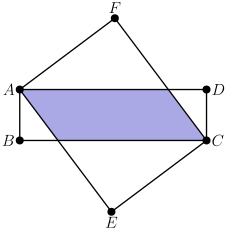
En el diagrama de abajo, ABCDABCD es un rectángulo de lados AB=3AB = 3 y BC=11,BC = 11, y AECFAECF es un rectángulo de lados AF=7AF = 7 y FC=9,FC = 9, como se muestra. El área de la región sombreada común a los interiores de ambos rectángulos es mn,\frac{m}{n}, donde mm y nn son enteros positivos primos entre sí. Halle m+n.m + n.

In the diagram below, ABCDABCD is a rectangle with side lengths AB=3AB = 3 and BC=11,BC = 11, and AECFAECF is a rectangle with side lengths AF=7AF = 7 and FC=9,FC = 9, as shown. The area of the shaded region common to the interiors of both rectangles is mn,\frac{m}{n}, where mm and nn are relatively prime positive integers. Find m+n.m + n.

Solución:

Coloque B=(0,0),B = (0, 0), C=(11,0),C = (11, 0), A=(0,3),A = (0, 3), D=(11,3).D = (11, 3). Resolviendo AF=7AF = 7 y CF=9CF = 9 (consistente ya que AC2=112+32=130AC^2 = 11^2 + 3^2 = 130 =72+92= 7^2 + 9^2) se obtiene F=(285,365),F = \left(\frac{28}{5}, \frac{36}{5}\right), y como las diagonales del rectángulo AECFAECF se bisecan mutuamente, E=A+CF=(275,215).E = A + C - F = \left(\frac{27}{5}, -\frac{21}{5}\right).

Los lados AEAE y FCFC tienen dirección (3,4),(3, -4), y están sobre las rectas 4x+3y=94x + 3y = 9 y 4x+3y=44;4x + 3y = 44; los lados AFAF y ECEC están sobre 3x4y=123x - 4y = -12 y 3x4y=33.3x - 4y = 33. Todo punto de ABCDABCD satisface 123x4y33,-12 \le 3x - 4y \le 33, así que la región común es solo la parte de la franja 0y30 \le y \le 3 entre las rectas 4x+3y=94x + 3y = 9 y 4x+3y=44:4x + 3y = 44: un paralelogramo con vértices A=(0,3),A = (0, 3), (94,0),\left(\frac{9}{4}, 0\right), C=(11,0),C = (11, 0), y (354,3).\left(\frac{35}{4}, 3\right).

Sus lados horizontales tienen longitud 1194=35411 - \frac{9}{4} = \frac{35}{4} y la altura entre ellos es 3,3, así que el área es 3543=1054,\frac{35}{4} \cdot 3 = \frac{105}{4}, y m+n=105+4=109.m + n = 105 + 4 = 109.

Place B=(0,0),B = (0, 0), C=(11,0),C = (11, 0), A=(0,3),A = (0, 3), D=(11,3).D = (11, 3). Solving AF=7AF = 7 and CF=9CF = 9 (consistent since AC2=112+32=130AC^2 = 11^2 + 3^2 = 130 =72+92= 7^2 + 9^2) gives F=(285,365),F = \left(\frac{28}{5}, \frac{36}{5}\right), and since the diagonals of rectangle AECFAECF bisect each other, E=A+CF=(275,215).E = A + C - F = \left(\frac{27}{5}, -\frac{21}{5}\right).

Sides AEAE and FCFC have direction (3,4),(3, -4), lying on the lines 4x+3y=94x + 3y = 9 and 4x+3y=44;4x + 3y = 44; sides AFAF and ECEC lie on 3x4y=123x - 4y = -12 and 3x4y=33.3x - 4y = 33. Every point of ABCDABCD satisfies 123x4y33,-12 \le 3x - 4y \le 33, so the common region is just the part of the strip 0y30 \le y \le 3 between the lines 4x+3y=94x + 3y = 9 and 4x+3y=44:4x + 3y = 44: a parallelogram with vertices A=(0,3),A = (0, 3), (94,0),\left(\frac{9}{4}, 0\right), C=(11,0),C = (11, 0), and (354,3).\left(\frac{35}{4}, 3\right).

Its horizontal sides have length 1194=35411 - \frac{9}{4} = \frac{35}{4} and the height between them is 3,3, so the area is 3543=1054,\frac{35}{4} \cdot 3 = \frac{105}{4}, and m+n=105+4=109.m + n = 105 + 4 = 109.

← Problema 1#1Examen completoProblema 3#3 →

El Problema 2 en otros años