2022 AMC 10B Problema 16

A continuación está la solución preparada profesionalmente para el Problema 16 del 2022 AMC 10B, de LIVE by Po-Shen Loh. También puedes intentar el examen cronometrado completo, ver todas las soluciones del 2022 AMC 10B, o revisar la clave de respuestas.

Todos los problemas se usan con el permiso legal oficial de la Mathematical Association of America (MAA).

Conceptos:congruencia (geometría)semejanzatrapecio

Nivel de dificultad: 2150

16.

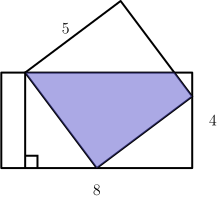
El diagrama de abajo muestra un rectángulo con lados de longitud 44 y 88 y un cuadrado con lado de longitud 5.5. Tres vértices del cuadrado están sobre tres lados diferentes del rectángulo, como se muestra. ¿Cuál es el área de la región que está dentro tanto del cuadrado como del rectángulo?

The diagram below shows a rectangle with side lengths 44 and 88 and a square with side length 5.5. Three vertices of the square lie on three different sides of the rectangle, as shown. What is the area of the region inside both the square and the rectangle?

1518 15\dfrac{1}{8}

1538 15\dfrac{3}{8}

1512 15\dfrac{1}{2}

1558 15\dfrac{5}{8}

1578 15\dfrac{7}{8}

Solución:

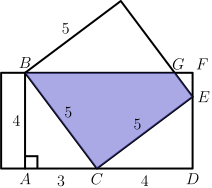
Primero, etiquetemos los puntos de la siguiente manera:

Como tenemos un rectángulo, AB=4.AB = 4. Por el teorema de Pitágoras, tenemos AC=3.AC = 3. Luego, dado que ACB\angle ACB y DCE\angle DCE son complementarios, BAC=CDE=90,\angle BAC = \angle CDE = 90^\circ, y BC=CEBC = CE, sabemos que ABCCDE.ABC \cong CDE. Por lo tanto, ED=3ED = 3 y EF=1.EF = 1.

Como CED\angle CED y GEF\angle GEF son complementarios y EFG=CDE=90,\angle EFG = \angle CDE = 90^\circ, sabemos que EFGEFG y CDECDE son semejantes. Esto significa que ECCD=EGEF, \dfrac{EC}{CD} = \dfrac{EG}{EF}, así que EG=1.25.EG = 1.25. Como la región sombreada es un trapecio, podemos obtener el área como (GE+BC)EC2=5(5+1.25)2\dfrac{(GE+BC)EC}2 = \dfrac{ 5(5+1.25)}2 =56.252=15.625.= \dfrac{5\cdot 6.25}{2} = 15.625.

Esto es igual a 1558. 15 \dfrac 58.

Así, la respuesta es D.

Firstly, let's label the points as follows:

Since we have a rectangle, AB=4.AB = 4. By the Pythagorean Theorem, we have AC=3.AC = 3. Then, since ACB\angle ACB and DCE\angle DCE are complementary, BAC=CDE=90,\angle BAC = \angle CDE = 90^\circ, and BC=CEBC = CE we know ABCCDE.ABC \cong CDE. Therefore, ED=3ED = 3 and EF=1.EF = 1.

Since CED\angle CED and GEF\angle GEF are complementary and EFG=CDE=90,\angle EFG = \angle CDE = 90^\circ, we know EFGEFG and CDECDE are similar. This means ECCD=EGEF, \dfrac{EC}{CD} = \dfrac{EG}{EF}, so EG=1.25.EG = 1.25. Since the shaded region is a trapezoid, we can get the area as (GE+BC)EC2=5(5+1.25)2\dfrac{(GE+BC)EC}2 = \dfrac{ 5(5+1.25)}2 =56.252=15.625.= \dfrac{5\cdot 6.25}{2} = 15.625.

This is equal to 1558. 15 \dfrac 58.

Thus, the answer is D .

← Problema 15#15Examen completoProblema 17#17 →

El Problema 16 en otros años