2014 AMC 10A Problema 16

A continuación está la solución preparada profesionalmente para el Problema 16 del 2014 AMC 10A, de LIVE by Po-Shen Loh. También puedes intentar el examen cronometrado completo, ver todas las soluciones del 2014 AMC 10A, o revisar la clave de respuestas.

Todos los problemas se usan con el permiso legal oficial de la Mathematical Association of America (MAA).

Conceptos:rectángulopunto mediosemejanza

Nivel de dificultad: 1660

16.

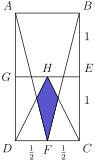
En el rectángulo ABCD,ABCD, AB=1,AB=1, BC=2,BC=2, y los puntos E,E, F,F, y GG son los puntos medios de BC,\overline{BC}, CD,\overline{CD}, y AD,\overline{AD}, respectivamente. El punto HH es el punto medio de GE.\overline{GE}. ¿Cuál es el área de la región sombreada?

In rectangle ABCD,ABCD, AB=1,AB=1, BC=2,BC=2, and points E,E, F,F, and GG are midpoints of BC,\overline{BC}, CD,\overline{CD}, and AD,\overline{AD}, respectively. Point HH is the midpoint of GE.\overline{GE}. What is the area of the shaded region?

112\dfrac1{12}

318\dfrac{\sqrt3}{18}

212\dfrac{\sqrt2}{12}

312\dfrac{\sqrt3}{12}

16\dfrac16

Solución:

Podemos hallar el área de la región sombreada calculando el área del DHC\triangle DHC y restando los dos triángulos no sombreados.

Prolonga DH\overline{DH} hasta que llegue a B.B. Sea la intersección de DB\overline{DB} y AF\overline{AF} el punto X.X.

Tenemos que DXF\triangle DXF BXA.\sim \triangle BXA. Como AB=2DF,AB = 2 \cdot DF, se cumple que BX=2AX.BX = 2 \cdot AX.

Esto significa que DX=13DB,DX = \dfrac{1}{3} \cdot DB, por lo que la altura del DXF\triangle DXF es 13\dfrac{1}{3} de la altura del rectángulo.

El área del DXF\triangle DXF es entonces 121223=16. \dfrac{1}{2} \cdot \dfrac{1}{2} \cdot \dfrac{2}{3} = \dfrac{1}{6}.

El área de los dos triángulos no sombreados es entonces 216=13.2 \cdot \dfrac{1}{6} = \dfrac{1}{3}. El área del DHC\triangle DHC es 1211=12. \dfrac{1}{2} \cdot 1 \cdot 1 = \dfrac{1}{2}.

El área de la región sombreada es entonces 1213=16.\dfrac{1}{2} - \dfrac{1}{3} = \dfrac{1}{6}.

Por lo tanto, E es la respuesta correcta.

We can find the area of the shaded region by finding the area of DHC\triangle DHC and subtracting out the two unshaded triangles.

Extend DH\overline{DH} so that it hits B.B. Let the intersection of DB\overline{DB} and AF\overline{AF} be X.X.

We have that DXF\triangle DXF BXA.\sim \triangle BXA. Since AB=2DF,AB = 2 \cdot DF, we have that BX=2AX.BX = 2 \cdot AX.

This means that DX=13DB,DX = \dfrac{1}{3} \cdot DB, which means that the altitude of DXF\triangle DXF is 13\dfrac{1}{3} the height of the rectangle.

The area of DXF\triangle DXF is then 121223=16. \dfrac{1}{2} \cdot \dfrac{1}{2} \cdot \dfrac{2}{3} = \dfrac{1}{6}.

The area of both unshaded triangles is then 216=13.2 \cdot \dfrac{1}{6} = \dfrac{1}{3}. The area of DHC\triangle DHC is 1211=12. \dfrac{1}{2} \cdot 1 \cdot 1 = \dfrac{1}{2}.

The area of the shaded region is then 1213=16.\dfrac{1}{2} - \dfrac{1}{3} = \dfrac{1}{6}.

Thus, E is the correct answer.

← Problema 15#15Examen completoProblema 17#17 →

El Problema 16 en otros años