2019 AMC 10A Problema 13

A continuación está la solución preparada profesionalmente para el Problema 13 del 2019 AMC 10A, de LIVE by Po-Shen Loh. También puedes intentar el examen cronometrado completo, ver todas las soluciones del 2019 AMC 10A, o revisar la clave de respuestas.

Todos los problemas se usan con el permiso legal oficial de la Mathematical Association of America (MAA).

Conceptos:ángulo inscritopersecución de ángulostriángulo isósceles

Nivel de dificultad: 1420

13.

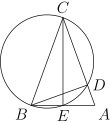
Sea ABC\triangle ABC un triángulo isósceles con BC=ACBC = AC y ACB=40.\angle ACB = 40^{\circ}. Construye la circunferencia de diámetro BC,\overline{BC}, y sean DD y EE los otros puntos de intersección de la circunferencia con los lados AC\overline{AC} y AB,\overline{AB}, respectivamente. Sea FF la intersección de las diagonales del cuadrilátero BCDE.BCDE. ¿Cuál es la medida en grados de BFC\angle BFC?

Let ABC\triangle ABC be an isosceles triangle with BC=ACBC = AC and ACB=40.\angle ACB = 40^{\circ}. Construct the circle with diameter BC,\overline{BC}, and let DD and EE be the other intersection points of the circle with the sides AC\overline{AC} and AB,\overline{AB}, respectively. Let FF be the intersection of the diagonals of the quadrilateral BCDE.BCDE. What is the degree measure of BFC?\angle BFC ?

9090

100100

105105

110110

120120

Solución:

Como BC\overline{BC} es el diámetro de la circunferencia, BDC\angle BDC y BEC\angle BEC son ángulos rectos.

Sabemos que ABC=70\angle ABC = 70^{\circ} por el hecho de que ABC\triangle ABC es isósceles.

Usando que los ángulos de un triángulo suman 180,180^{\circ}, obtenemos que ECB=1807090=20 \begin{align*} \angle ECB &= 180^{\circ} - 70^{\circ} - 90^{\circ}\\&= 20^{\circ} \end{align*} y DBC=1804090=50. \begin{align*} \angle DBC &= 180^{\circ} - 40^{\circ} - 90^{\circ}\\&= 50^{\circ}.\end{align*}

Ahora, a partir de BFC,\triangle BFC, obtenemos que BFC=1805020=110.\begin{align*} \angle BFC &= 180^{\circ} - 50^{\circ} - 20^{\circ} \\&= 110^{\circ}.\end{align*} Por lo tanto, D es la respuesta correcta.

Since BC\overline{BC} is the diameter of the circle, we get that BDC\angle BDC and BEC\angle BEC are right angles.

We know that ABC=70\angle ABC = 70^{\circ} from the fact that ABC\triangle ABC is isosceles.

Using the fact that the angles of a triangle add up to 180,180^{\circ}, we get that ECB=1807090=20 \begin{align*} \angle ECB &= 180^{\circ} - 70^{\circ} - 90^{\circ}\\&= 20^{\circ} \end{align*} and DBC=1804090=50. \begin{align*} \angle DBC &= 180^{\circ} - 40^{\circ} - 90^{\circ}\\&= 50^{\circ}.\end{align*}

Now, from BFC,\triangle BFC, we get that BFC=1805020=110.\begin{align*} \angle BFC &= 180^{\circ} - 50^{\circ} - 20^{\circ} \\&= 110^{\circ}.\end{align*} Thus, D is the correct answer.

← Problema 12#12Examen completoProblema 14#14 →

El Problema 13 en otros años