2014 AMC 10A Problema 13

Intenta el Problema 13 del 2014 AMC 10A a continuación y luego compara tu respuesta con la solución preparada profesionalmente de LIVE by Po-Shen Loh. También puedes intentar el examen cronometrado completo, ver todas las soluciones del 2014 AMC 10A, o revisar la clave de respuestas.

Todos los problemas se usan con el permiso legal oficial de la Mathematical Association of America (MAA).

13.
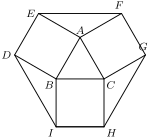
El △ABC\triangle ABC equilátero tiene lado 1,1, y los cuadrados ABDE,ABDE, BCHI,BCHI, CAFGCAFG están fuera del triángulo. ¿Cuál es el área del hexágono DEFGHIDEFGHI?
Equilateral △ABC\triangle ABC has side length 1,1, and squares ABDE,ABDE, BCHI,BCHI, CAFGCAFG lie outside the triangle. What is the area of hexagon DEFGHI?DEFGHI?
12+334\dfrac{12+3\sqrt3}4
92\dfrac92
3+33+\sqrt3
6+332\dfrac{6+3\sqrt3}2
66
Respuesta: C
Conceptos:triángulo equiláterocuadrado (geometría)descomposición de áreas
Nivel de dificultad: 1540
Pista pequeña:
Descompón el hexágono en el triángulo original, tres cuadrados y tres triángulos exteriores.
Decompose the hexagon into the original triangle, three squares, and three outer triangles
Pista grande:
Cada triángulo exterior tiene lados 1,11,1 con ángulo comprendido 120∘120^\circ.
Each outer triangle has sides 1,11,1 with included angle 120∘120^\circ
Solución:
Podemos calcular las áreas de todas las piezas y luego sumarlas.
El área del triángulo equilátero central es 1234=34. \dfrac{1^2 \sqrt{3}}{4} = \dfrac{\sqrt{3}}{4}.
El área total de todos los cuadrados es 3⋅12=3. 3 \cdot 1^2 = 3.
También tenemos que ∠EAF=360∘−60∘−2⋅90∘ \angle EAF = 360^{\circ} - 60^{\circ} - 2 \cdot 90^{\circ}=120∘. = 120^{\circ}.
Además, AE=AF=1AE=AF=1 y ∠EAF=120∘\angle EAF=120^\circ. Al trazar la altura desde AA, vemos que EF=3EF=\sqrt3 y que la altura es 12\frac12, por lo que [EAF]=34[EAF]=\frac{\sqrt3}{4}. Los otros dos triángulos exteriores tienen la misma área. Así, su área combinada es 334\frac{3\sqrt3}{4}.
El área total es 34+334+3=3+3. \dfrac{\sqrt{3}}{4} + \dfrac{3\sqrt{3}}{4} + 3 = 3 + \sqrt{3}.
Por lo tanto, C es la respuesta correcta.
We can find the areas of all the individual pieces and then add them up together.
The area of the center equilateral triangle is 1234=34. \dfrac{1^2 \sqrt{3}}{4} = \dfrac{\sqrt{3}}{4}.
We have that the areas of all the squares is 3⋅12=3. 3 \cdot 1^2 = 3.
We also have that ∠EAF=360∘−60∘−2⋅90∘ \angle EAF = 360^{\circ} - 60^{\circ} - 2 \cdot 90^{\circ}=120∘. = 120^{\circ}.
Also, AE=AF=1AE=AF=1 and ∠EAF=120∘\angle EAF=120^\circ. Dropping the altitude from AA shows that EF=3EF=\sqrt3 and the altitude is 12\frac12, so [EAF]=34[EAF]=\frac{\sqrt3}{4}. The other two outer triangles have the same area. Thus their combined area is 334\frac{3\sqrt3}{4}.
The total area is then 34+334+3=3+3. \dfrac{\sqrt{3}}{4} + \dfrac{3\sqrt{3}}{4} + 3 = 3 + \sqrt{3}.
Thus, C is the correct answer.
Problema 12#12
Examen completo

El Problema 13 en otros años