2017 AMC 10B Problema 21

A continuación está la solución preparada profesionalmente para el Problema 21 del 2017 AMC 10B, de LIVE by Po-Shen Loh. También puedes intentar el examen cronometrado completo, ver todas las soluciones del 2017 AMC 10B, o revisar la clave de respuestas.

Todos los problemas se usan con el permiso legal oficial de la Mathematical Association of America (MAA).

Conceptos:circunferencia inscrita, incentro e inradiotriángulo rectánguloárea del triángulo

Nivel de dificultad: 1720

21.

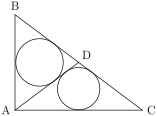
En el ABC,\triangle ABC, AB=6,AB=6, AC=8,AC=8, BC=10,BC=10, y DD es el punto medio de BC.\overline{BC}. ¿Cuál es la suma de los radios de las circunferencias inscritas en el ADB\triangle ADB y el ADC\triangle ADC?

In ABC,\triangle ABC, AB=6,AB=6, AC=8,AC=8, BC=10,BC=10, and DD is the midpoint of BC.\overline{BC}. What is the sum of the radii of the circles inscribed in ADB\triangle ADB and ADC?\triangle ADC?

5\sqrt{5}

114\dfrac{11}{4}

222\sqrt{2}

176\dfrac{17}{6}

33

Solución:

El triángulo ABCABC es un triángulo rectángulo con el ángulo recto en A.A. Esto hace que DD sea el circuncentro del triángulo, ya que es el punto medio de la hipotenusa.

Por lo tanto, AD=BD=DC=5.AD = BD = DC = 5. Además, el área de ABCABC es 682=24.\dfrac{6\cdot 8}2 = 24.

Como BDBD y DCDC tienen la misma altura y base, los triángulos ABDABD y ACDACD tienen la misma área de 12.12.

Luego, para cada triángulo, tenemos A=rsA = rs donde AA es el área, rr es el inradio y ss es el semiperímetro. Esto significa 12=12rP12 = \frac12 {rP} para cada triángulo, donde PP es el perímetro. Así, sabemos que r=24P.r=\dfrac{24}P. Aplicamos este hecho a ABD,ABD, para ver que r=245+5+6=32.r=\dfrac{24}{5+5+6} = \dfrac 32. De manera similar, para ACD,ACD, es r=245+5+8=43.r=\dfrac{24}{5+5+8} = \dfrac 43.

Su suma es 32+43=176.\dfrac 32 + \dfrac 43 = \dfrac{17}6 .

Por lo tanto, la respuesta correcta es D.

The triangle ABCABC is a right triangle with a right angle at A.A. This makes DD the circumcenter of the triangle since it is the midpoint of the hypotenuse.

Therefore, AD=BD=DC=5.AD = BD = DC = 5. Also, the area of ABCABC is 682=24.\dfrac{6\cdot 8}2 = 24.

Since BDBD and DCDC have the same altitude and base, the triangles ABDABD and ACDACD have the same area of 12.12.

Then, for each triangle, we have A=rsA = rs where AA is the area, rr is the inradius, and ss is the semiperimeter. This means 12=12rP12 = \frac12 {rP} for each triangle, where PP is the perimeter. Thus, we know that r=24P.r=\dfrac{24}P. We apply this fact for ABD,ABD, to see that r=245+5+6=32.r=\dfrac{24}{5+5+6} = \dfrac 32. Similarly, for ACD,ACD, it r=245+5+8=43.r=\dfrac{24}{5+5+8} = \dfrac 43.

Their sum is 32+43=176.\dfrac 32 + \dfrac 43 = \dfrac{17}6 .

Thus, the correct answer is D .

← Problema 20#20Examen completoProblema 22#22 →

El Problema 21 en otros años