2004 AMC 10A Problema 21

A continuación está la solución preparada profesionalmente para el Problema 21 del 2004 AMC 10A, de LIVE by Po-Shen Loh. También puedes intentar el examen cronometrado completo, ver todas las soluciones del 2004 AMC 10A, o revisar la clave de respuestas.

Todos los problemas se usan con el permiso legal oficial de la Mathematical Association of America (MAA).

Conceptos:sector circularárea del círculocorona circularecuación lineal

Nivel de dificultad: 1880

21.

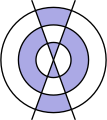
Dos rectas distintas pasan por el centro de tres círculos concéntricos de radios 3,3, 2,2, y 1.1. El área de la región sombreada en el diagrama es 813\dfrac{8}{13} del área de la región no sombreada. ¿Cuál es la medida en radianes del ángulo agudo formado por las dos rectas? (Nota: π\pi radianes es 180180 grados.)

Two distinct lines pass through the center of three concentric circles of radii 3,3, 2,2, and 1.1. The area of the shaded region in the diagram is 813\dfrac{8}{13} of the area of the unshaded region. What is the radian measure of the acute angle formed by the two lines? (Note: π\pi radians is 180180 degrees.)

π8\dfrac{\pi}{8}

π7\dfrac{\pi}{7}

π6\dfrac{\pi}{6}

π5\dfrac{\pi}{5}

π4\dfrac{\pi}{4}

Solución:

Sea θ\theta el ángulo agudo. La región sombreada tiene tres partes: dos sectores agudos del disco unitario con área total θ,\theta, dos sectores obtusos del anillo entre los radios 11 y 22 con área total 3(πθ),3(\pi - \theta), y dos sectores agudos del anillo entre los radios 22 y 33 con área total 5θ.5\theta.

Sumando estas se obtiene un área sombreada de θ+3(πθ)+5θ=3π+3θ. \theta + 3(\pi - \theta) + 5\theta = 3\pi + 3\theta.

La región sombreada es 813\dfrac{8}{13} de la región no sombreada, así que es 821\dfrac{8}{21} del área total 9π.9\pi. Entonces 3π+3θ=821(9π)=24π7, 3\pi + 3\theta = \dfrac{8}{21}(9\pi) = \dfrac{24\pi}{7}, lo que da θ=π7.\theta = \dfrac{\pi}{7}.

Por lo tanto, la respuesta correcta es B.

Let θ\theta be the acute angle. The shaded region has three parts: two acute sectors of the unit disk with total area θ,\theta, two obtuse sectors of the ring between radii 11 and 22 with total area 3(πθ),3(\pi - \theta), and two acute sectors of the ring between radii 22 and 33 with total area 5θ.5\theta.

Adding these gives a shaded area of θ+3(πθ)+5θ=3π+3θ. \theta + 3(\pi - \theta) + 5\theta = 3\pi + 3\theta.

The shaded region is 813\dfrac{8}{13} of the unshaded region, so it is 821\dfrac{8}{21} of the total area 9π.9\pi. Then 3π+3θ=821(9π)=24π7, 3\pi + 3\theta = \dfrac{8}{21}(9\pi) = \dfrac{24\pi}{7}, which gives θ=π7.\theta = \dfrac{\pi}{7}.

Thus, the correct answer is B.

← Problema 20#20Examen completoProblema 22#22 →

El Problema 21 en otros años