
Problemas del 2017 AMC 10B
25 problemas · 75 minutos
¡Desplázate hacia abajo y presiona Iniciar para intentar el examen! O ve al PDF imprimible, la clave de respuestas, o las soluciones profesionales preparadas por LIVE by Po-Shen Loh.
O salta directamente a un solo problema con su solución: 1 · 2 · 3 · 4 · 5 · 6 · 7 · 8 · 9 · 10 · 11 · 12 · 13 · 14 · 15 · 16 · 17 · 18 · 19 · 20 · 21 · 22 · 23 · 24 · 25
Todos los problemas se usan con el permiso legal oficial de la Mathematical Association of America (MAA).
¿Quieres aprender de forma profesional con clases interactivas en video?
Aprende con LIVECon tiempo
1:15:00
1.
Mary pensó en un número positivo de dos cifras. Lo multiplicó por y le sumó Luego intercambió las cifras del resultado y obtuvo un número entre y inclusive. ¿Cuál era el número de Mary?
Mary thought of a positive two-digit number. She multiplied it by and added Then she switched the digits of the result, obtaining a number between and inclusive. What was Mary’s number?
Respuesta: B
Pista pequeña:
Trabaja hacia atrás a partir de los posibles resultados invertidos.
Work backward from the possible reversed results
Pista grande:
Después de invertir y restar , verifica la divisibilidad entre .
After reversing and subtracting , check divisibility by
Solución:
Trabajamos hacia atrás desde los posibles resultados. Al invertir se obtiene respectivamente. Al restar se obtiene Solo y son divisibles por y solo tiene dos cifras.
Por tanto, la respuesta correcta es B.
Work backward from the possible results. Reversing gives respectively. Subtracting gives Only and are divisible by and only is a two-digit number.
Thus, the correct answer is B .
2.
Sofia corrió vueltas alrededor de la pista de metros de su escuela. En cada vuelta, corrió los primeros metros a una velocidad media de metros por segundo y los metros restantes a una velocidad media de metros por segundo. ¿Cuánto tiempo tardó Sofia en correr las vueltas?
Sofia ran laps around the -meter track at her school. For each lap, she ran the first meters at an average speed of meters per second and the remaining meters at an average speed of meters per second. How much time did Sofia take running the laps?
minutos y segundos
minutes and seconds
minutos y segundos
minutes and seconds
minutos y segundos
minutes and seconds
minutos y segundos
minutes and seconds
minutos y segundos
minutes and seconds
Respuesta: C
Pista pequeña:
Halla el tiempo de los primeros metros y de los últimos metros de una vuelta.
Find the time for the first meters and the last meters of one lap
Pista grande:
Multiplica el tiempo de una vuelta por y convierte los segundos en minutos.
Multiply one-lap time by and convert seconds to minutes
Solución:
En total corrió metros a metros por segundo y metros a metros por segundo.
Por lo tanto, su tiempo es segundos.
Esto equivale en total a minutos y segundos.
Por lo tanto, la respuesta correcta es C.
She ran a total of meters at meters per second and meters at meters per second.
Therefore, her time is seconds.
This is equal to a total of minutes and seconds.
Thus, the correct answer is C .
3.
Los números reales y satisfacen las desigualdades y
¿Cuál de los siguientes números es necesariamente positivo?
Real numbers and satisfy the inequalities and
Which of the following numbers is necessarily positive?
Respuesta: E
Pista pequeña:
La opción se puede comprobar directamente a partir de las cotas dadas.
The choice can be tested directly from the given bounds
Pista grande:
Usa un pequeño contraejemplo para descartar cada una de las demás expresiones.
Use one small counterexample to reject each other expression
Solución:
Como y podemos sumar las desigualdades para ver que Esto prueba de forma natural que la opción E es correcta.
Además, podemos eliminar todas las demás opciones con los siguientes valores:
Por lo tanto, la respuesta correcta es E.
Since and we can add the inequalities to see that This naturally proves choice E correct.
Furthermore, we can eliminate every other choice with the following values:
Thus, the correct answer is E .
4.
Supongamos que y son números reales distintos de cero tales que ¿Cuál es el valor de
Suppose that and are nonzero real numbers such that What is the value of
Respuesta: D
Pista pequeña:
Elimina el denominador de la ecuación dada.
Clear the denominator in the given equation
Pista grande:
La ecuación fuerza rápidamente una relación entre y .
The equation quickly forces a relation between and
Solución:
Dado que podemos multiplicar por el denominador para obtener Al resolver, vemos que
Por lo tanto,
Por lo tanto, la respuesta correcta es D.
Given that we can multiply by the denominator to get Solving, we can see that
Therefore,
Thus, the correct answer is D .
5.
Camilla tenía el doble de gomitas de arándano que de gomitas de cereza. Después de comerse de cada tipo, ahora tiene el triple de gomitas de arándano que de cereza. ¿Cuántas gomitas de arándano tenía originalmente?
Camilla had twice as many blueberry jelly beans as cherry jelly beans. After eating pieces of each kind, she now has three times as many blueberry jelly beans as cherry jelly beans. How many blueberry jelly beans did she originally have?
Respuesta: D
Pista pequeña:
Representa con variables las cantidades originales de cereza y de arándano.
Let the original cherry and blueberry counts be variables
Pista grande:
Plantea una ecuación antes y una después de comer las gomitas.
Use one equation before and one equation after eating the jelly beans
Solución:
Sea el número de gomitas de cereza y sea el número de gomitas de arándano.
Entonces sabemos que a partir del primer y segundo enunciados respectivamente.
Por lo tanto, Esto significa que
Por lo tanto, la respuesta correcta es D.
Let the number of cherry jelly beans be and let the number of blueberry jelly beans be
Then, we know from the first and second statements respectively.
Therefore, This means that
Thus, the correct answer is D .
6.
¿Cuál es el mayor número de bloques sólidos de pulgadas pulgadas pulgada que caben en una caja de pulgadas pulgadas pulgadas?
What is the largest number of solid -in -in -in blocks that can fit in a -in -in -in box?
Respuesta: B
Pista pequeña:
Empieza con la cota superior dada por el volumen.
Start with the volume upper bound
Pista grande:
Luego verifica que realmente se pueden acomodar cuatro bloques.
Then check that four blocks really can be arranged
Solución:
El volumen del objeto sólido grande es y el volumen del objeto más pequeño es Esto significa que caben como máximo de los objetos pequeños.
Podemos lograrlo colocando de los objetos pequeños en un prisma rectangular de , y entonces queda un espacio de donde podemos colocar un objeto pequeño más.
Por lo tanto, la respuesta correcta es B.
The volume of the large solid object is and volume of the smaller object is This means we can fit at most of the small objects.
We can make this happen by putting of the small objects in a rectangular prism, and then we have a space left where we can place one small object.
Thus, the correct answer is B .
7.
Samia salió en bicicleta a visitar a su amiga, viajando a una velocidad media de kilómetros por hora. Cuando había recorrido la mitad de la distancia hasta la casa de su amiga, se le pinchó una llanta y caminó el resto del camino a kilómetros por hora.
En total tardó minutos en llegar a la casa de su amiga. En kilómetros redondeados a la décima más cercana, ¿qué distancia caminó Samia?
Samia set off on her bicycle to visit her friend, traveling at an average speed of kilometers per hour. When she had gone half the distance to her friend’s house, a tire went flat, and she walked the rest of the way at kilometers per hour.
In all, it took her minutes to reach her friend’s house. In kilometers rounded to the nearest tenth, how far did Samia walk?
Respuesta: C
Pista pequeña:
Sea la distancia caminada, de modo que la distancia en bicicleta también sea .
Let the walking distance be , so the biking distance is also
Pista grande:
Suma el tiempo en bicicleta y el tiempo caminando para obtener minutos.
Add the biking time and walking time to get minutes
Solución:
Sea la distancia que Samia caminó. Recorrió esa misma distancia en bicicleta, así que su tiempo total de viaje da Al resolver se obtiene que se redondea a kilómetros.
Por lo tanto, la respuesta correcta es C.
Let be the distance Samia walked. She bicycled the same distance, so her total travel time gives Solving yields which rounds to kilometers.
Thus, the correct answer is C .
8.
Los puntos y son vértices del con La altura desde corta al lado opuesto en ¿Cuáles son las coordenadas del punto ?
Points and are vertices of with The altitude from meets the opposite side at What are the coordinates of point
Respuesta: C
Pista pequeña:
En un triángulo isósceles, la altura desde el vértice también biseca la base.
In an isosceles triangle, the altitude from the vertex also bisects the base
Pista grande:
Usa como el punto medio de .
Use as the midpoint of
Solución:
Como la altura desde también biseca la base Por lo tanto, es el punto medio de Si entonces Por consiguiente,
Así, la respuesta correcta es C.
Since the altitude from also bisects the base Therefore, is the midpoint of If then we have As such,
Thus, the correct answer is C .
9.
Un programa de radio tiene un concurso que consta de preguntas de opción múltiple, cada una con opciones. Un concursante gana si acierta o más de las preguntas. El concursante responde al azar cada pregunta. ¿Cuál es la probabilidad de ganar?
A radio program has a quiz consisting of multiple-choice questions, each with choices. A contestant wins if he or she gets or more of the questions right. The contestant answers randomly to each question. What is the probability of winning?
Respuesta: D
Pista pequeña:
Cuenta exactamente tres aciertos más exactamente dos aciertos.
Count exactly three correct plus exactly two correct
Pista grande:
Para exactamente dos aciertos, elige cuál pregunta se falla.
For exactly two correct, choose which question is missed
Solución:
La probabilidad de que un concursante acierte las es La probabilidad de que acierte exactamente es La probabilidad combinada es
Por lo tanto, la respuesta correcta es D.
The probability that a contestant gets all correct is The probability of getting exactly correct is The combined probability is
Thus, the correct answer is D .
10.
Las rectas con ecuaciones y son perpendiculares y se cortan en ¿Cuánto vale ?
The lines with equations and are perpendicular and intersect at What is
Respuesta: E
Pista pequeña:
Reescribe ambas rectas en la forma pendiente-ordenada.
Rewrite both lines in slope-intercept form
Pista grande:
Las pendientes perpendiculares y el punto determinan los parámetros.
Perpendicular slopes and the point determine the parameters
Solución:
La primera ecuación se puede reescribir como y la segunda como Como las rectas son perpendiculares, sus pendientes tienen producto así que
Al sustituir en las dos ecuaciones originales se obtiene y Al sumar estas ecuaciones resulta así que y
Por tanto, la respuesta correcta es E.
The first equation can be rewritten as and the second as Because the lines are perpendicular, their slopes multiply to so
Substituting into the two original equations gives and Adding these equations yields so and
Thus, the correct answer is E .
11.
En la Preparatoria Typico, al de los estudiantes les gusta bailar, y al resto no. De quienes les gusta bailar, el dice que les gusta, y el resto dice que no les gusta. De quienes no les gusta bailar, el dice que no les gusta, y el resto dice que sí les gusta. ¿Qué fracción de los estudiantes que dicen que no les gusta bailar en realidad sí les gusta?
At Typico High School, of the students like dancing, and the rest dislike it. Of those who like dancing, say that they like it, and the rest say that they dislike it. Of those who dislike dancing, say that they dislike it, and the rest say that they like it. What fraction of students who say they dislike dancing actually like it?
Respuesta: D
Pista pequeña:
Separa la preferencia real de la preferencia declarada.
Separate actual preference from reported preference
Pista grande:
El denominador es todo aquel que dice que no le gusta bailar.
The denominator is everyone who says they dislike dancing
Solución:
Del de las personas a quienes realmente les gusta bailar, solo el dice que le gusta. Así, el de todos los estudiantes dice que le gusta bailar, y el de quienes sí disfrutan bailar dice que no le gusta.
Además, el del de personas a quienes no les gusta bailar dice que no le gusta, lo que representa el de todos los estudiantes.
Por tanto, el total que dice que no le gusta bailar es
La fracción de quienes dicen que no les gusta bailar pero en realidad sí les gusta es
Así, la respuesta correcta es D.
Observe that of the of people that actually like dancing, only say they like dancing. This suggests that of the students say that they like dancing, and as such, of the students who like dancing say they don’t like it.
Then, we know that of the of people who don’t like dancing say they don’t like it, which is of the total student population.
This means the total amount of people who say they don’t like dancing is
We know then that the fraction of people who say they dislike dancing but actually like it is equal to:
Thus, the correct answer is D .
12.
El auto nuevo de Elmer tiene una eficiencia de combustible, medida en kilómetros por litro, un mejor que la de su auto viejo. Sin embargo, su auto nuevo usa diésel, que es un más caro por litro que la gasolina que usa su auto viejo. ¿Qué porcentaje de dinero ahorrará Elmer si usa su auto nuevo en lugar del viejo para un viaje largo?
Elmer’s new car gets better fuel efficiency, measured in kilometers per liter, than his old car. However, his new car uses diesel fuel, which is more expensive per liter than the gasoline his old car uses. By what percent will Elmer save money if he uses his new car instead of his old car for a long trip?
Respuesta: A
Pista pequeña:
Compara el costo por kilómetro, no el costo por litro.
Compare cost per kilometer, not cost per liter
Pista grande:
El combustible nuevo usa menos litros, pero cada litro cuesta más.
New fuel uses fewer liters but each liter costs more
Solución:
Sea el rendimiento del auto viejo, en kilómetros por litro, y sea el precio de la gasolina, en dólares por litro. Entonces el auto viejo cuesta dólares por kilómetro de combustible.
El auto nuevo rinde kilómetros por litro y su combustible cuesta dólares por litro, así que su costo de combustible por kilómetro es
El nuevo costo de combustible es el del anterior, así que Elmer ahorra un
Por lo tanto, la respuesta correcta es A.
Let the old car’s fuel efficiency be kilometers per liter and let gasoline cost dollars per liter. The old car therefore costs dollars per kilometer to fuel.
The new car gets kilometers per liter and its fuel costs dollars per liter, so its fuel cost per kilometer is
The new fuel cost is of the old one, so Elmer saves
Thus, the correct answer is A .
13.
Hay estudiantes que participan en un programa extraescolar que ofrece clases de yoga, bridge y pintura. Cada estudiante debe tomar al menos una de estas tres clases, pero puede tomar dos o las tres.
Hay estudiantes que toman yoga, que toman bridge y que toman pintura. Hay estudiantes que toman al menos dos clases. ¿Cuántos estudiantes toman las tres clases?
There are students participating in an after-school program offering classes in yoga, bridge, and painting. Each student must take at least one of these three classes, but may take two or all three.
There are students taking yoga, taking bridge, and taking painting. There are students taking at least two classes. How many students are taking all three classes?
Respuesta: C
Pista pequeña:
Sea el número de estudiantes que toman exactamente una, dos y tres clases.
Let count students taking exactly one, two, and three classes
Pista grande:
La inscripción total en las clases cuenta estos grupos con pesos .
The total class enrollment counts these groups with weights
Solución:
El número total de inscripciones en clases es
Sea el número de personas que toman sea el número de personas que toman clases, y sea el número de personas que toman clases.
Entonces, sabemos que
Además, el número total de personas es así que Esto da
El número de personas que toman al menos dos clases es así que
Por lo tanto, que es la respuesta.
Por lo tanto, la respuesta correcta es C.
The number of classes taken total is
Let represent the number of people who take let represent the number of people who take classes, and let represent the number of people who take classes.
Then, we know
As such, the total number of people is so This makes
The number of people who take at least two classes is so
Therefore, making that the answer.
Thus, the correct answer is C .
14.
Se elige al azar un entero en el rango . ¿Cuál es la probabilidad de que el residuo de al dividirlo entre sea ?
An integer is selected at random in the range . What is the probability that the remainder when is divided by is
Respuesta: D
Pista pequeña:
Módulo , solo importa si es divisible entre .
Modulo , only whether is divisible by matters
Pista grande:
Usa el pequeño teorema de Fermat o revisa las clases de residuos módulo .
Use Fermat’s little theorem or check residue classes modulo
Solución:
Por el pequeño teorema de Fermat, siempre que no sea divisible por Por tanto,
Hay múltiplos de así que hay valores permitidos de
Un múltiplo de tiene así que no funciona ningún otro valor. Por tanto, la probabilidad es
Así, la respuesta correcta es D.
By Fermat’s Little Theorem, whenever is not divisible by Therefore,
There are multiples of so there are allowable values of
A multiple of has so no other values work. Thus the probability is
Thus, the correct answer is D .
15.
El rectángulo tiene y El punto es el pie de la perpendicular desde a la diagonal ¿Cuál es el área del ?
Rectangle has and Point is the foot of the perpendicular from to diagonal What is the area of
Respuesta: E
Pista pequeña:
Usa la semejanza entre y .
Use similarity between and
Pista grande:
Luego compara con usando sus bases sobre .
Then compare to using their bases on
Solución:
El área del es . Como está sobre , los triángulos y comparten la misma altura desde , así que .
Por el teorema de Pitágoras, . Además , así que , lo que da . Por lo tanto .
Por lo tanto . Así, E es la respuesta correcta.
The area of is . Since lies on , triangles and share the same altitude from , so .
By the Pythagorean Theorem, . Also , so , giving . Thus .
Therefore . Thus, E is the correct answer.
16.
¿Cuántos de los numerales en base diez de los enteros positivos menores o iguales que contienen el dígito ?
How many of the base-ten numerals for the positive integers less than or equal to contain the digit
Respuesta: A
Pista pequeña:
Cuenta el complemento: los números sin ningún dígito .
Count the complement: numbers with no digit
Pista grande:
Sepáralos en números de una, dos, tres y cuatro cifras hasta .
Split by one-, two-, three-, and four-digit numbers up to
Solución:
Para los números menores que solo hay un si es múltiplo de de los cuales hay
Para los números entre y inclusive, usaremos conteo complementario. Hay números en total en este rango. Además, hay números en este rango sin ningún , ya que hay formas de elegir cada cifra para que no sea Por lo tanto, el total en este rango es
Para los números entre y inclusive, usaremos de nuevo conteo complementario. Hay números en total en este rango. Además, hay números en este rango sin ningún , ya que hay formas de elegir cada una de las últimas cifras para que no sea y la primera cifra debe ser Por lo tanto, el total en este rango es
Hay números entre y inclusive, cada uno con un en la segunda cifra desde la izquierda.
Esto hace que el total sea
Por lo tanto, la respuesta correcta es A.
For numbers less than we only have a if it is a multiple of of which there are
For numbers between and inclusive, we will use complementary counting. There are total numbers in this range. Also, there are numbers in this range with no since there are ways to choose each digit to not be Thus, the total in this range is
For numbers between and inclusive, we will use complementary counting again. There are total numbers in this range. Also, there are numbers in this range with no since there are ways to choose each of the last digits to not be and the first digit must be Thus, the total in this range is
There are numbers between and inclusive, each with a in the second digit from the left.
This makes the total
Thus, the correct answer is A .
17.
Llamamos a un entero positivo monótono si es un número de una cifra o si sus dígitos, leídos de izquierda a derecha, forman una sucesión estrictamente creciente o estrictamente decreciente. Por ejemplo, y son monótonos, pero y no lo son. ¿Cuántos enteros positivos monótonos hay?
Call a positive integer monotonous if it is a one-digit number or its digits, when read from left to right, form either a strictly increasing or a strictly decreasing sequence. For example, and are monotonous, but and are not. How many monotonous positive integers are there?
Respuesta: B
Pista pequeña:
Los números crecientes quedan determinados por su conjunto de dígitos.
Increasing numbers are determined by their digit set
Pista grande:
Los números decrecientes pueden incluir el , pero el número en sí no es positivo.
Decreasing numbers may include , but the number itself is not positive
Solución:
Los enteros positivos estrictamente crecientes corresponden a los subconjuntos no vacíos de , escritos en orden creciente. Hay de estos.
Los enteros positivos estrictamente decrecientes corresponden a los subconjuntos de , escritos en orden decreciente, salvo el conjunto vacío y . Hay de estos.
Los números de una cifra del al se contaron en ambos grupos, así que el total es . Así, B es la respuesta correcta.
The strictly increasing positive integers correspond to the nonempty subsets of , written in increasing order. There are of these.
The strictly decreasing positive integers correspond to subsets of , written in decreasing order, except for the empty set and . There are of these.
The one-digit numbers through were counted in both groups, so the total is . Thus, B is the correct answer.
18.
En la figura de abajo, de los discos se van a pintar de azul, de rojo y de verde. Dos coloraciones que se pueden obtener una de otra mediante una rotación o una reflexión de toda la figura se consideran iguales. ¿Cuántas coloraciones diferentes son posibles?

In the figure below, of the disks are to be painted blue, are to be painted red, and is to be painted green. Two paintings that can be obtained from one another by a rotation or a reflection of the entire figure are considered the same. How many different paintings are possible?
Respuesta: D
Pista pequeña:
Usa la simetría para reducir el disco verde a dos casos.
Use symmetry to reduce the green disk to two cases
Pista grande:
Para cada posición del verde, cuenta las posibles ubicaciones de los discos rojos salvo simetría.
For each green position, count possible red-disk placements up to symmetry
Solución:
Por simetría, el disco verde tiene dos tipos posibles de posición: una esquina o el punto medio de un lado. Fijemos un representante de cada tipo. Hay maneras de elegir los dos discos rojos.
La reflexión que fija la posición verde fija uno de los otros discos e intercambia los otros cuatro en dos pares. Exactamente elecciones de discos rojos permanecen invariantes bajo esta reflexión: elegir cualquiera de los pares intercambiados. Las otras elecciones forman pares de imágenes especulares. Por tanto, hay pinturas para cada tipo de posición verde.
Los dos tipos dan entonces pinturas.
Así, la respuesta correcta es D.
By symmetry, the green disk has two possible types of position: a corner or a side midpoint. Fix one representative of either type. There are ways to choose the two red disks.
The reflection that fixes the green position fixes one of the other disks and exchanges the other four disks in two pairs. Exactly red-disk choices are unchanged by this reflection: choosing either exchanged pair. The other choices form mirror-image pairs. Hence there are paintings for each type of green position.
The two types therefore give paintings.
Thus, the correct answer is D .
19.
Sea un triángulo equilátero. Prolonga el lado más allá de hasta un punto de modo que De manera similar, prolonga el lado más allá de hasta un punto de modo que y prolonga el lado más allá de hasta un punto de modo que
¿Cuál es la razón entre el área del y el área del ?
Let be an equilateral triangle. Extend side beyond to a point so that Similarly, extend side beyond to a point so that and extend side beyond to a point so that
What is the ratio of the area of to the area of
Respuesta: E
Pista pequeña:
Divide el triángulo grande en el triángulo original y seis triángulos que lo rodean.
Break the large triangle into the original triangle and six surrounding triangles
Pista grande:
Compara el área de cada triángulo que lo rodea con la del original usando base y altura.
Compare each surrounding triangle area to the original using base and height
Solución:
Sea el área de Cada uno de y tiene una base tres veces tan larga como un lado correspondiente de y la misma altura. Por tanto, cada uno tiene área
Luego, tiene tres veces la base y la misma altura que cuya área es Así, tiene área Del mismo modo, y tienen área
Estas siete regiones forman el triángulo grande, así que La razón pedida es
Por lo tanto, E es la respuesta correcta.
Let be the area of Each of and has a base three times as long as a side of and the same corresponding altitude. Each therefore has area
Next, has three times the base and the same altitude as whose area is Thus has area Similarly, and each have area
These seven regions partition the large triangle, so The requested ratio is
Thus, the correct answer is E .
20.
El número tiene más de divisores enteros positivos. Se elige uno de ellos al azar. ¿Cuál es la probabilidad de que sea impar?
The number has over positive integer divisors. One of them is chosen at random. What is the probability that it is odd?
Respuesta: B
Pista pequeña:
Cuenta el exponente de en .
Count the exponent of in
Pista grande:
Para cada parte impar de un divisor, solo un exponente de da un divisor impar.
For each odd part of a divisor, only one exponent of gives an odd divisor
Solución:
El exponente de en es Así, para algún entero impar
Para cada divisor de los divisores de cuya parte impar es son Exactamente uno de estos divisores es impar, así que la probabilidad es
Por tanto, la respuesta correcta es B.
The exponent of in is Thus for some odd integer
For every divisor of the divisors of with odd part are Exactly one of these divisors is odd, so the probability is
Thus, the correct answer is B .
21.
En el y es el punto medio de ¿Cuál es la suma de los radios de las circunferencias inscritas en el y el ?
In and is the midpoint of What is the sum of the radii of the circles inscribed in and
Respuesta: D
Pista pequeña:
Primero reconoce que el triángulo es rectángulo.
First recognize the triangle as right
Pista grande:
Usa que el área es igual al inradio por el semiperímetro para los dos triángulos más pequeños.
Use area equals inradius times semiperimeter for the two smaller triangles
Solución:
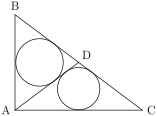
El triángulo es rectángulo, con ángulo recto en Como es el punto medio de la hipotenusa, es el circuncentro del triángulo.
Por tanto, Además, el área de es
Las bases y son iguales, y los dos triángulos comparten la misma altura desde Por tanto, y tienen área
Para cada triángulo, tenemos , donde es el área, es el inradio y es el semiperímetro. Equivalentemente, donde es el perímetro, así que Para el inradio es Para es
Su suma es
Así, la respuesta correcta es D.
The triangle is a right triangle with a right angle at This makes the circumcenter of the triangle since it is the midpoint of the hypotenuse.
Therefore, Also, the area of is
The bases and are equal, and the two triangles share the same altitude from Therefore, and each have area
Then, for each triangle, we have where is the area, is the inradius, and is the semiperimeter. Equivalently, where is the perimeter, so For the inradius is For it is
Their sum is
Thus, the correct answer is D .
22.
El diámetro de una circunferencia de radio se prolonga hasta un punto fuera de la circunferencia de modo que Se elige el punto de modo que y la recta es perpendicular a la recta El segmento corta a la circunferencia en un punto entre y ¿Cuál es el área del ?
The diameter of a circle of radius is extended to a point outside the circle so that Point is chosen so that and line is perpendicular to line Segment intersects the circle at a point between and What is the area of
Respuesta: D
Pista pequeña:
Usa el ángulo del semicírculo para obtener un triángulo rectángulo.
Use the semicircle angle to get a right triangle
Pista grande:
Compara y por semejanza.
Compare and by similarity
Solución:
Como el radio es y tenemos Como y el ángulo en es recto, el área de es
Por el teorema de Pitágoras, Además, es un ángulo recto, ya que es un diámetro. Los triángulos comparten el ángulo en así que por semejanza ángulo-ángulo.
Sus hipotenusas correspondientes son y así que su razón de áreas es Por lo tanto,
Por lo tanto, la respuesta correcta es D.
Since the radius is and we have Since and the angle at is a right angle, the area of is
By the Pythagorean Theorem, Also, is a right angle because is a diameter. The triangles share the angle at so by angle-angle similarity.
Their corresponding hypotenuses are and so their area ratio is Therefore,
Thus, the correct answer is D .
23.
Sea el número de cifras que se forma escribiendo los enteros del al en orden, uno tras otro. ¿Cuál es el residuo cuando se divide entre ?
Let be the -digit number that is formed by writing the integers from to in order, one after the other. What is the remainder when is divided by
Respuesta: C
Pista pequeña:
Halla el residuo módulo y módulo .
Find the remainder modulo and modulo
Pista grande:
Combínalos para obtener el residuo módulo .
Combine them to get the remainder modulo
Solución:
Para hallar el residuo al dividir entre debemos hallar los residuos al dividir entre y El residuo al dividir entre es el residuo de la cifra de las unidades al dividir entre es decir,
Para hallar el residuo al dividir entre normalmente sumamos las cifras. Sin embargo, todo número de dos cifras tiene el mismo residuo módulo que la suma de sus cifras, así que basta sumar los enteros del al porque cada entero es congruente con su propia suma de cifras. Esta suma es que es múltiplo de Por tanto, es múltiplo de
Como es múltiplo de y deja residuo al dividirse entre su residuo al dividirse entre es
Así, la respuesta correcta es C.
To find the remainder when divided by we must find the remainder when divided by and The remainder when divided by is the remainder when the units digit is divided by making it
To find the remainder when divided by we usually find the sum of the digits. However, each double digit number has the same remainder when divided by as its digit sum, so we can just sum the integers from to because each integer is congruent to its own digit sum. This sum is which is a multiple of Thus, is a multiple of
Since it is a multiple of and has a remainder of when divided by the remainder when divided by is
Thus, the correct answer is C .
24.
Los vértices de un triángulo equilátero están sobre la hipérbola y un vértice de esta hipérbola es el baricentro del triángulo. ¿Cuál es el cuadrado del área del triángulo?
The vertices of an equilateral triangle lie on the hyperbola and a vertex of this hyperbola is the centroid of the triangle. What is the square of the area of the triangle?
Respuesta: C
Pista pequeña:
Usa la simetría de la hipérbola respecto de .
Use symmetry of the hyperbola about
Pista grande:
Relaciona la distancia del baricentro al vértice con el circunradio del triángulo equilátero.
Relate the centroid-to-vertex distance to the circumradius of the equilateral triangle
Solución:
Por simetría, supongamos que el centroide es el vértice de la hipérbola Al menos dos vértices del triángulo están en la misma rama de la hipérbola. No pueden estar ambos en la rama negativa: si dos coordenadas fueran negativas, la tercera excedería mientras que la suma de las tres coordenadas sería menor que contradiciendo que el centroide es . Por tanto, dos vértices están en la rama positiva.
Escribamos estos vértices como y donde El centroide de un triángulo equilátero también es su circuncentro, así que y están a la misma distancia de Para el cuadrado de la distancia de a es Esto aumenta estrictamente cuando aumenta desde por lo que los puntos distintos deben satisfacer Así, y son reflejos respecto de
El tercer vértice está en la mediatriz Sus coordenadas también satisfacen así que es o No puede ser el centroide, por lo que es Entonces el circunradio es la distancia de a es decir,
Al dividir el triángulo equilátero en tres triángulos desde su centro, su área es El cuadrado del área es
Por lo tanto, C es la respuesta correcta.
By symmetry, assume that the centroid is the hyperbola vertex At least two triangle vertices lie on the same branch of the hyperbola. They cannot both lie on the negative branch: if two of their -coordinates were negative, the third would exceed while the sum of the three -coordinates would be less than contradicting that their centroid is Thus two vertices lie on the positive branch.
Write these vertices as and where The centroid of an equilateral triangle is also its circumcenter, so and are equidistant from For the squared distance from to is This is strictly increasing as increases from so the distinct points must satisfy Hence and are reflections across
The third vertex lies on the perpendicular bisector Its coordinates also satisfy so it is either or It cannot equal the centroid, so it is Therefore, the circumradius is the distance from to namely
Dividing the equilateral triangle into three triangles at its center gives its area as The square of the area is
Thus, the correct answer is C .
25.
El año pasado Isabella presentó exámenes de matemáticas y obtuvo calificaciones distintas, cada una un entero entre y inclusive. Después de cada examen notó que el promedio de sus calificaciones era un entero. Su calificación en el séptimo examen fue ¿Cuál fue su calificación en el sexto examen?
Last year Isabella took math tests and received different scores, each an integer between and inclusive. After each test she noticed that the average of her test scores was an integer. Her score on the seventh test was What was her score on the sixth test?
Respuesta: E
Pista pequeña:
La calificación total final debe ser múltiplo de .
The final total score must be a multiple of
Pista grande:
Usa la séptima calificación para forzar la suma de las primeras seis, luego usa la divisibilidad entre .
Use the seventh score to force the first six-score sum, then use divisibility by
Solución:
Sea la suma de las siete calificaciones. Como los siete promedios fueron enteros, es divisible entre . Además, las siete calificaciones distintas están entre y , así que .
Así, , y los posibles múltiplos de son . Como la séptima calificación es , las primeras seis calificaciones suman , que debe ser divisible entre . Esto obliga a que .
Las primeras seis calificaciones suman . El promedio de las primeras cinco también fue un entero, así que la suma de las primeras cinco calificaciones es divisible entre . Por lo tanto, la sexta calificación es divisible entre . Como la séptima calificación ya es y todas las calificaciones son distintas, la sexta calificación es . Así, E es la respuesta correcta.
Let be the sum of all seven scores. Since all seven averages were integers, is divisible by . Also the seven distinct scores are between and , so .
Thus , and the possible multiples of are . Since the seventh score is , the first six scores sum to , which must be divisible by . This forces .
The first six scores sum to . The first five-score average was also an integer, so the sum of the first five scores is divisible by . Therefore the sixth score is divisible by . Since the seventh score is already and all scores are distinct, the sixth score is . Thus, E is the correct answer.